
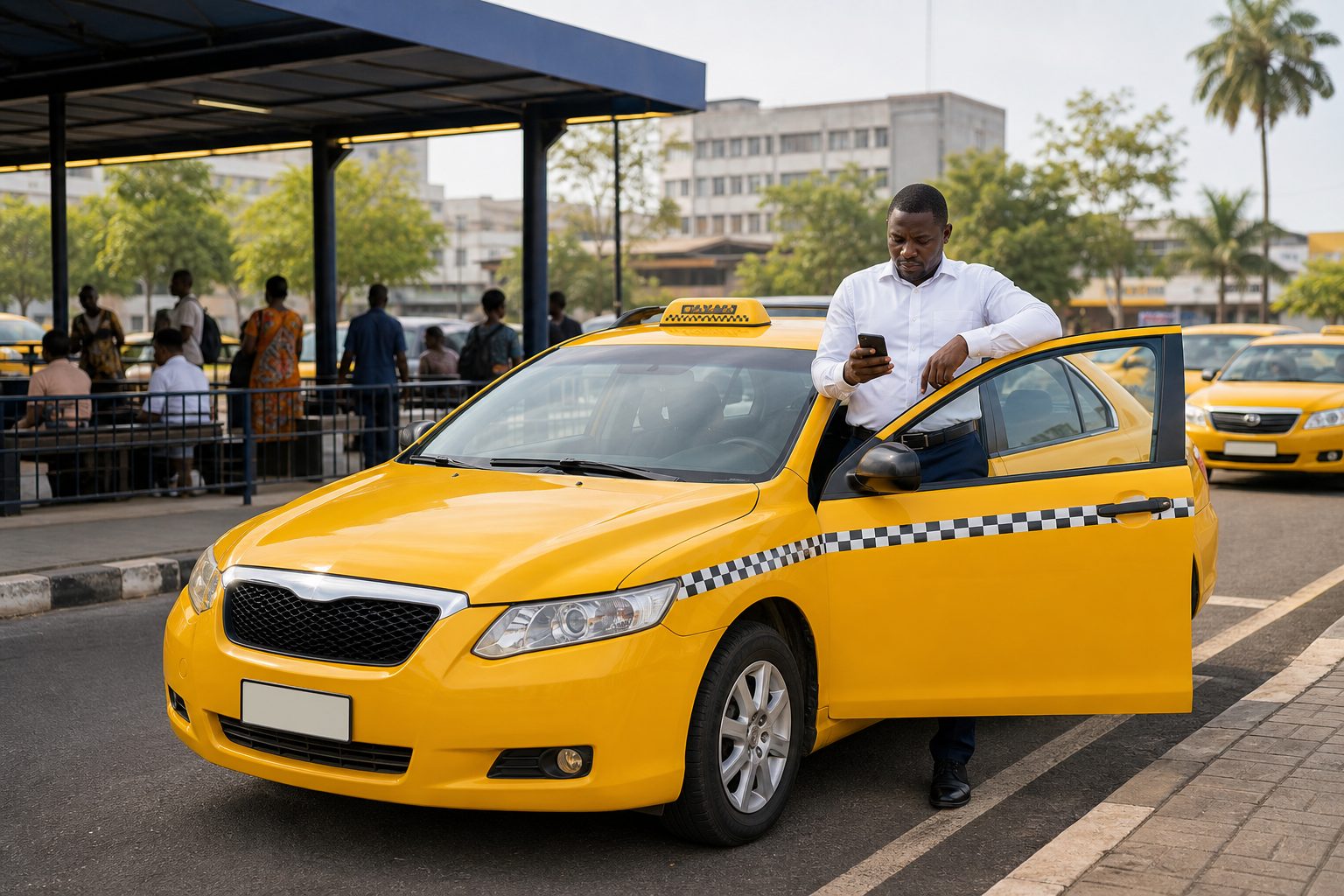
A passenger gets in, names a destination, and the day tips one way or the other. Three kilometres or forty, a familiar district or an address never seen, a return fare or a long empty run back: the driver finds out at the exact moment he can no longer decline. This consent to the unknown defines the trade, and it governs everything else.
Three ways of being found
A taxi does not look for passengers the same way at every hour and in every place. There are three methods, each with its own logic.
The rank is a waiting post. You take your place, you wait, you move up one. The work consists of being there, sometimes for a long time, and the queue protects as much as it constrains: it guarantees your turn and forbids jumping it.
Cruising is the opposite: you drive in order to be seen. It is the most fuel-hungry and least certain method, but the one that lets you follow the city — offices emptying, a match ending, the last train, a sudden downpour.
Booking is the most recent to have taken hold at scale, by telephone, then radio dispatch, then app. The French classification for taxi passenger transport explicitly mentions dispatch centres and radio taxis: remote ordering has been part of the trade for a long time, well before smartphones.
A driver who makes a decent living does not choose between these three; he knows what hour each of them becomes the best one.
A regulated trade, regulated differently everywhere
Taxi work is a regulated occupation almost everywhere, because it occupies public space and because a passenger, once inside, is no longer in a position to negotiate. Depending on the country and the city, that framework may take the form of a limited-number licence or rank permit, a professional badge, an examination including knowledge of the local area, periodic medical checks, reinforced vehicle inspection, compulsory identifying features — colour, roof sign, visible number — an approved taximeter, and capped fares.
None of this is universal, and presenting one country's system as the general rule would simply be wrong. What is constant is the purpose behind the rules: making the price predictable and the professional identifiable. A passenger getting into a taxi should be able to know what it will cost and who is driving.
What the apps moved
The arrival of app-based booking upset a long-standing balance. The International Transport Forum, which brings together transport ministries from dozens of countries under the OECD umbrella, has published dedicated work on regulating for-hire passenger transport. Its central finding is straightforward: these services allocate spare capacity more efficiently than traditional arrangements, but they caught regulatory frameworks designed for another world off guard.
In practice, several things changed for the driver. The job now arrives with its destination displayed, which changes the nature of consent. Ratings become a professional asset. Prices can move with demand. And the boundary between the traditional taxi and other on-demand forms has blurred in the public's eye, even where it remains sharp in law.
The Forum recommends keeping the regulation of for-hire passenger transport as simple and uniform as possible, and focusing it on what genuinely protects the user. For a working driver the translation is clear: what durably separates one driver from another is no longer scarcity of supply but observed quality of service.
The city in your head
You can follow a map. You cannot follow a map and simultaneously know that one road jams at the same hour every day, that a market spills onto the carriageway on Saturdays, that a school releases four hundred parents at midday, that a bridge has been under repair for three weeks, or that it is better to drop someone on the far side of the square than at the entrance.
That kind of knowledge cannot be bought or downloaded. It accumulates. It explains why an experienced driver can beat an app on a route he has driven for ten years, and why regular passengers end up asking for the same driver.
It also has direct commercial value: knowing where a city's hotels, clinics, government offices, bus stations and places of worship are is knowing where demand rises, and at what hour.
The economics of a shift: the loaded ratio
A taxi that is driving does not earn money. A taxi that is driving with a passenger earns money. The whole trade lives in the gap between those two sentences.
Costs, meanwhile, run continuously: fuel or energy, servicing, tyres, insurance, vehicle depreciation, sometimes a licence fee or platform commission. They are largely indifferent to whether anyone is in the back.
Hence the obsessive attention drivers pay to a handful of variables: the share of loaded kilometres, the length of approach runs, the ability to find a return fare rather than driving back empty, and time spent queuing at a rank. A long trip out to the periphery can be worth less than it looks if it ends in forty minutes of empty return.
Seasonality and the rhythm of the week matter too: days are not equal, nights even less so, and many drivers build their income on a few slots they know well rather than on exhausting, continuous presence.
In African cities, the taxi is rarely alone
The Africa Transport Policy Program, hosted by the World Bank, published work in 2025 on informal public transport, built on case studies across fourteen African cities. Its title already states the argument: rather than trying to replace this sector, recognise it and improve it.
The report notes that informal public transport — minibuses, shared taxis, motorcycle taxis and other locally adapted modes — is the backbone of daily mobility for millions of people in Sub-Saharan Africa. It also describes a distinctive economic structure: vehicles most often individually owned, low-paid drivers frequently working on a daily vehicle rental basis, and operations organised through unions or associations.
For a taxi driver working in that context, two things follow. First, he operates inside a dense ecosystem where the individual taxi sits alongside shared taxis, minibuses and motorcycles, each occupying a precise niche of distance, price and timing. Second, the question of who owns the vehicle — I drive my own, or I hand over a daily take to an owner — largely determines what is left at the end of the day.
Safety as a professional responsibility
The World Health Organization estimates that around 1.16 million people are killed each year in road traffic crashes, and notes that 92% of those deaths occur in low- and middle-income countries, which hold around 60% of the world's vehicles. More than half of the victims are vulnerable road users: pedestrians, cyclists and riders of powered two-wheelers. The risk factors are well established: speed, alcohol and psychoactive substances, non-use of helmets and seat belts, distracted driving, unsafe infrastructure and vehicles, and inadequate post-crash care.
For a taxi driver these figures are not an abstraction: he spends his working life exactly where they materialise. The consequence is not a speech but a set of habits — a vehicle whose lights, tyres and brakes are genuinely maintained, seat belts worn front and rear, a speed that suits conditions rather than merely matching the limit, a phone left alone while moving, and a deliberate refusal to drive when too tired to do it properly.
The ILO guidelines on promoting decent work and road safety in the transport sector make the link explicit: workable conditions of employment are a precondition of safety, not a nicety added on top.
What passengers actually judge
A passenger cannot assess a driving line. He assesses other things: being picked up without argument, a price announced or metered without surprises, a clean vehicle, a driver who listens to the whole address, a style of driving that does not make him hold on, and the ability to pay by whatever means he has.
That last point has become decisive in many cities: accepting cash, cards where possible and mobile money where it is widespread mechanically widens the customer base. Refusing a common payment method is refusing fares.
Being findable
Taxi work historically lived on the physical encounter. It now also lives on visibility away from the street, and most of that turns on a few very concrete pieces of information: the name you trade under, the city and districts you genuinely cover, your hours of availability — including nights and weekends if you work them — the distinct services you offer (in-town fares, airport or station transfers, hourly hire, intercity trips quoted on request), whether advance booking is possible, the payment methods you accept, and a phone or messaging number that is actually answered.
Service area and hours are the two most profitable things to publish. Someone who has to leave for the airport at four in the morning is not looking for the best taxi in town: they are looking for the one that drives at four in the morning and says so.
In short
Taxi work means being available for a demand you cannot predict, in a city you must know by heart, with a vehicle whose condition puts other people's safety at stake. Its difficulty is not the driving: it is managing permanent uncertainty, and an economy in which unloaded time costs as much as loaded time earns.
Licences, permits, compulsory equipment and fare rules vary from country to country and often from city to city; it falls to each professional to check what applies where they work. What does not vary is what the passenger wants — to be picked up, to arrive, and to know what they are paying.
Do you drive a taxi? Set out your area, your hours, your services and your payment methods: that is what people check before calling you.