
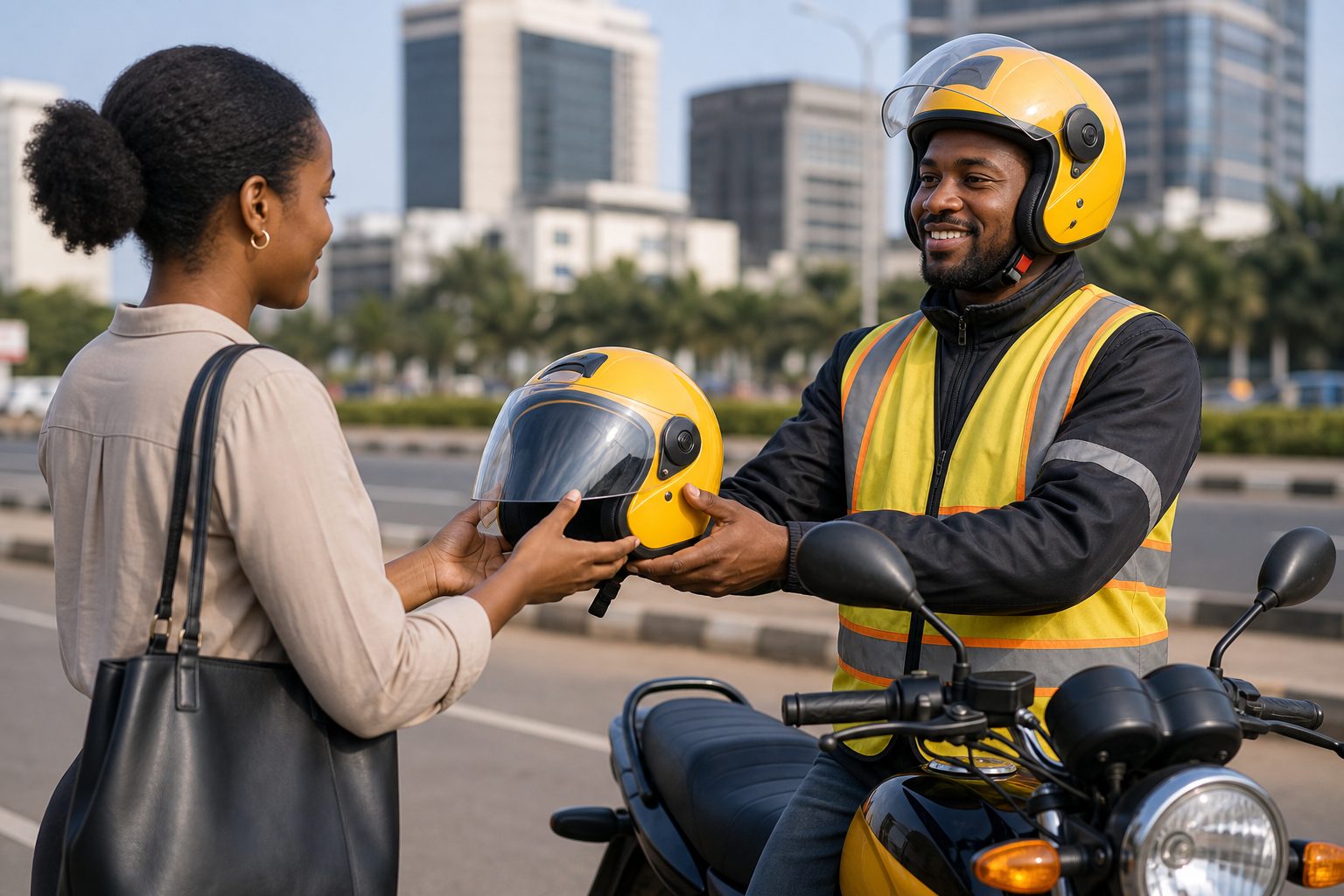
An unpaved street, a jam that has not moved in twenty minutes, a district no route serves, an address seven hundred metres from a junction where no four-wheeled vehicle can turn: that is exactly where the moto taxi becomes irreplaceable. The job is not about covering long distances, but about filling the gaps every other mode leaves behind.
A trade defined by what it makes possible
The moto taxi is not a budget version of the taxi. It is a distinct mode, with its own geography and its own customers.
It carries one person at a time, over generally short distances, in conditions where a car's effective speed collapses. It reaches areas public transport does not touch, or touches only at fixed hours. It lets someone arrive on time for an interview, reach a bus stop from home, take a child to school, or carry a file across the city centre.
The Africa Transport Policy Program, hosted by the World Bank, explicitly counts motorcycle taxis among the components of informal public transport, alongside minibuses and shared taxis, and describes that whole system as the backbone of daily mobility for millions of people in Sub-Saharan Africa. The moto taxi is therefore not an afterthought: in many cities it is a structural link in access to work, health care and services.
Many fares, few kilometres
The economics of the trade resemble no other form of passenger transport. Where a car driver looks for long trips, a moto taxi rider lives off a large number of short ones.
That imposes a particular rhythm: the gaps between customers weigh proportionally far more than the length of the rides themselves. A well-positioned rider — outside a market, a bus station, a school, a hospital, an interchange — moves from one fare to the next; a badly positioned rider waits.
Hence the central role of the waiting point. This is no picturesque detail: the gathering point, often run by a riders' association, organises turns, gives a physical address to a mobile trade, and lets regular customers know where to find someone. The World Bank report notes precisely that this sector is largely organised through unions or professional associations.
The helmet handed to the passenger
There is one gesture that on its own separates a professional rider from a casual one: offering a second helmet, clean, to the person getting on.
The figures justify the insistence. In its global status report on road safety published in 2023, the World Health Organization counts roughly 1.19 million road traffic deaths a year. The same organisation notes that more than half of those deaths fall on vulnerable road users — pedestrians, cyclists and riders of powered two-wheelers — and that non-use of helmets is among the major identified risk factors, alongside speed, alcohol and distracted driving. WHO also points out that 92% of road deaths occur in low- and middle-income countries, which hold only around 60% of the world's vehicles.
For a professional, that data translates into habits that are simple and highly visible: keeping a passenger helmet in good condition and offering it every time, wearing your own properly fastened, refusing to carry more than one person when the machine is not built for it, matching your speed to the actual road surface rather than to what the bike allows, and turning down a fare rather than riding in conditions you know are bad.
It has to be said plainly: those choices sometimes cost a fare. They are also what durably separates the rider you trust with your thirteen-year-old daughter from the one you use once.
The motorcycle is a tool, and it wears out fast
A motorcycle in professional use goes through nothing comparable to private use. It runs every day, often on degraded surfaces, with constant stopping and starting, carrying two people and sometimes luggage.
Maintenance is therefore not optional spending: it is the condition of continued income. Tyres, brakes, chain, lights, suspension, oil changes — each has its own rhythm, and each costs far more when neglected, either as a breakdown in the middle of a working day or as a crash.
Experienced riders reason in days off the road rather than in the price of a part. A repair done in the evening costs the price of the part; the same repair done urgently at eleven in the morning costs the part plus half a day.
Who owns the motorcycle?
This is the question that most strongly determines what a rider actually earns, and it is rarely asked by people looking at the trade from outside.
The World Bank report on informal public transport describes a very widespread model: individually owned vehicles, and low-paid drivers frequently working on the basis of a daily rental of the machine. In other words, the rider hands an agreed sum to the owner each day and keeps whatever he manages to earn beyond it.
The consequence is direct and heavy: risk shifts entirely onto the rider. A day of rain, a breakdown, a check, an immobilisation — and the day's payment is still owed. The report identifies access to affordable vehicle financing as one of the main levers for improving the sector, precisely because moving from daily rental to ownership changes the economic nature of the job.
Parcels, errands, deliveries: the other half of the work
Many riders do not carry only people. Urgent documents, meals, medicines, market purchases, light goods for traders: delivery often accounts for a significant share of the activity, and sometimes the steadiest share.
It has its own requirements. A parcel does not complain, but it cannot be reassured either: it must be genuinely secured, an unbalancing load must be refused, rain protection must be planned, and the handover accounted for — to whom, at what time, with what confirmation. It is also the part of the work that most easily turns into a contract: a shopkeeper, a pharmacy or an office that needs daily runs is looking for a reliable, reachable rider, not the cheapest one. That kind of client turns an erratic income into a partly predictable one.
A largely informal trade that is slowly structuring itself
The International Labour Organization has long documented the scale of informal employment worldwide, notably in its statistical picture of women and men in the informal economy. On-demand transport belongs to it in many countries.
Informality is not a moral failing: it is an economic situation, with real advantages — immediate access to the trade, no barrier to entry — and real costs: no cover in case of an accident, no pension, no recourse in a dispute, difficulty accessing credit.
That is exactly why intermediate forms of structuring matter so much: riders' associations, cooperatives, numbered identification, group insurance, mobile money accounts in the professional's own name, membership of a platform. None of these steps formalises everything, but each makes the trade a little less fragile.
What electrification is already changing
This is no longer theoretical. In an analysis published in 2026 on the World Bank's blogs, two of the institution's authors describe the effect of a Kenyan scheme combining electric motorcycles, lease-to-own arrangements and battery swapping stations. They start with the scale of the sector: around two million boda bodas operate in the country's urban centres.
Over an eight-week observation period, the study records marked changes among riders who switched to electric: productivity up by around 37%, working hours up by 40% — close to three and a half additional hours a day — daily distance up by roughly 70 kilometres, and energy efficiency doubled. The authors link part of that to a change in status: the rider is no longer renting indefinitely but gradually acquiring his own tool.
The result deserves to be read both ways. It shows that the economic structure of the trade — who owns the machine, at what running cost — weighs more on income than individual effort does. It is also a reminder that working 40% longer is not in itself progress: fatigue and sustainable rhythms remain an open question.
A regular customer is worth more than a fare
A rider who lives purely on passing trade starts from zero every morning. A rider who has built a small portfolio of regular journeys — an employee in the morning, two children to school, a trader who sends deliveries three times a week — works on a base.
That base is built on unspectacular things: arriving when you said you would, being reachable on the same number, not renegotiating an agreed price, remembering how someone likes things done, having a clean helmet. None of it is technical. All of it is professional.
Being reachable and identifiable
Moto taxi work is the transport trade where professional presentation changes the most, because it is the one where trust must be established fastest and on the fewest clues.
What a customer wants to know fits in a few lines: the name you work under, which districts and municipalities you genuinely cover, what hours you work — early morning, late evening, Sundays? — whether you take advance bookings or only on-demand fares, whether you also deliver parcels, whether you offer regular journeys at a fixed rate, how to reach you by phone or messaging, and which payment methods you accept, mobile money included.
Two items deserve special billing. First the service area, written with real district names: that is what triggers the call. Second the passenger helmet: mentioning it explicitly is not marketing, it is a piece of information many customers look for and rarely find.
A few photographs are enough: the clean motorcycle, the vest, both helmets. They say at a glance what a paragraph explains badly.
In short
The moto taxi is a trade of access. It exists because people need to get somewhere nothing else serves, and it rests on a rare combination: real knowledge of the streets, a maintained machine, sensible riding, and trust built in a few seconds.
Conditions of practice — licence, registration, insurance, municipal authorisation, helmet requirements, association membership — vary sharply between countries and even between cities, and it falls to each professional to check what applies locally. What does not vary is this: a rider who hands over a clean helmet and arrives on time does not have to sell himself for long.
Do you ride a moto taxi? Make your districts, your hours, your regular runs and your number easy to find: that is what people check before getting on.