
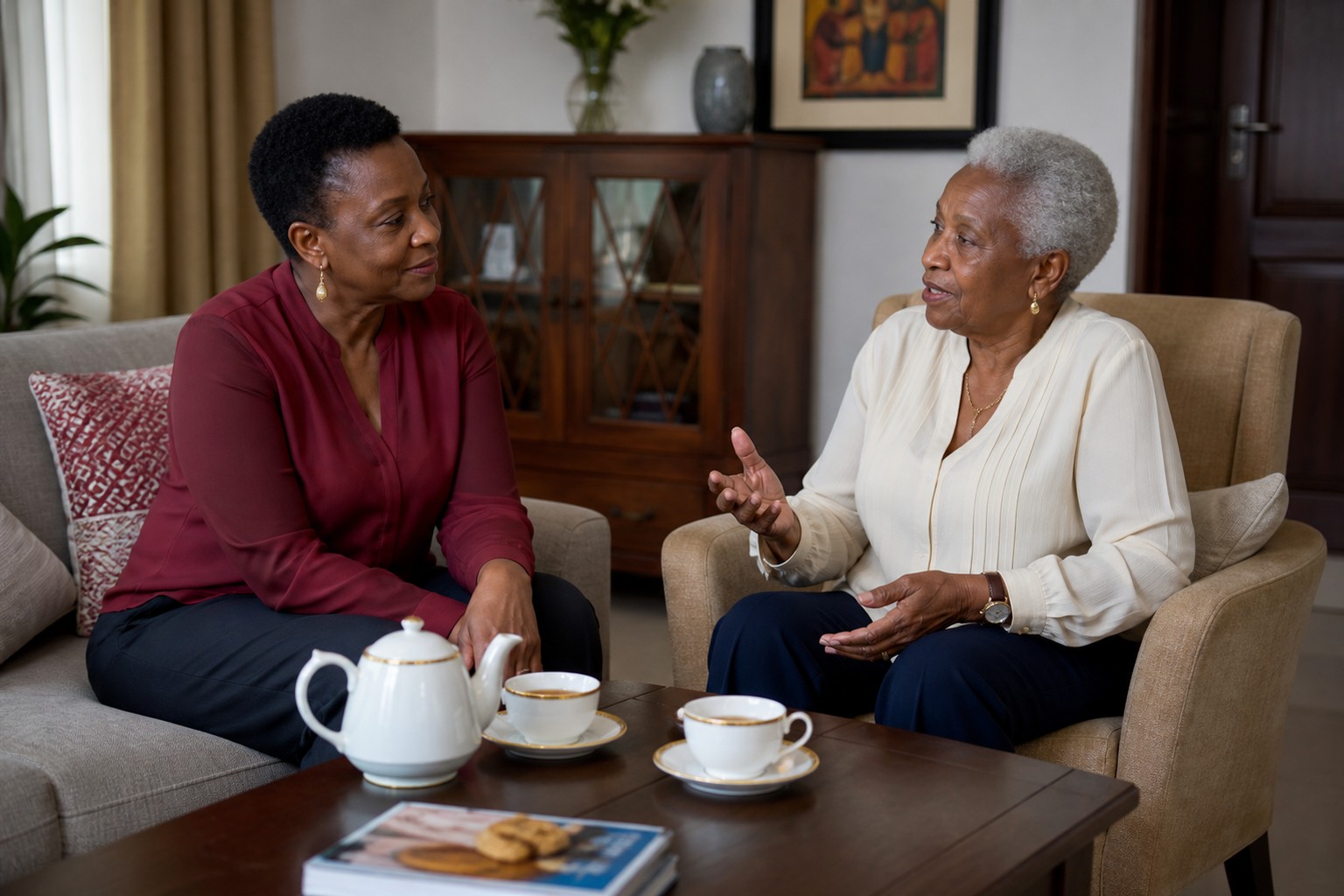
A family rarely calls to ask for companionship. They call about getting up, meals, the fear of a fall. A month later, asked what has changed, they talk about the conversations. That gap says a great deal: this trade is bought for practical help and judged on presence.
What "care" means here, and what it does not
The word misleads, because it suggests passive supervision and a person reduced to their dependency. The reality is different: it means supporting an adult in their own home, in the everyday acts that have become costly, while leaving them to decide their day.
What the work actually covers: presence and conversation, help getting up and going to bed, moving around the home, meals, accompanying someone to appointments, reminders about appointments and treatments, and the link with the family.
What it does not cover: nursing care. Ageing is not an illness, and a home carer is neither a nurse, nor a doctor, nor a therapist. That distinction is not a formality: it determines what may be done and what must be refused.
The prior assessment: saying honestly whether you are enough
A visit before any commitment decides everything that follows, and its most useful outcome is sometimes negative.
You look at the home and what it allows, the acts the person still performs alone and those that have become costly, the appointments and treatments in progress, the habits they want to keep, what the family expects, and above all what the person themselves wants.
That assessment answers a precise question: is non-clinical support enough? If the answer is no — because the situation calls for acts that belong to a health professional — saying so straight away is a professional act, not a commercial retreat. Over-promising is always paid for, and it is paid for by the person being supported.
The agreed scope is then written down: tasks, hours, frequency, the family contact, what to do in case of an incident. What makes the price vary — duration, frequency, hours, travel, level of assistance — is named in the same place; the levels themselves depend on the local market and do not transfer.
Helping without doing it for them
This is the trade's technical principle, and it is counter-intuitive: supporting someone well often means doing less.
A person from whom every act is taken loses their capacities faster. Buttoning a shirt for them takes thirty seconds; letting them do it takes five minutes and maintains something. The trade-off recurs all day, and it is settled in favour of independence whenever safety allows.
The World Health Organization structures its approach to older people's health around that idea. Its Integrated care for older people approach aims at maintaining older people's intrinsic capacity and functional ability, rather than an approach organised disease by disease. A non-clinical carer does not implement that approach, which addresses health systems; but they share its logic — you work to preserve what remains possible.
It also implies a way of speaking. You address an adult, not a child: you do not talk about them in the third person in front of them, you do not decide their day without asking, you knock before entering, you respect privacy and refusals.
Companionship is not an extra
It is the least visible line on a quotation and often the most decisive.
Conversation, reading, memory games, an outing, listening: those hours do not look like a service. Yet they make up most of what the family notices after a few weeks, because isolation weighs on mood, on appetite and on the will to move.
A professional therefore owns that part instead of treating it as dead time — and includes it in what is agreed, rather than leaving it to depend on whatever time is left after the tasks.
Treatments: remind, record, do not decide
This is the trade's most sensitive point, and it is handled by a clear rule rather than by case-by-case judgement.
What belongs to a non-clinical carer: reminding someone that a treatment is due at a given time, making sure they have what they need, recording what was taken or not, and reporting anything out of the ordinary.
What does not: deciding on a medicine, a dose, a timing, a stop or a substitution; interpreting a symptom to draw a medical conclusion; performing an act of care.
Who may do what — preparing a pill organiser, assisting with taking medication, administering it — depends on the person's qualification, on the written instructions received from the prescriber or the family, and on the locally applicable regulatory framework. That is defined in advance, with the family and, where possible, with the health professional following the person. In case of doubt, you do not decide alone: you call.
The daily record and the alert
Long-term support produces knowledge nobody else has, provided it is written down.
A record kept each day — meals, sleep, mood, mobility, treatments taken, outings, visits — makes visible what a monthly family visit never will: an appetite declining for ten days, sleep shifting, someone going out less. Those slow changes are exactly what deserves a doctor's attention.
The record stays available to the person being supported and to the designated family. It is not published, does not circulate in group chats and is not illustrated with shared photographs.
Alongside the record, alerting follows a different logic: some situations are not written down, they are phoned in. A fall, unusual confusion, refusing food, new pain: you tell the family the same day, without waiting for the next visit.
When the situation exceeds the role
You have to recognise those moments, and know what to do without exposing yourself.
The principle is constant: recognise that a situation exceeds your role, put the person reasonably out of harm's way without endangering yourself, alert the family or the designated contact, call the emergency services where necessary, pass on the useful information, and record what happened.
After a fall in particular, lifting someone without knowing their condition can make things worse: you first make sure of their state, you call, and you do not do alone what needs two people or a professional.
Emergency numbers, available services and real response times vary from country to country and city to city. They are asked of the family at the assessment stage, written somewhere visible, and checked — an article cannot supply them.
In the African context
Situations vary sharply between countries, cities and families: there is no single African way of growing older or of calling on a carer, and a professional applying one model would be wrong almost everywhere.
The first reality is the diversity of family arrangements. In some households several generations live under one roof and professional support comes to relieve relatives already present. In others, adult children work in another city or another country, and the older person lives alone. Both situations coexist, including within the same family at different times, and they do not call for the same service: supporting relatives is not replacing them.
The second is the available provision. Depending on the country and the city, residential facilities, home nursing services and social protection arrangements exist very unevenly. Where provision is limited, home support sometimes becomes the only option available — which creates real pressure to overstep the role. It is precisely in that context that the boundary with nursing care must be held most firmly, and that a professional serves people by saying what they cannot provide.
The third is demand from a distance. A family far away is buying practical help, but above all information and peace of mind. The daily record, a regular call, a message after each visit then take on particular value. In several countries mobile payment allows regular settlement from abroad, and messaging allows same-day reporting. The International Telecommunication Union puts the share of the world's population using the Internet at 74 per cent in 2025, with 36 per cent for Africa, the lowest of the regions it measures: these channels matter where they exist, without ever replacing a visit or an assessment.
The fourth is the form of employment. The International Labour Organization's Domestic Workers Convention No. 189, adopted in 2011 with Recommendation No. 201, is an international reference framework recognising the special conditions of domestic work — without being a law automatically applicable everywhere. The report Care work and care jobs for the future of decent work, published in 2018 by the same organisation from data collected in more than ninety countries, analyses paid and unpaid care work and addresses the quality of jobs in the sector explicitly. What that means here: home support is work, not a favour, and it gains from being defined as such.
Finally, professionalisation opens a concrete prospect. Someone who carries out an assessment before committing, keeps a record, knows how to say what belongs to a health professional, respects the independence of the person supported and reports regularly stands out clearly — and reaches families, at home and abroad, looking for precisely that reliability. Depending on the country, agencies are forming, training their staff and organising cover: another route to structuring the same trade.
What home support does not promise
It promises no nursing care, no diagnosis, no decision about a treatment, no rehabilitation, no permanent supervision outside the agreed hours, and no guarantee that nothing will happen. It stands in neither for a health professional, nor an emergency service, nor the family for the decisions that are theirs, nor for existing social provision.
What it does commit to can be checked: an honest prior assessment, a written scope, hours that are kept, respect for the person's independence and privacy, a daily record, a same-day alert when something notable occurs, a defined course of action for incidents, and a receipt or invoice.
The home imposes its own rules: what is seen there is not recounted elsewhere, means of access are recorded and returned, and nothing concerning the person — health, address, habits, photographs — is published or circulated without their agreement and that of the designated family.
Artificial intelligence can help prepare a schedule, a checklist, a record template or a report for the family. It supervises nobody, does not establish that a person is well, assesses no symptom, does not decide that a situation is an emergency and does not replace the judgement of the person who is there. A beneficiary's health information has no business being handed to it.