
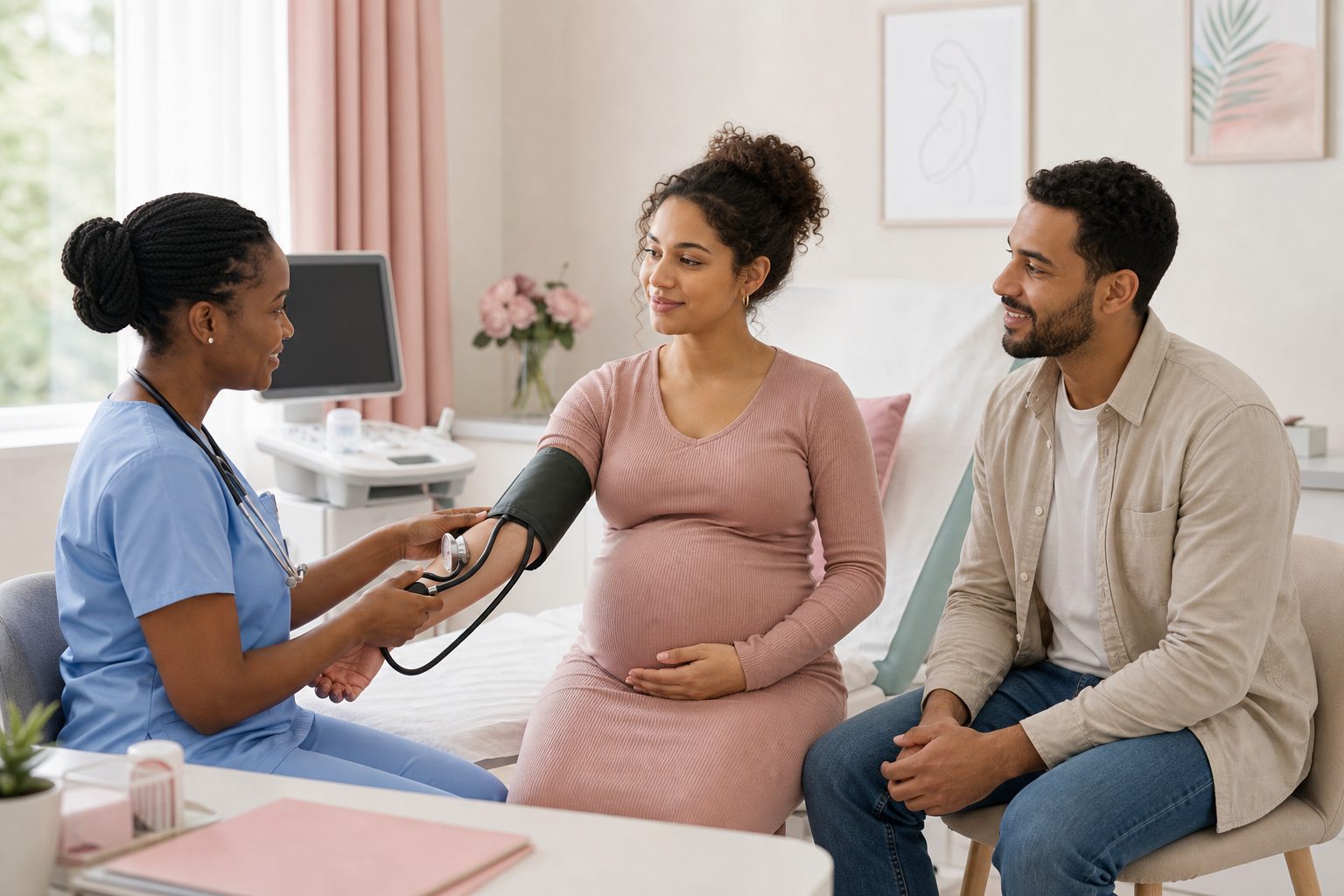
When people think of midwifery, they think of birth. That is accurate, but it is a small part of the reality. Most of the work takes place before and after that moment — sometimes over months — and it rests on a professional competence far broader than is generally assumed.
Support that begins long before birth
The World Health Organization describes the midwife as a professional providing "skilled, knowledgeable and compassionate care" covering the pre-conception period, pregnancy, birth, the postpartum period and the first weeks of life.
That continuity is the signature of the profession. The same person — or the same team — follows a woman from her first questions through to the weeks after birth. They know her history, her medical background, her fears, her family situation. This accumulated knowledge is not a comfort: it makes it possible to spot earlier what falls outside the ordinary.
The profession is not limited to maternity care either. Depending on the country, it also covers sexual and reproductive health more broadly, preventive gynaecological follow-up, and information and support on contraception.
What a midwife does
The work combines dimensions that are too often set against one another.
There is a clinical dimension: follow-up consultations, monitoring of pregnancy, support during labour and birth, examination of the newborn, follow-up in the weeks after delivery. This rests on precise technical competence, framed by training and by the rules of each country.
There is a dimension of education and preparation: explaining what is happening, preparing for birth, supporting breastfeeding, answering questions people do not always dare ask elsewhere.
There is a dimension of recognition and referral: identifying situations that require a medical opinion or specialist care, and passing them on at the right moment.
And there is a permanent human dimension: reassuring, listening, respecting choices, and also supporting pregnancies that go badly, bereavements and difficult situations.
A profession whose impact is measured
Few professions have such clear data on their usefulness.
WHO indicates that midwives educated to international standards can deliver around 87% of essential services in sexual, reproductive, maternal and newborn health. Above all, it estimates that 83% of maternal deaths, stillbirths and newborn deaths could be prevented by quality care provided by midwives.
It also recalls the scale of the shortfall: around 900,000 more midwives are needed worldwide, and 810 women die every day from preventable causes related to pregnancy and childbirth.
These figures are global. They describe no country in particular, but they say one thing unambiguously: strengthening this profession produces direct and measurable effects.
Who do they work with?
Women, first of all, at every stage. Newborns. But also, very often, families: partners, mothers, sisters, who accompany, worry, ask questions and play a real role in the weeks following a birth.
Midwives also work closely with other professionals: doctors, obstetricians and gynaecologists, paediatricians, nurses, anaesthetists depending on the situation, and social care professionals where the family context requires it.
Where does a midwife practise?
The settings are more varied than people assume:
- in a maternity unit, public or private;
- in a hospital or health centre, in follow-up services;
- in a private practice, alone or in a group;
- at home, for follow-up visits, particularly after birth;
- in community or local health structures;
- in teaching, training and research;
- in public health programmes and humanitarian organisations.
Many practitioners combine several of these settings over the course of a career.
An autonomous profession
This point is often misunderstood. In many countries, the midwife is not a medical auxiliary: they practise a profession with its own scope of competence and full responsibility within it. The International Confederation of Midwives explicitly upholds access to quality care from "autonomous midwives" and publishes international standards defining the profession and its scope of practice.
That autonomy has a direct consequence day to day: within their field, the midwife decides without waiting for systematic authorisation. They also know precisely where their field ends, and at what moment they must hand over.
The skills that make the difference
- Clinical rigour, since monitoring relies on signs that have to be read correctly.
- Composure, because a situation can change very quickly.
- Listening and respect, in moments of great emotional intensity.
- The ability to explain, a large part of the work being teaching.
- Decision-making, tied to professional autonomy.
- Stamina, with on-call duties, unsocial hours and long days.
- Discretion, in a field that touches on the intimate.
- Teamwork, including under pressure.
Training and practice: national rules
The length and level of study, the recognised qualification, registration with a council or health authority, the exact range of permitted procedures, the possibility of self-employed practice, prescribing arrangements: all of this falls under national rules and varies considerably between countries.
WHO stresses that strengthening midwifery education to international standards is "a key step" towards improving the quality of care. But translating those standards into practice belongs to each country. No national arrangement can be presented as the general rule, and anyone concerned should refer to the authorities and professional bodies of their own country.
The profession in Africa
The subject is particularly sensitive across the African continent, where maternal and newborn health remains a public health priority.
WHO puts the global shortage of midwives at around 900,000, and indicates more broadly that most of the projected shortfall in nursing and midwifery personnel will be concentrated in the WHO African and Eastern Mediterranean regions. These are regional figures, which cannot be reduced to any given country.
Realities vary considerably between countries, between urban and rural areas, and between health systems. One constant nevertheless stands out: where qualified midwives are present and accessible, maternal and newborn health outcomes improve. That is what makes the structuring and visibility of this profession so important.
Presenting the work professionally
A midwife working in a private practice, self-employed or making home visits needs to be found — and often by women searching in urgency or in worry.
What people look for at that moment is very concrete: what kinds of follow-up does she offer? does she see people at a practice or does she travel? does she provide birth preparation, postnatal follow-up, breastfeeding support? where is she based? at what times? how can she be reached quickly?
Making this information clear and accessible is not promotion: it is what allows a woman to find the right professional at the right moment. That presentation must of course remain consistent with the communication rules applying to health professionals in the country of practice.
In summary
The midwife supports a decisive moment in life, over a long period, with her own scope of competence and real responsibility. The work combines clinical rigour, professional autonomy, teaching and human presence, within a framework whose rules vary by country.
It is a profession whose usefulness is demonstrated and whose shortage is worldwide. But women still have to know where to find one.
Are you a midwife? Find out how to present your work clearly online: the follow-up you offer, where you practise, your availability and how to contact you.