
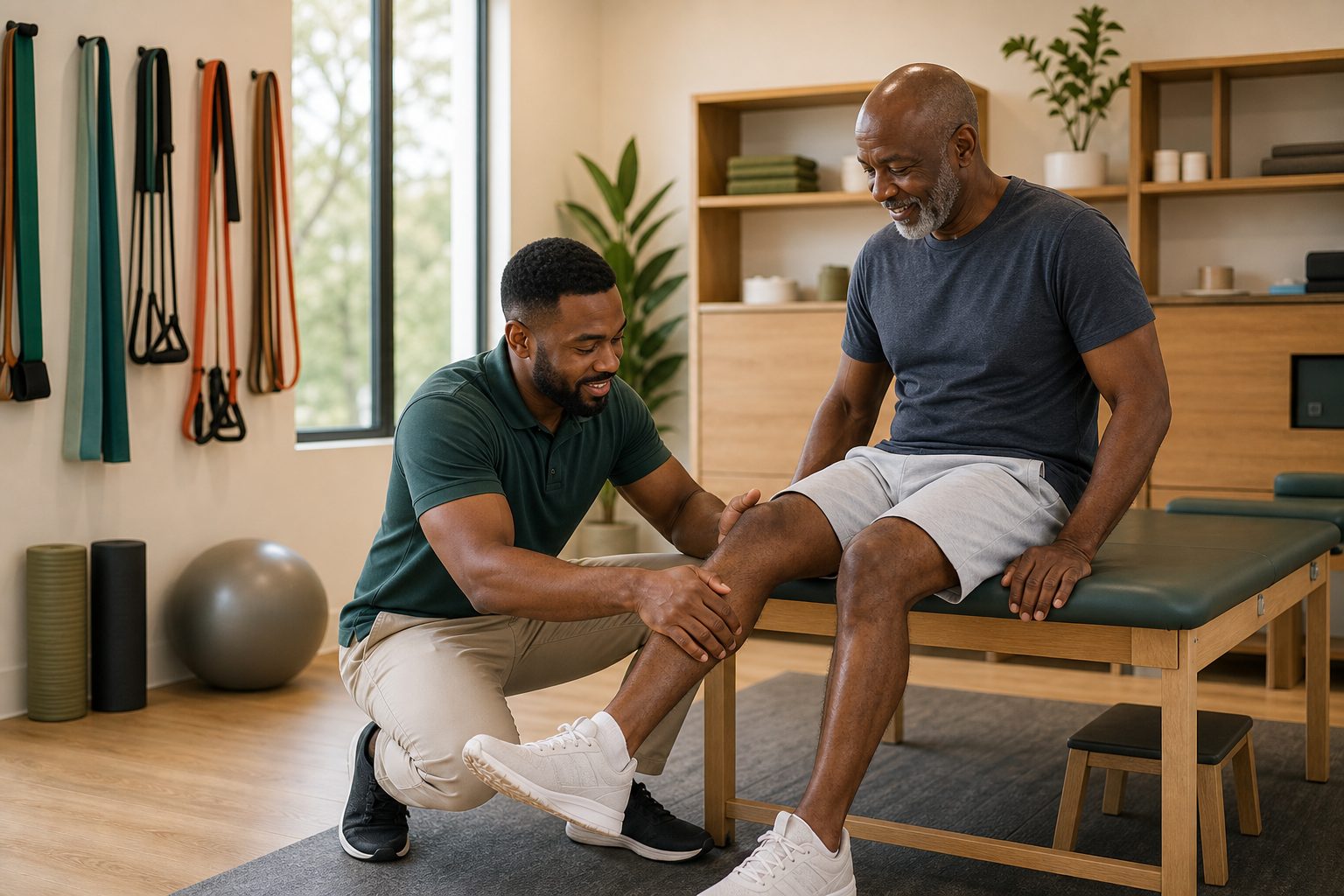
He arrives with a bag, sometimes a folding table, and he works in a living room, a bedroom, a courtyard. The home physiotherapist practises the same profession as a colleague based in a practice, but under conditions that have almost nothing in common. That difference is what makes this work so interesting — and so demanding.
Why some care happens at home
Physiotherapy belongs to what the World Health Organization calls rehabilitation: a set of interventions designed to optimise a person's functioning and reduce disability, taking their environment into account. And that environment is not always reachable from a practice.
WHO notes that rehabilitation services are delivered in hospitals, in outpatient practices, and directly in people's living environments: home, school, workplace. Home care is therefore not a fallback. It is a setting in its own right, chosen because it is sometimes the only one possible — and sometimes the most relevant.
For someone who cannot manage three flights of stairs, who has just come out of hospital, who lives far from any health facility, or whose condition makes every journey exhausting, care can only exist if it comes to them.
Who is being cared for
The people seen at home are not quite the same as those seen in a practice. They are mainly:
- older people whose mobility is declining and whose priority is to stay independent at home;
- people recovering after a hospital stay or an operation;
- people living with disabilities for whom travel is costly in energy;
- people living with long-term conditions;
- more rarely, children followed in their usual living environment.
WHO makes the same point in its approach to integrated care for older people: the aim is to optimise intrinsic capacity and functional ability — in other words, what a person can actually do in daily life. At home, that aim becomes concrete: the house itself is the terrain.
A completely different way of organising
A physiotherapist in a practice manages a place. A home physiotherapist manages a route.
The day is made of time slots and journeys. One appointment running twenty minutes late shifts the whole round. A poorly given address, roadworks, a broken lift: these are professional hazards, not minor details. Building a coherent round — grouping visits by district, allowing realistic margins, keeping a slot for the unexpected — is part of the job just as much as technique.
There is also the equipment to manage: what you carry, what you leave behind, what you can improvise. The professional works with whatever fits in a bag and whatever is available on site.
Adapting to a place never designed for care
This is probably the least understood aspect of the work. A practice is designed for care: table height, lighting, room to move, equipment within reach. A home is not.
The professional therefore has to size up very quickly the space available, the light, the floor, the furniture that can be used, the room around the bed. They also have to deal with what cannot be controlled: the television on, the neighbours, a pet, a child passing through, the heat.
This constant adaptation calls for a skill that is rarely taught: turning an ordinary room into a safe working space, without disrupting it, and without making the person feel their home is being invaded.
A particular professional relationship
Entering someone's home changes the relationship. The professional is no longer on their own ground but on the other person's. That creates a real closeness, and that closeness has to be held with care.
You have to be welcomed without becoming one of the family, warm without becoming a friend of the house, able to accept a glass of water without the session turning into a social visit. The professional distance that is self-evident in a practice has to be deliberately built here.
The people around the patient occupy a place a practice never sees. A spouse, a child, a carer sometimes sits in on the session, asks questions, worries. The home physiotherapist therefore explains a great deal — to the person, and often to those who live with them.
Working alone, but not in isolation
Another distinctive feature: no colleagues in the room. No peer to consult between two patients, no front desk to filter calls.
Hence the importance of coordinating at a distance: general practitioner, nurse, occupational therapist, home help, family. The professional is often the one who sees the person most regularly and for the longest time; they notice changes others cannot see. Knowing how to pass on a useful observation, to the right person, is part of the value of their work.
The qualities that really count
Beyond technical competence, this work calls for:
- considerable autonomy, since decisions are made alone and on the spot;
- solid organisation, the round being the backbone of the day;
- flexibility, because nothing ever happens twice under the same conditions;
- ease with people, including with those around the patient;
- discretion, because you see a great deal of people's private lives;
- stamina, between the travel, the stairs and improvised working postures;
- rigour in written records, the only trace shared with other professionals.
Training and practice: it depends on the country
The conditions for entering physiotherapy — length of study, qualification required, licence to practise, existence of a professional council — fall under national rules and differ from one country to another. The arrangements specific to home practice (need for a referral, funding conditions, declaration requirements) vary as well.
There is therefore no single global rule. Anyone considering this work, or wishing to practise in a country other than the one where they trained, should check with the relevant health authorities and professional bodies.
Home care in Africa: answering a real need
Across the African continent, access to rehabilitation remains uneven. WHO points out that in several low- and middle-income countries, more than half of the people who need rehabilitation services do not receive them, and that the number of trained professionals remains limited. The WHO Regional Office for Africa likewise identifies insufficient rehabilitation services as a persistent obstacle.
In that context, home visits take on particular meaning. Where facilities are distant, where transport is expensive, where a whole family has to organise itself to take a relative to an appointment, the professional's travelling removes several obstacles at once.
Situations differ widely between countries, and no local observation can be generalised across the continent. But the logic holds: when distance is the main barrier to care, the mobile professional becomes an obvious answer.
Being findable without a shopfront
Here lies the paradox of this work: it serves people who struggle to travel, yet it has no sign to make itself known. No frontage, no plaque, no waiting room where the practitioner's name gets passed around.
A professional working at home therefore needs, even more than others, to exist clearly somewhere. In practice, a family searching wants simple answers: does this person cover my neighbourhood? which groups do they work with? at what times? how can they be reached? are they taking on new patients?
These details look modest. Yet they decide whether the call happens at all. A stated coverage area, legible availability and a direct means of contact are worth, for this kind of work, everything a fine shopfront brings to a practice.
In summary
The home physiotherapist practises physiotherapy in the field: going to people who cannot come, adapting to their living environment, managing their own organisation alone, and working closely with families and other professionals. It is a profession of mobility, autonomy and relationship, whose rules of practice vary by country.
Its main difficulty is not technical: it is being known and reachable by those who would need it.
Do you provide physiotherapy at home? Find out how to present your work clearly online: your coverage area, the people you support, your availability and how to reach you.