
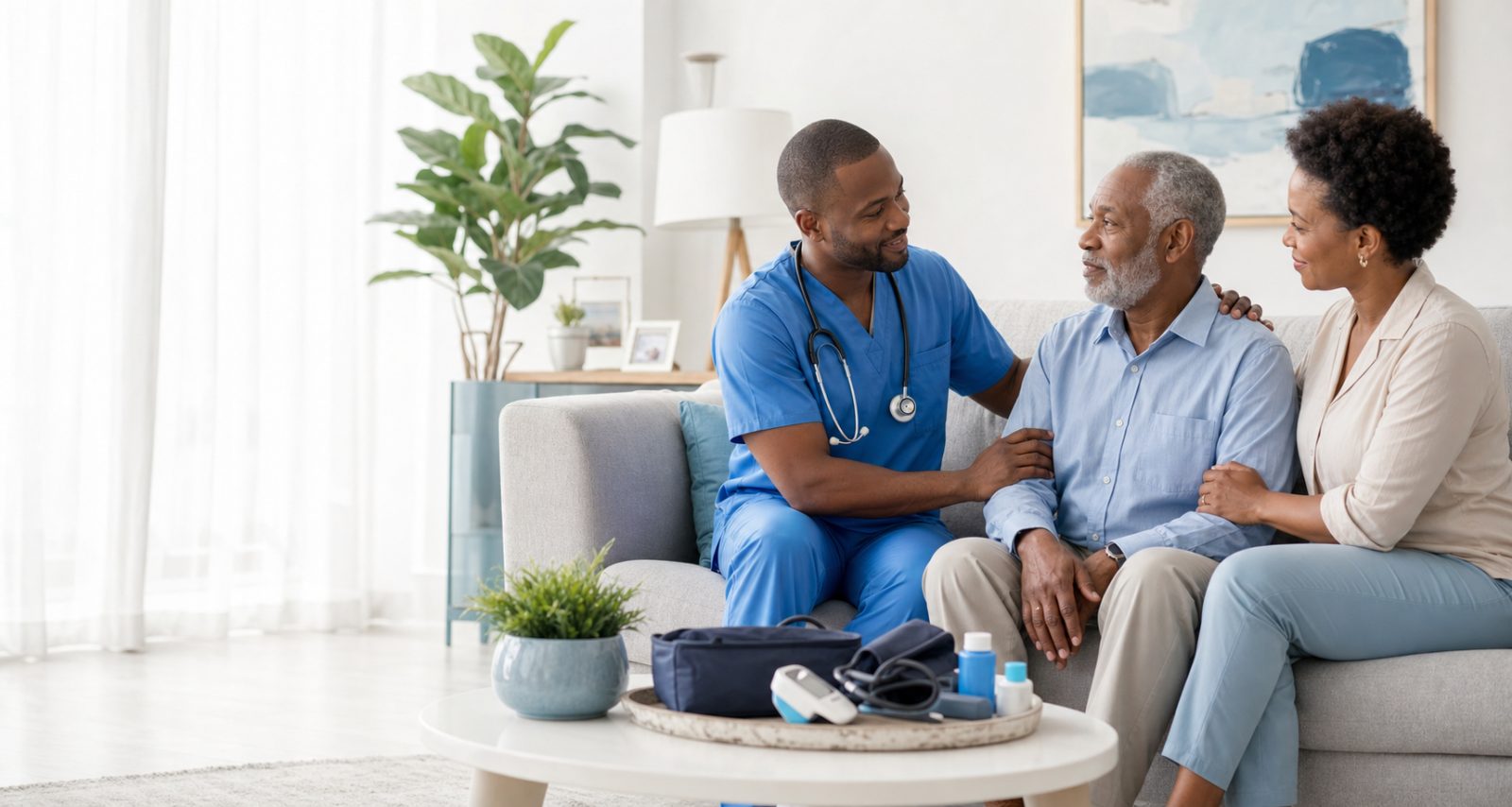
It is a profession that starts early and finishes late, often in a car, on a motorbike or on foot. The home nurse does not receive patients: they go to them. That simple reversal changes almost everything — the organisation, the responsibility, the relationship, and even the way professional judgement is exercised.
What the nursing profession covers
The World Health Organization gives the profession a deliberately broad definition: nursing "encompasses autonomous and collaborative care of individuals of all ages, families, groups and communities, sick or well and in all settings". Health promotion, prevention, care for people who are ill, living with disability or at the end of life: the scope is wide.
WHO adds two observations that make the profession's real weight clear: nurses and midwives account for nearly half of the global health workforce, and the nurse is often "the first and sometimes only health professional a patient will see".
That last point takes on its full meaning when care moves into the home.
Why the home changes the nature of the work
In a hospital ward, the nurse works within a system: a doctor is reachable, colleagues are present, equipment is at hand, protocols apply in a stable setting.
At home, none of that is immediate. The professional arrives alone, with what they have prepared, in an environment they do not control. They observe, they decide, they act, and they report afterwards. That autonomy is not an added flourish of the profession: it is the daily condition of practice.
It comes with matching responsibility. Spotting that a situation is deteriorating, judging what can wait until tomorrow and what cannot, raising the alarm at the right moment with the right person: that is where the real professional value lies.
Who is being cared for
The people seen at home are marked by duration and fragility:
- older people whose ability to stay at home depends on a regular visit;
- people living with a chronic condition requiring close follow-up;
- people discharged from hospital and recovering;
- people living with disabilities;
- people at the end of life, supported in their own home;
- more occasionally, people needing care for a limited period.
WHO's approach to integrated care for older people sheds light on this orientation: the aim is to optimise functional ability, in other words what the person can actually do in their life. The organisation notes that "health and care workers in the community need support on how to identify health and social care needs of older people and effectively address them".
The round: a skill in its own right
A home nurse's day is structured by a round. That word covers a demanding reality.
Some visits must happen at fixed times. Others can be moved. Some take ten minutes, others much longer. Between each visit there are journeys, addresses to find, staircases, a locked gate, a closed road. A well-built round takes account of geography, timing constraints, real travel times and a margin for the unexpected — because there is always something unexpected.
There is also the equipment to prepare: what to take, in what quantity, how to transport it, how to manage hygiene and the disposal of clinical waste outside any facility. These are daily logistical questions, and they determine the safety of the care.
Working in someone's living space
A home is not a hospital room. It was not designed for care and it must not become one.
The professional therefore has to make do: find a clean work surface, sufficient light, a position that works for the person and for themselves, without rearranging the house. They enter an intimate space, where a great deal is visible — living conditions, financial difficulties, family tensions, isolation. Discretion here is not an optional quality.
They also have to accept not being in charge of the setting: the television, visitors, pets, the heat, the space available. Constant adaptation is part of the craft.
Family and those close to the patient
This is a major difference from working in a facility: the people around the patient are present, and they matter.
A spouse, a child, a carer often sits in on the care, asks questions, worries, sometimes helps. The nurse explains, reassures, demonstrates, corrects. A real part of the work consists of making those around the patient capable — without loading them with what is not theirs to carry.
The relationship builds over time. Seeing someone several times a week for months creates a strong closeness, which has to be held with care: present without becoming one of the family, warm without losing professional distance.
Coordinating, reporting, raising the alarm
The home nurse is rarely the only professional involved. General practitioner, physiotherapist, home help, pharmacy, social services, family: they sit at the centre of a network in which they are often the most regular point of observation.
Hence the importance of handovers. A clear report, a dated observation, a precisely worded alert: these are the only tools that let information circulate when professionals never cross paths. Rigour in writing is not paperwork here — it is the continuity of care.
The qualities that count
- Independent judgement, since decisions are made alone and on the spot.
- Organisation, the round being the very structure of the day.
- Rigour, in practice as much as in written records.
- Relational skill, with the person and with those around them.
- Discretion, in a profession that enters the privacy of homes.
- Physical and mental resilience, between the travel, the hours and demanding situations.
- Composure, since an emergency can arise with no team around you.
Training and practice: by country
Initial training, the qualification required, registration with an authority or council, permitted procedures, the terms of self-employed or salaried practice, prescribing and funding arrangements: all of this is set nationally and varies a great deal.
No national rule can be presented as universal. Anyone wishing to practise, or to practise in a country other than the one where they trained, should refer to the relevant health authorities and professional bodies.
Home care in Africa
WHO points out that the global shortage of nurses, estimated at 5.8 million in 2023, will be concentrated for around 70% in the WHO African and Eastern Mediterranean regions by 2030, and that nurse density in Africa remains roughly five times lower than in the European region.
These are regional figures: they describe a group of countries, not any one national situation, and local realities differ widely.
They do, however, illuminate a concrete issue. Where health facilities are distant and where travel represents a real cost for a family, the professional who comes to them removes several obstacles at once. Home care there is not a comfort service: it is often the most workable form of follow-up.
Being identifiable without premises
A home nurse has no shopfront, no waiting room, no plaque visible from the street. They rely on word of mouth and referrals — which works, but slowly and unevenly.
A family searching needs simple answers: do they cover my neighbourhood? what kinds of follow-up do they provide? at what times? are they taking on new patients? how can they be reached quickly?
A stated coverage area, legible availability and a direct means of contact are worth here everything a shopfront brings to a facility. That is often what decides whether the call is made — or not.
In summary
The home nurse practises a profession of autonomy, organisation and relationship. They travel to people who are vulnerable, decide alone in environments they do not control, coordinate information between several professionals, and support families as much as patients. Their framework of practice depends on national rules, but their usefulness is the same everywhere.
Their difficulty is not finding work: it is being reachable by those looking for them.
Do you work as a home nurse? Find out how to present your work clearly online: your coverage area, the care you provide, your availability and how to reach you.