
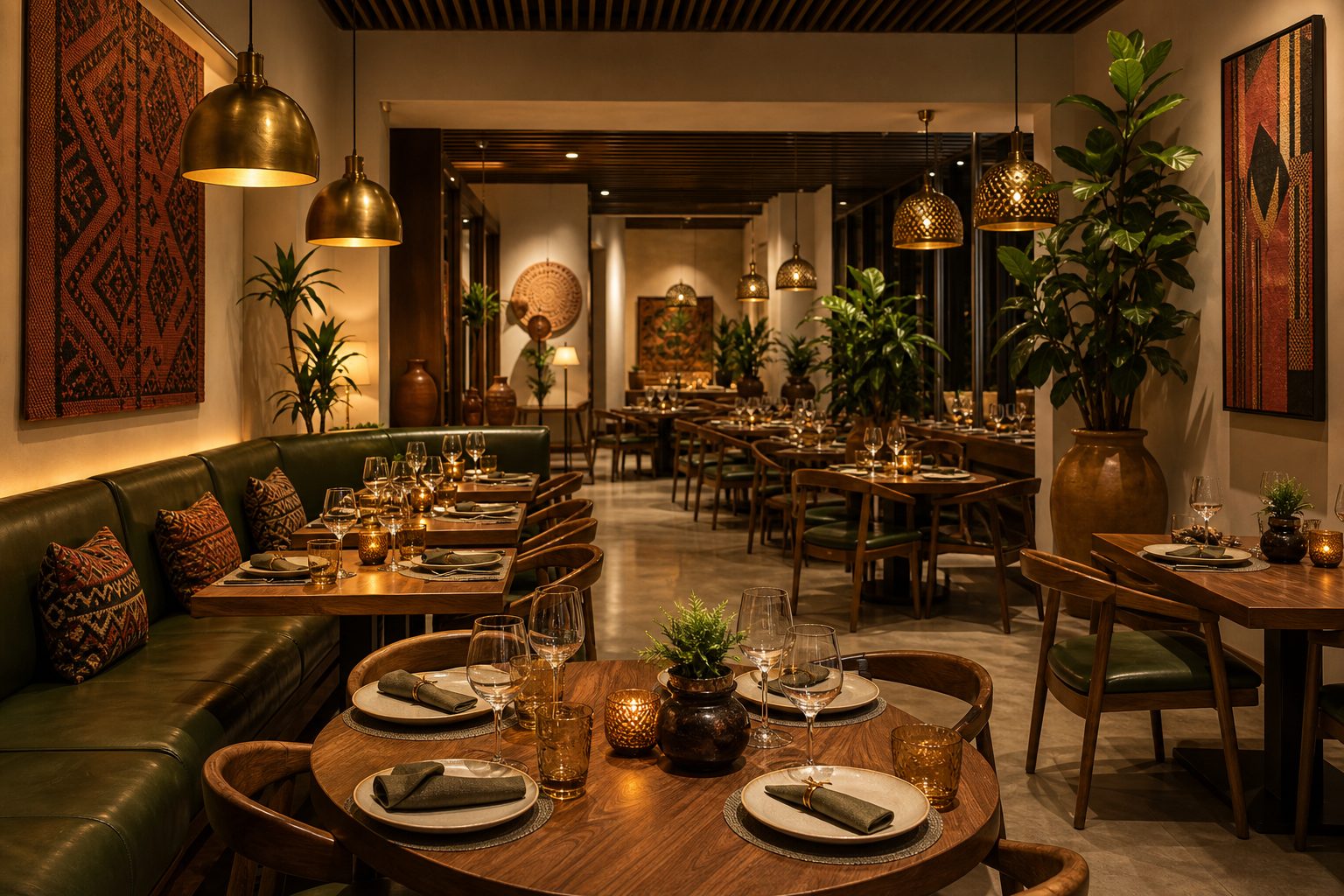
At 7.30 in the evening a couple pushes a door, finds a free table, sits down and reads a menu. That entirely ordinary moment is the end point of a full working day they will see nothing of. That is a restaurant: a complex machine whose only visible success is to appear simple.
The part of the day nobody sees
A restaurant opens its doors long after it starts working.
In the morning there are deliveries to receive and check — quantities, condition, temperature on arrival. There is the immediate putting away of whatever cannot wait. Then production: stocks, sauces, vegetables cut, portions weighed, long cooking, desserts. In the kitchen all of that is called mise en place, and it decides whether service will hold.
Meanwhile the floor gets ready: floors, tables, linen or trays cleaned, crockery and glassware checked one by one, cutlery polished, chairs squared, lighting and music set, bookings reread, table plan decided. Someone checks the toilets are spotless, because a guest will judge them.
Then comes the briefing: what is on today, what has run out, what needs selling first because it will not keep, allergies flagged at booking, tables to watch. Ten minutes that save an hour of drifting.
A menu is not a wish list
It is the most common mistake among people who open: building a menu from what they enjoy cooking rather than from what they can produce.
A menu is a production plan. Every dish added is one more ingredient to buy, store, watch and sometimes throw away. A long menu ties up stock, complicates prep, lengthens ticket times and mechanically increases waste. A short menu concentrates purchasing, allows better buying, cuts waste and makes the team faster on every plate.
It is also a trade-off between what can be prepared ahead and what must be cooked to order. A dish finished in advance goes out in thirty seconds but ages; a dish cooked entirely to the minute is excellent but ties up a section. A workable menu balances the two, and spreads dishes across sections so that none collapses on its own on a full Saturday.
The swing door
Kitchen and floor never see each other work. They do not share the same noise, the same temperature, the same relationship to the guest, often not even the same vocabulary. And yet they must produce a single experience.
The whole trade lives in the quality of that link. An order taken badly is paid for in the kitchen. A dish announced as "two minutes" that takes ten is paid for on the floor. An allergen not passed on is paid for very dearly. Restaurants that work well all share the same reflexes in one form or another: orders written down rather than memorised, clear calling of what is going out, someone regulating the traffic between the two — the position tradition calls the pass — and the habit of saying what is wrong immediately rather than at the end.
The international classification of economic activities puts all these forms of service in a single class — table-service restaurants, cafeterias, fast food, takeaway and delivery — because they share one nature: providing prepared meals to customers. The French nomenclature, for its part, singles out restaurant activity with table service, precisely the model where the floor has a role of its own rather than merely a counter's.
The rush
A restaurant does not work at a steady pace. It works in peaks.
Over an evening service, most orders often land inside a single hour. The entire organisation exists to absorb that moment: it is why the prep was done, the sections divided, the quantities forecast and the table plan set. When it goes well, nobody notices. When it goes badly, everything shows at once — plates waiting under the lamp, tables not cleared, a bill that never comes.
What separates solid teams is not the absence of surprises but how they handle them: telling a table there will be a ten-minute wait is infinitely better than letting it hope.
The table is the truly scarce resource
A restaurant does not only sell dishes: it sells seats for a given length of time.
How many covers a place can do in an evening depends on the number of tables, their size, and the average length of occupation. The trade calls this turnover. One extra cover per table across a service changes the month; a table for four occupied by two people for three hours on a Saturday night costs real money without anyone noticing.
Hence the importance of bookings, which are not a luxury reserved for grand houses: they let you anticipate purchasing, size the team, organise the room and limit lost tables. And hence, just as concretely, the importance of confirming bookings and handling no-shows, one of the quietest loss lines in the business.
Buying, storing, throwing away as little as possible
A restaurant's raw material is perishable, and it degrades even when it is stored properly.
Purchasing therefore means buying as close as possible to real need: ordering against bookings and the known pattern of the week, rotating stock so that what came in first goes out first, dating anything opened, and knowing how to transform rather than discard when that is possible and safe.
It is an area where small decisions add up: a portion size slightly off, repeated three hundred times; an order placed "to be on the safe side"; a product put in the wrong place and forgotten. None of these is dramatic; together they separate a restaurant that holds from one that grinds itself down.
Hygiene is an organisation, not a clean-up
The World Health Organization has condensed food safety into five principles that fit on a poster translated into more than eighty languages: keep clean, separate raw and cooked, cook thoroughly, keep food at safe temperatures, and use safe water and raw materials.
Their simplicity is deceptive. Applied in a restaurant they become permanent organisation: boards and utensils that do not travel between uses, a clear work surface, hands washed at defined moments rather than when it occurs to you, a cold room arranged so that nothing drips onto anything, products covered and dated, cleaning built into the day rather than pushed to the last minute.
The international reference framework is the Codex Alimentarius collection of codes of practice, developed jointly by FAO and WHO, whose general principles of food hygiene form the common basis for every other hygiene text. The concrete obligations — registration, official inspection, compulsory training, control plans — belong to each country's law, and sometimes to each local authority. An operator should always check what applies locally rather than transposing something read elsewhere.
A trade of unsocial hours
You work when other people go out: evenings, weekends, public holidays. Service means standing for long stretches, in heat in the kitchen and noise on the floor, with split shifts that stretch the day without filling it.
In 2017 the International Labour Organization adopted guidelines on decent work in the tourism sector, which covers hospitality and catering. They set out common principles for a sector recognised as a strong job creator but also marked by atypical hours, night and weekend work, heavy seasonality and a majority of very small businesses.
For an establishment the translation is managerial before it is regulatory: rotas announced in advance, reasonable splits, a team you keep rather than a team you replace. In a trade where quality rests on learned gestures, constant turnover costs more than it appears to save.
What brings a guest back
A guest almost never returns for a single reason. They return because nothing went wrong.
The food was good, but also: they were recognised, someone answered when they called, they did not wait without knowing why, the bill was right, the toilets were clean, and booking was not a struggle. Consistency counts for more here than brilliance: a restaurant that is excellent eight times out of ten loses guests that a merely correct one keeps ten times out of ten.
Making the restaurant legible from outside
Most of the decision is made far from the dining room. Someone looking for dinner wants five very concrete things: what you serve, where you are, when you are open, whether they can book, and roughly what to expect.
A professional presentation answers that without becoming an advertisement: the name of the place and its concept in one honest sentence, the menu or at least the specialities, a precise address and a landmark to find it by, the real days and hours of service — including closing days — how to book and how much notice you prefer, the capacity of the room, whether you can take a group or be hired privately, contact details that are actually answered, and the payment methods you accept.
Photographs deserve particular care, provided they show reality: the room as it is, a few dishes you genuinely serve, the team. A guest disappointed by the gap between the picture and the place does not come back, and says so.
Finally, if you serve people with dietary constraints, say so plainly. Being able to answer "what is in this dish?" is part of being professional, and the obligations on ingredient and allergen information vary from country to country: it is the local rule you need to know and apply.
In short
A restaurant is a production business and a hospitality trade carried out at the same moment, in the same place, by two teams who never see each other work. Its difficulty is not cooking well one evening: it is doing it again, identically, two hundred times a year, with perishable goods, a room of fixed size and guests who all arrive at once.
The requirements for opening, hygiene, training and display depend entirely on the country and sometimes the city. What does not vary is the implicit contract: a guest comes for an evening without a hitch, and judges everything — not just the plate.
Do you run a restaurant? Set out your menu, your address, your hours and how bookings work: that is what people check before pushing the door.