
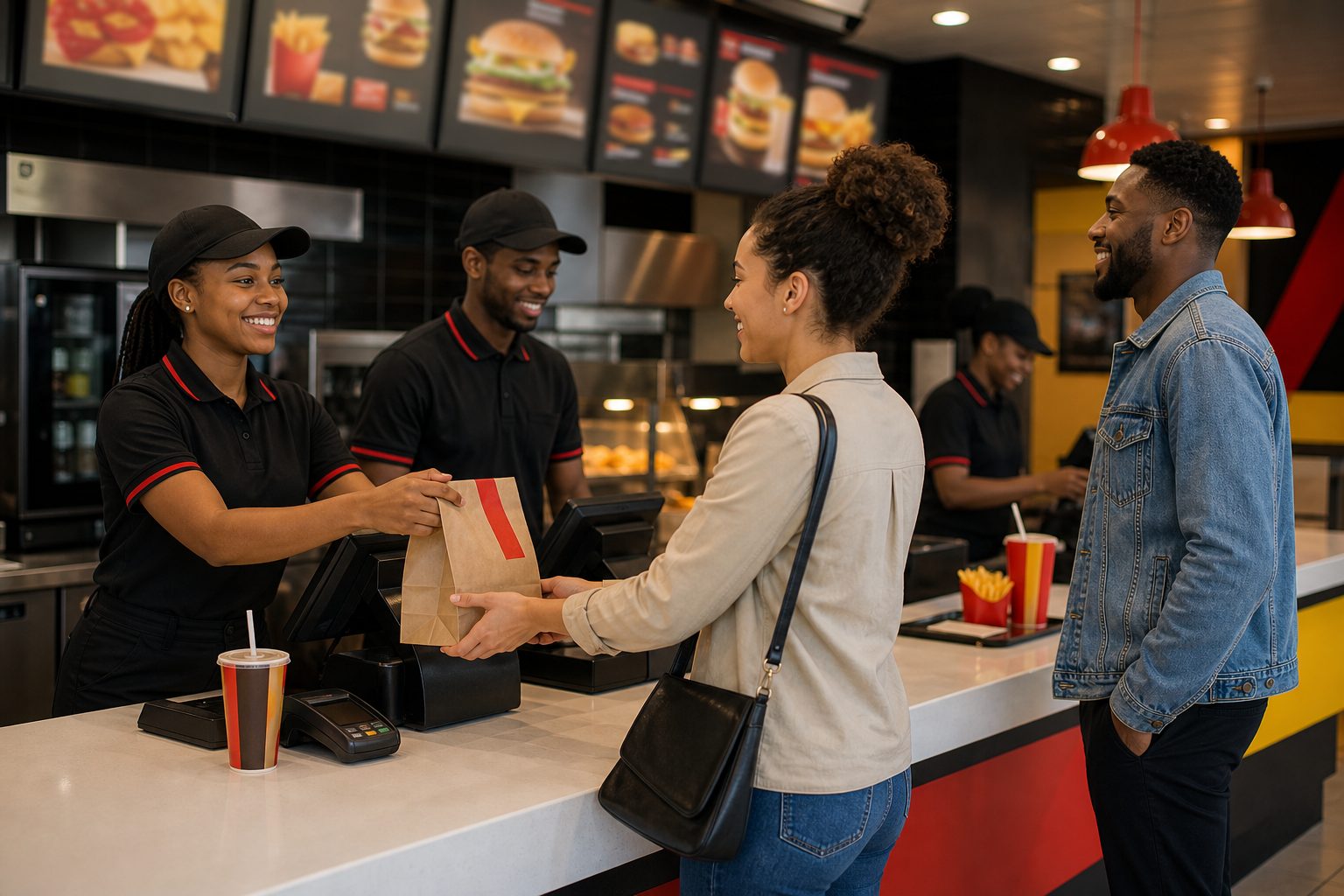
Someone has twenty minutes for lunch. They are not looking for discovery, they are looking for certainty: walk in, order, get exactly what they had in mind, and leave on time. A fast food business is an operation built entirely around that constraint.
The minute is the unit of measure
In a restaurant you talk about service. In fast food you talk about cycle time: how long passes between a customer placing an order and holding it.
That number governs absolutely everything. It sets the length of the menu, because every extra line adds a choice, therefore a hesitation, therefore seconds at the counter and stock lines in the kitchen. It sets the layout of the stations, because one wasted step repeated six hundred times a day costs hours. It sets what is prepared ahead and what is assembled to order. It even sets how the order is taken and how payment is processed.
That is why fast food menus are short and stay short: not a failure of imagination, but a production constraint openly accepted.
Prepare ahead, assemble on demand
The model rests on a clean separation between two phases.
Upstream, preparation: cutting, sauces, garnishes, portioning, part-cooking, stations set up. It happens before opening and is topped up between peaks. It is what makes fast assembly possible.
During service, assembly: you do not cook, you build. Each station has its components within reach, in a fixed order, and the product is put together in a learned sequence. That division also explains why a fast food business can run with a team trained in a few days on a specific station, where a restaurant kitchen takes months — and why, in exchange, consistency depends far more on procedures than on individuals.
The international classification of economic activities groups restaurants, cafeterias, fast food outlets, takeaway, delivery, mobile vendors and market stall food preparation into a single family: it is the same activity of providing prepared meals, with different service arrangements. The French nomenclature, for its part, singles out fast food service, defined as counter provision of food and drink for consumption on site or to take away.
The lunch peak
A fast food outlet does not work eight hours: it works a few dozen minutes, several times a day, with troughs in between.
Over a lunch service, most of the takings can happen inside an hour. The whole organisation is sized for that moment: staff positioned, stock brought forward, stations topped up just before, nobody on break. An outlet that handles its peak badly does not only lose the customers who leave: it loses the ones who see the queue and never come in.
Conversely, overstaffing the quiet hours costs money for nothing. Fine-tuning rotas against the real footfall curve — which varies with the neighbourhood, the offices, the schools, market days — is one of the most profitable management skills in the trade.
Consistency beats excellence
This is where fast food differs most sharply from the rest of the food trade.
A restaurant guest accepts that a dish varies slightly from one visit to the next. A fast food customer does not: they come back precisely because they know what they will get. A product better than usual is almost as unsettling as one that is worse.
That requirement translates into simple tools: written recipes with weights, portioning utensils rather than hands, timed cooking, holding times beyond which product is discarded, and regular checks on what goes out. This is not bureaucracy: it is what guarantees that a product sold at midday and one sold at eight in the evening are the same product.
Packaging is part of the product
In a trade where a large share of orders leaves the premises, packaging is not a container: it is the last stage of manufacture.
It has to hold temperature, stop anything crisp going soft, prevent a sauce from spreading, allow transport without crushing, and close properly. It also has to identify the order — especially when it leaves with a courier who did not prepare it. A misidentified order means one customer served wrongly and two customers unhappy.
Delivery adds a constraint that counter sales do not have: the time between production and the first mouthful is no longer two minutes but twenty or thirty. That forces choices about what you accept to deliver, adjustments to some cooking, separation of what must stay crisp from what is wet, and the discipline to refuse a zone that is too far rather than deliver a degraded product that will damage the reputation of the business.
Hygiene in a high-volume trade
Handling a lot, fast, with sensitive products and a team that turns over: that is exactly the combination that makes food safety organisation indispensable.
The five food safety principles published by the World Health Organization are the basis here: keep clean, separate raw and cooked, cook thoroughly, keep food at safe temperatures, use safe water and raw materials. In a fast food operation four points concentrate the attention: strict separation between raw meats and ready-to-eat products, cooking through, control of hot and cold holding times, and hand washing in an environment where the same people take payment and assemble food.
These principles do not replace regulation: registration, training, inspection and display obligations belong to each country's law and sometimes to each municipality. It falls to every operator to check what applies locally.
Street food, and its professionalisation
Fast food is not confined to premises with a sign. In many cities it is practised at the roadside, on stalls, from vehicles or small structures — and both the international classification and the French nomenclature explicitly place those forms in the same activity.
Economically it is considerable. The International Labour Organization has long documented the scale of informal employment worldwide, of which street food is one of the most visible urban components. This activity feeds whole cities at an accessible price, generates income quickly and requires little start-up capital.
It also calls for food safety support. In May 2025 the FAO reported validating two national documents in Senegal aimed precisely at this activity: a guide for official food inspections and a hygiene best practices manual for street vendors. The same publication recalls, citing the World Health Organization, that over 91 million people fall ill each year in Africa from foodborne diseases, with roughly 137,000 deaths, diarrhoeal illnesses accounting for around 70% of cases.
The useful reading of those figures is not discouraging but professional: demand for affordable meals grows as cities expand, and what durably separates one vendor from another is the confidence they inspire. A clean station, safe water, covered products, a clear separation between money and food, a tidy appearance: these gestures are visible to the customer, and they are what builds loyalty.
The economics of a low average ticket
A fast food business earns little per order. It therefore depends on three variables that must be watched together.
Volume first: the number of orders makes the turnover, and it depends on location more than on anything else. Materials next: in a low-ticket trade, a few grams of variance per portion, repeated hundreds of times a day, shows immediately — hence the importance of portioning and of tracking waste. Labour last, whose cost is largely fixed across a service while footfall varies.
To these are added costs specific to the model: packaging, individual sauces, cooking energy, and commissions when working with delivery platforms. Those commissions are not a fatality, but they must be known and built into pricing, failing which the extra volume they bring can cost more than it earns.
Presenting a fast food business
A fast food customer decides quickly, often on their phone, and looks for immediate answers: what do you sell, how long does it take, where are you, do you deliver to me, and how do I pay.
A professional presentation gives the name of the business and its speciality in one sentence, the menu with prices, the address and a landmark, real opening hours — including late evening if you open late — whether orders can be placed ahead and how much notice, takeaway, delivery with the area actually covered and the average time, how to order (phone, messaging, platform) and the payment methods accepted.
Two things make a particular difference. Photographs of your real products: in this trade the customer buys what they see, and the gap between the picture and the plate is paid for in bad reviews. And the delivery area written out plainly, district by district: it is the piece of information that prevents the most cancelled orders and pointless calls.
In short
Fast food is an organisational trade before it is a cooking one. It rests on a short menu, stable stations, upstream preparation, quick assembly and a consistency that outranks creativity. Its difficulty is not making a good product once: it is making exactly the same one six hundred times, with a team that changes.
Setting-up, hygiene, training and takeaway obligations vary between countries and local authorities: local rules apply. What does not vary is what the customer buys — a certainty, within an announced time.
Do you run a fast food business? Publish your menu, your prices, your hours and your delivery area: that is exactly what people look for before ordering.