
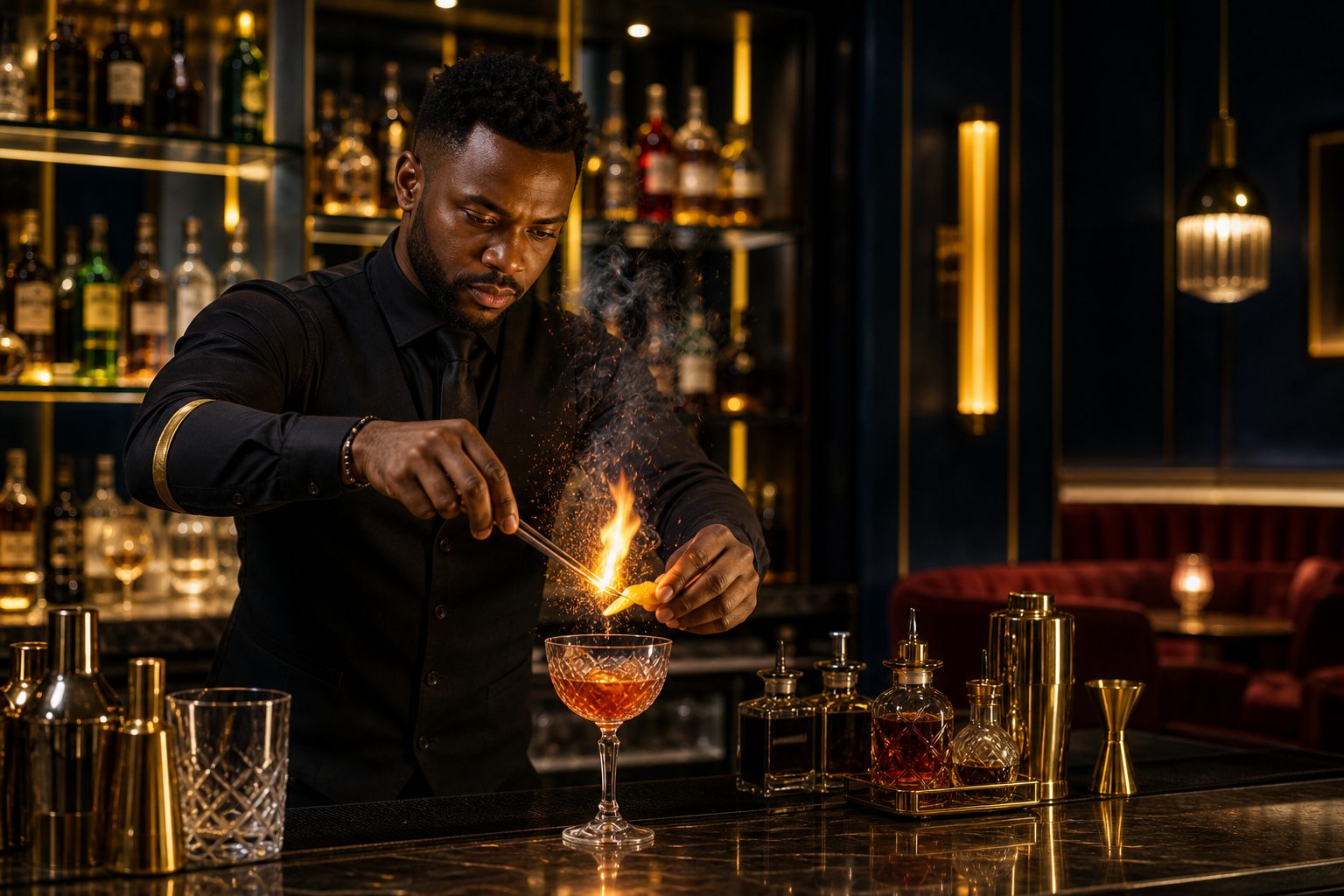
It is six in the evening. Most shops on the street are pulling down the shutters. A bar is only starting: deliveries put away, ice made, fruit cut, the lighting just set, and the first team taking up position for a working day that will end in the middle of the night. That shift in hours is not an organisational detail: it conditions almost everything about the trade.
Selling an atmosphere
You can drink at home for far less. If people still come out, they are buying something other than the contents of the glass.
That something is manufactured, and it is manufactured with very concrete parameters. Light first, which decides everything: too bright and the place becomes a cafeteria; too dim and it becomes uncomfortable. Sound next, whose volume is the least well managed variable in the trade — a level that prevents conversation empties a room more surely than bad service. Density last: a half-empty bar looks like a failure, a saturated one becomes unpleasant; furniture and circulation exist precisely to create zones that fill in a certain order.
Add temperature, smell, the cleanliness of the toilets — on which a customer forms a final judgement — and the way someone is greeted in the first ten seconds. None of these appears on the list. All of them decide whether a customer stays one hour or three.
The bar is a stage
This is what sets a bar apart from almost every other food and drink trade: the customer watches what they are about to consume being made.
That changes the nature of the work. Consistency of movement becomes visible; the cleanliness of the station becomes an argument; how you measure, shake, pour and clean between drinks is part of the product. A professional behind a bar works facing forward, under observation, while holding a conversation, keeping an eye on the room and memorising several orders.
Hence the importance of an invisible but rigorous organisation: every bottle in a fixed place, tools permanently within reach, ice accessible without moving, glassware ready by family, fruit cut in advance, house preparations labelled and dated. A well-designed bar is recognisable by the fact that the bartender does not take three steps for one glass.
The list follows the same logic. An over-long drinks list ties up stock, multiplies rarely ordered lines and slows every order. A tight list, built around a limited number of bases, allows better buying, faster training and quicker service at busy hours.
Stock is an asset
This is a major economic difference from restaurants: a bar's raw material does not rot.
An unopened bottle keeps. That sounds comfortable, and it actually creates two specific problems. First, capital tied up: a wall of bottles impresses the customer but represents money asleep, sometimes for months. Second, leakage: in a trade that serves by the glass, the gap between what left the stock and what was rung up is the classic loss — over-pouring, breakage, unrecorded comps, till errors.
Hence practices every serious venue shares: regular rather than annual stocktaking, measured rather than estimated pours, systematic recording of anything given away or discarded, and yield tracking per bottle. These controls do not express distrust of the team: they simply make visible what would otherwise never be seen.
What the French activity classification says illuminates the positioning: beverage serving establishments cover the preparation and serving of drinks for consumption on the premises — bars, cafés, and nightclubs where beverage service is the main activity. Reselling packaged drinks belongs to retail instead, and nightclubs where drink is not predominant belong to recreational activities. The same venue can therefore change category according to what it actually does, with the regulatory consequences that follow.
A team living in reverse
Working nights is not working days at different hours.
Shifted hours disrupt sleep, complicate social and family life, and make recruitment harder. Evening service is also physically demanding: you stand, you carry, you speak loudly, you manage end-of-shift tiredness at the exact moment the room needs the most attention.
The guidelines adopted in 2017 by the International Labour Organization on decent work in the tourism sector — which covers hospitality and catering — describe a sector that creates many jobs and is made up mostly of very small businesses, but is marked by atypical hours, night and weekend work, heavy seasonality and high staff turnover.
For a venue the translation is concrete: rotas announced in advance, a fair rotation of closing shifts, real breaks, a safe way home after a night service, and serious training for newcomers rather than learning on the job on a busy night.
Serving alcohol carries responsibility
This is the responsibility that distinguishes a bar from any other drinks business, and it deserves to be looked at squarely.
The World Health Organization estimates that around 2.6 million deaths were caused by alcohol consumption in 2019 — 1.6 million linked to noncommunicable diseases, 700,000 to injuries and 300,000 to communicable diseases — with mortality very unevenly distributed between men and women. It further estimates that around 400 million people, or 7% of the world's population aged 15 and over, lived with alcohol use disorders, including 209 million with dependence. It notes that alcohol consumption carries health risks even at low levels, and that most harm comes from heavy or continuous drinking.
A publican is not there to do public health, and an article introducing a trade is not there to give medical advice: anyone with a concern should speak to a health professional. But running a bar means running an activity that states regulate everywhere, precisely because of these stakes. WHO has grouped under its SAFER initiative the measures it considers most effective, among them controlling availability, countering drink-driving, restricting marketing and using taxation.
What that means at the counter is simple and belongs to the trade: knowing and applying local rules on minimum age, permitted hours and conditions of sale; knowing how to stop serving someone visibly in difficulty; offering water and a genuine non-alcoholic range, which is now an expectation rather than a courtesy; offering something to eat; and caring about how customers get home. A venue that does this does not lose custom: it earns the trust of the custom that returns.
The concrete obligations — licence or operating permit, minimum age, closing hours, compulsory notices, staff training — vary sharply from country to country and often from one municipality to another. It falls to every operator to check what applies locally before opening.
A bar's hygiene, which is not obvious
It is easy to imagine there is no food safety stake where nothing is cooked. That is a mistake.
The five food safety principles published by the World Health Organization — keep clean, separate raw and cooked, cook thoroughly, keep food at safe temperatures, use safe water and raw materials — apply to a bar very precisely. Ice is a food: it is made with safe water, stored covered and handled with a scoop, never with the glass or the hand. Fruit cut in advance is a fresh product, kept cold and dated. House preparations — syrups, infusions, purées — are perishable and must be labelled. Glassware passes from mouth to mouth and needs real washing. And hands both take payment and prepare drinks.
What brings people back
A bar is rarely chosen for a single product. It is chosen as a whole: the atmosphere at the hour you come, the welcome, the consistency of the drinks, the relationship between what you pay and what you experience, and the feeling of belonging there.
Consistency counts as much as in restaurants, but it applies to different things: the same atmosphere on a Thursday as three weeks ago, the same welcome whether you come alone or as a party of eight, the same drink whoever is behind the bar. A venue that changes personality every six weeks wears out its regulars.
Presenting a bar or lounge
A customer decides on very little information, and almost always looks for it online, often on the evening itself.
A professional presentation gives the name of the venue and its character in one honest sentence — cocktail bar, lounge, music bar, neighbourhood bar — what you serve, including the non-alcoholic range and food if you offer it, the address and a landmark, the real days and hours, whether there is a terrace or outdoor space, the capacity, whether a table can be booked or an area hired privately, your programming if you have any, contact details and the payment methods accepted.
Three pieces of information weigh especially heavily in this trade. Last service times, which customers look for first and rarely find. Group bookings: a birthday for twelve is a whole evening, and it is decided on how easily an answer is obtained. And photographs taken in the evening, in the venue's real light: a daytime picture of a lounge says nothing about what the customer is coming for.
In short
A bar is a business of atmosphere working out of step with the city. Its success rests on a controlled space, a bar organised under the customers' gaze, closely tracked stock, a team that accepts difficult hours, and an accepted responsibility for what is served and to whom.
Licences, permits, minimum ages and closing hours vary sharply between countries and municipalities: local rules always govern, and must be checked before opening. What does not vary is what the customer comes for: an evening they will remember, somewhere they feel properly received.
Do you run a bar or lounge? Set out your real hours, your atmosphere, your list and how to book: that is what people look for before choosing where to spend the evening.