
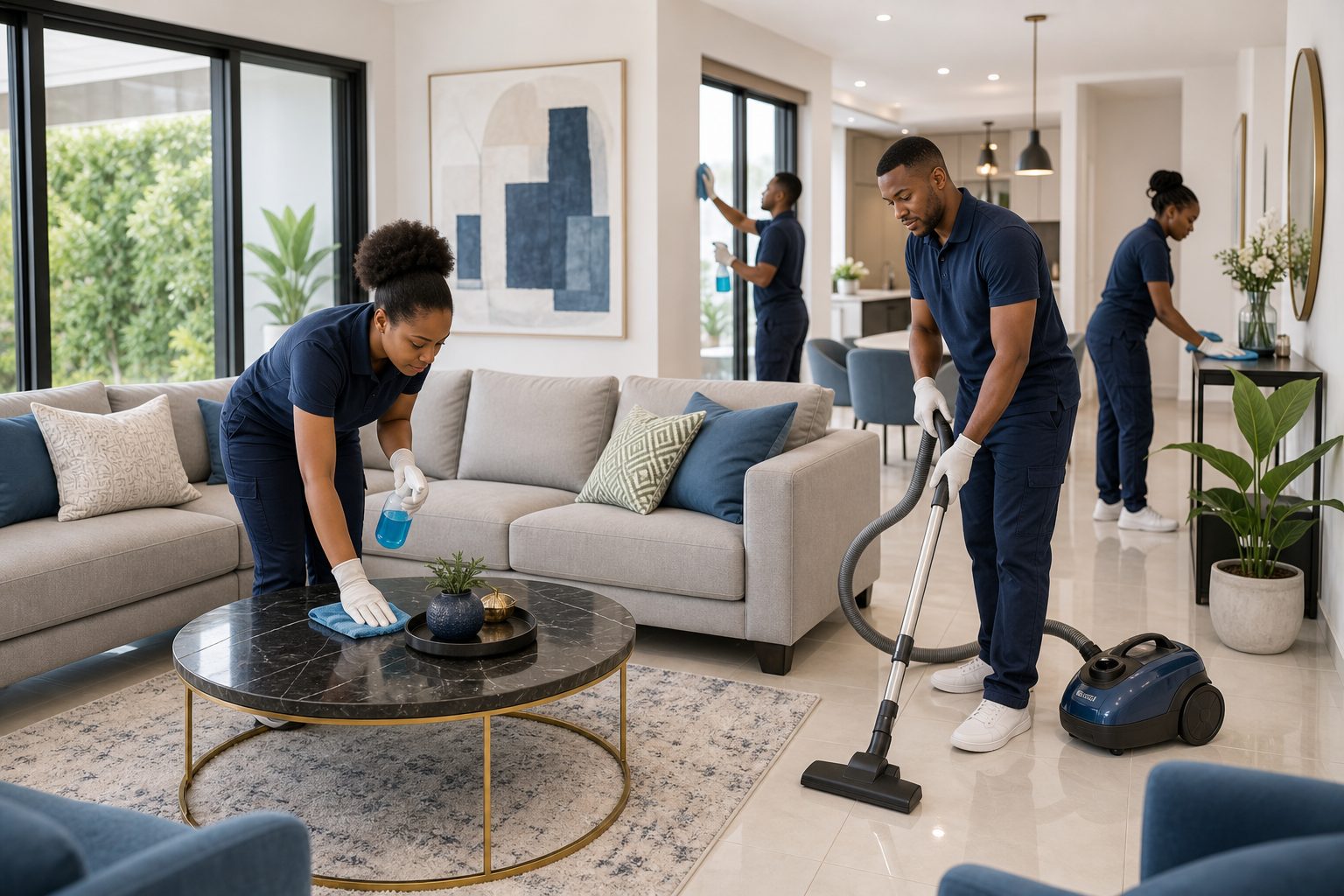
A client rarely calls to say "my house is dirty". They call because they have run out of time, because a baby has just arrived, because they are entertaining on Saturday, or because the person who used to come no longer does. The need is real but poorly formulated — and that is where the work begins.
What "cleaning" covers, and what it does not
The word misleads because it seems obvious. It is not: two clients asking for "a clean" often expect two different things.
The usual core is stable: floors, surfaces, bathrooms, kitchen, dust, bins. Around that core sit services that must be named, because they take time and therefore cost money: glazing, ironing, cleaning inside appliances, cupboards, terraces, tidying.
Hence the trade's most useful professional rule: what is done appears on a list, and what is not on it is added explicitly. A vague service produces the same misunderstanding every time — the client notices what is missing, the business notices what it had not sold.
The visit and the agreed list
You do not seriously price a home over the phone. The visit shows the actual floor area, the number of rooms and bathrooms, the type of flooring, how cluttered it is, the starting condition — a home left unmaintained for months is not a home under contract — and the points the client particularly cares about.
It also sets the frequency, which changes everything: a weekly visit maintains, a monthly visit catches up. These are not the same time, the same price or the same promise.
Price levels depend on the local market, the floor area, the frequency and what is included: no general scale means anything, and a price quoted before the visit is an estimate, not a quotation.
The same people, or no relationship
This is the point regular clients mention first, and it shapes how the business is organised.
Sending a different person every week forces the client to explain everything again, multiplies oversights and prevents trust from forming. Sending the same people, by contrast, requires stable schedules, geographically coherent rounds, and above all teams that stay — therefore working conditions that hold.
That has a consequence many small businesses discover late: service quality depends less on the products used than on staff turnover. A business that replaces its cleaners every three months will never be able to sell regularity.
Entering someone's home in their absence
Many regular clients are at work during visits. The service therefore requires access — a key handed over, a code, a caretaker who opens up.
That is a heavy commitment and is treated as one: knowing who holds what, recording handover and return, limiting the number of people involved, and agreeing what happens if a key is lost. A missing item at a client's home is very hard to settle without those precautions, including when the business is not at fault.
To that is added the question of insurance and liability for damage — a broken object, a floor spoiled by an unsuitable product. The cover available and the applicable obligations depend on the country and the contract: they are checked rather than assumed.
Products, equipment and surfaces
Bringing your own equipment and products is common practice, and a real selling point: the client has nothing to buy or store.
It is also a technical responsibility. Not all surfaces tolerate the same products: natural stone, wood flooring, a worktop, stainless steel, a screen, a textile are not treated the same way, and a mistake leaves a permanent mark. A professional knows their products, follows the manufacturer's instructions, does not mix them, labels them and stores them out of reach — particularly where there are children.
Equipment is maintained on the same principle: cloths washed and sorted by zone, mop heads changed, vacuum emptied. Dirty equipment does not clean, it redistributes.
Charging for time, or for a result
Two logics coexist. Charging for time on site is simple to understand but measures value poorly: a fast cleaner is penalised. Charging for a defined service — this list, in this home, at this frequency — measures what the client is actually buying, provided the list is precise.
In both cases what protects the relationship is the same: saying in advance what is included, what is extra, how an additional visit is ordered, and how the service is suspended or resumed. Cancellation, deposit and notice terms belong to the contract and the applicable law: no rule is universal.
Employing, being employed, or working for yourself
Cleaning in private homes touches a question of labour law the profession cannot ignore.
Two international instruments serve as a reference here: the Domestic Workers Convention No. 189 and the accompanying Recommendation No. 201, both adopted by the International Labour Organization in 2011. They recognise the special conditions under which domestic work is carried out and set out provisions concerning decent work for those workers.
The dividing line matters to everyone. A cleaning business that employs staff and sends them to its clients is an employer, with the employer obligations applicable in its country. A person employed directly by a household falls under a different framework. And a person working on their own account falls under a third. These situations do not carry the same rights or the same obligations, and they vary with national legislation: a serious professional finds out which one applies to them rather than improvising.
In the African context
Conditions vary sharply from one country, one city and one neighbourhood to another: there is no single African cleaning market, and the same offer does not sell the same way from one place to the next.
The first reality is the geography of the work. A small business lives on short, frequent visits, and its profitability rests on the round more than on the price: in several cities, a trip between two districts at the wrong hour costs more time than the job itself. That pushes towards densifying by area rather than accepting work anywhere, and turning down a client who is too far away beats promising them an hour that will not be kept. Transporting staff then becomes a question of organisation as much as of cost.
The second is the place of the existing offer. In many homes, that upkeep has long rested on someone the family employs itself. A business is therefore not arriving in an empty market: it offers something else — a team, cover for absence, equipment, an invoice. The International Labour Organization also documents the scale of informal employment in its statistical study on women and men in the informal economy, and cleaning is a common example. The opportunity is clear for those who structure themselves: declaring staff and issuing invoices opens access to clients — small offices, shops, landlords — who cannot contract any other way.
The third concerns material conditions. Depending on the area, dust is a permanent factor for part of the year, the rainy season transforms entrances and floors, and running water is not always continuously available. That translates into concrete organisation: planning for water, adapting frequency to the seasons rather than applying a uniform rhythm, and explaining to the client why a home gets dirty faster at certain times.
The fourth is training. The International Labour Organization has published a guide on upgrading informal apprenticeship in Africa, describing how many trades are transmitted in the course of work, alongside someone more experienced, outside formal schemes. That is precisely how many cleaners learn. A business that structures that transmission — a written method, support over the first weeks, clear rules on products — achieves stable quality without requiring a certificate.
The fifth is the client relationship, where digital genuinely changes things, unevenly across markets: instant messaging serves to agree a slot, warn of a delay or send a photograph after a deep clean, and mobile payment allows a visit to be settled without cash in the home. The International Telecommunication Union puts the share of the world's population using the Internet at 74 per cent in 2025, with 36 per cent for Africa, the lowest of the regions it measures: these channels matter where they exist, without replacing a visit or a written list.
What a cleaning business does not promise
It does not guarantee removing a stain that has been there for months, nor catching up in one visit on a home left unmaintained, nor restoring an already damaged surface, nor working on anything not in the quotation. It stands in neither for a tradesperson, nor for a textile specialist, nor for a personal care service.
What it does commit to can be checked: a visit before the quotation, a written task list, an agreed frequency, identified staff, products suited to the surfaces, serious management of access, and an invoice.
That is also what makes the business legible: a stable professional identity, a number that answers, an enquiry form, a schedule that is kept, quotations, contracts, invoices, clear payment methods and genuine reviews. No tool is compulsory, and no online presence guarantees clients.
Artificial intelligence can help prepare a task list, organise rounds, draft a standard quotation, summarise exchanges or sort enquiries. It does not see the home, does not assess the real state of a surface, guarantees no result, and does not replace the visit that precedes pricing.