
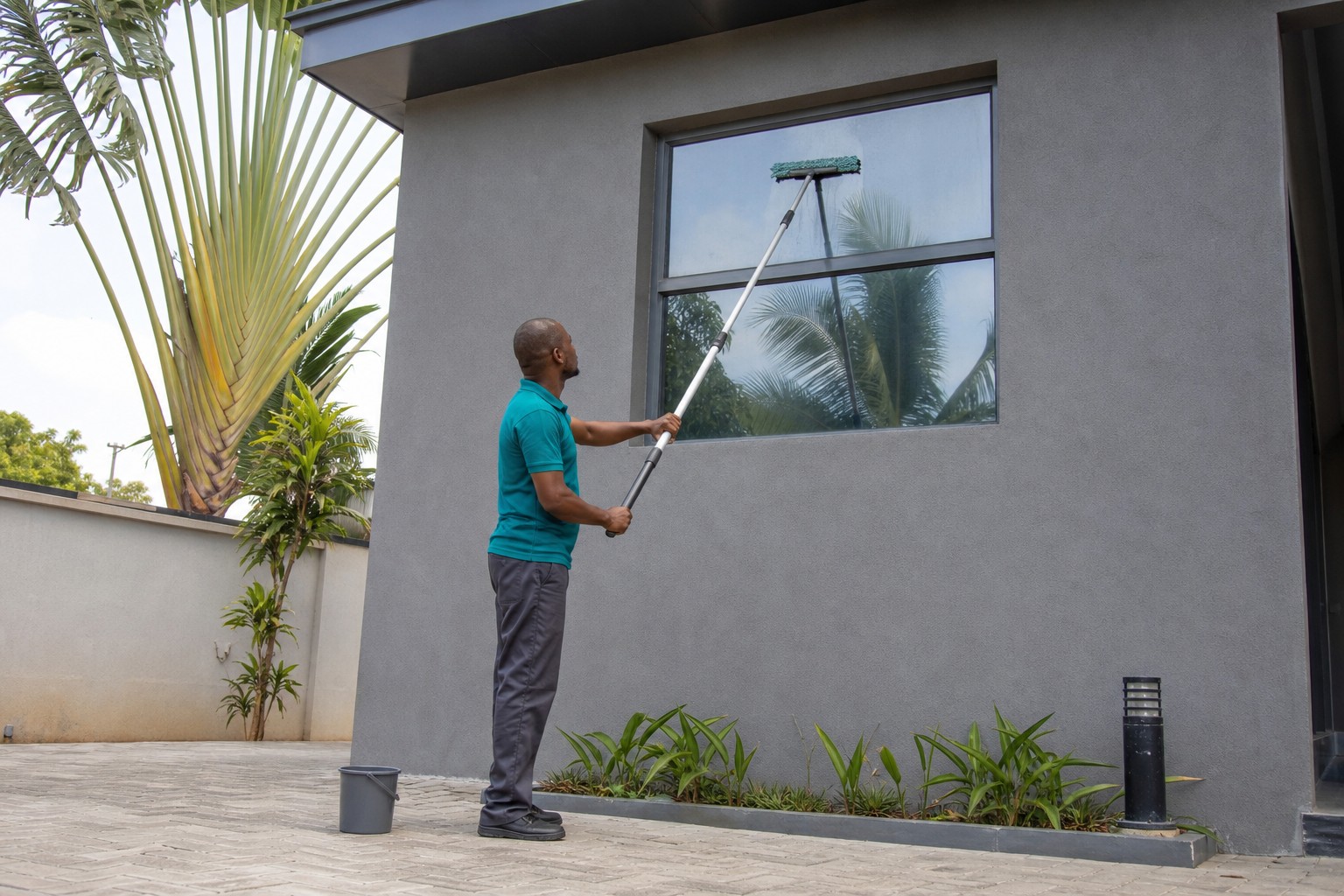
Everyone thinks they know this trade, because everyone has cleaned a window. That is exactly why it is usually done badly: the gestures that feel natural — scrubbing, wiping, going over it with a cloth — are precisely the ones that leave a film.
Technique, water, order of passes
Three things produce genuinely clean glazing, and none of them is spectacular.
The technique first: wet the surface to lift the dirt, then remove the loaded water in one continuous squeegee pass, wiping the blade between passes. What matters is taking the dirt off the glass, not moving it around.
The water next, the most frequent cause of poor results. Water heavy in minerals dries leaving a white film, especially on glazing exposed to the sun. Treated water avoids that deposit.
The order last: top to bottom, outside then inside or the reverse depending on exposure, and never returning to a surface that has already dried. You finish with frames and sills, because dirty water running back down clean glass undoes the work.
Why a cloth leaves a film
This is the trade's central misunderstanding, and it is worth explaining to the client.
A cloth absorbs some of the water and redistributes the rest, along with the dirt it already holds. It leaves a thin film, invisible while the light is diffuse and perfectly visible in raking light. Going over the glass with a cloth after the squeegee therefore cancels the squeegee's benefit.
The practical corollary: the result is checked in raking light, standing at an angle, not face on. A professional checks that way before leaving, because that is the position from which the client will look.
Looking at the glass before cleaning it
Glazing is not a neutral surface: it carries the history of what has been done to it, and part of that history cannot be corrected.
Before starting, a professional therefore notes what is already there: scratches, fine scoring from a badly used scraper, mineral deposit etched in by years of sprinkler water or loaded rainwater, adhesive film peeling or yellowed, degraded seals, misting between the panes of a failed double-glazed unit. None of those defects is a matter of cleaning, and all of them will be visible afterwards.
Reporting them before the work protects both sides. Without that, the client naturally attributes to the cleaner whatever they discover on a finally clean pane — and the argument becomes impossible to win. A few photographs taken before starting are usually enough to make it unnecessary.
Height: what is taken on and what is refused
This is where the trade involves a safety decision, and where a professional stands out by saying no.
Working from the ground with a telescopic pole allows moderately high glazing to be reached without leaving stable footing. Beyond that, suitable means of access are needed — a powered platform, scaffolding, or rope access — which require equipment, inspections and people trained in those techniques.
The applicable principles are set internationally. Convention No. 167 of the International Labour Organization on safety and health in construction, adopted in 1988, and the code of practice that accompanies it address work at height, lifting appliances, means of access, protective equipment and the need for competent personnel. These texts do not apply only to building sites: their logic — a suitable means of access, inspected, used by someone trained — is exactly that of glazing unreachable from the ground.
In practice, the line holds in two ways. You do not lean a ladder against a façade to gain a metre. And when a job goes beyond what can be done safely, you say so and point the client to a properly equipped firm rather than take the order. A refused job costs less than a fall.
The precise obligations — training required, inspections, equipment, any authorisations — depend on the country and the applicable regulations: they are checked locally.
Homes, shopfronts, access
The three situations do not call for the same organisation.
In a private home, the difficulty is internal access: someone must be there or a key must be entrusted. The outside can often be done without anyone present, which makes the service easy to schedule.
For a shopfront, the issue is the hour: the work is done before opening, because a window display is judged on the customer's first impression and you do not clean in front of them. The frequency is short and regular, and the service is worth mainly for its regularity.
In both cases you check before coming what determines the work: a water point, room to manoeuvre, the type of frames, the presence of grilles or insect screens — which completely change the time needed — and the starting condition, since glazing never cleaned for years needs a longer first visit.
Pricing by area, announced beforehand
The most readable pricing is based on what can be counted: the number and size of panes, accessibility, the presence of grilles, the starting condition, and travel.
What protects the relationship is measuring before pricing, and announcing the price before working. An extra discovered mid-job — a grille to remove, a bay larger than expected — is handled by calling, not by adding a line to the invoice.
Price levels depend on the local market, the glazed area and accessibility: no general scale means anything. Deposit terms, postponement in the rain and cancellation belong to the contract and the applicable law.
In the African context
Conditions vary sharply from one country, one city and one season to another: there is no single African context for this trade, and a building's immediate surroundings change the work more than its size does.
The first reality is dust. In several cities, for part of the year, glazing takes on a fine deposit within days, particularly beside unsurfaced roads or during the dry season. That shifts the economics towards a subscription rather than an isolated job: a monthly visit does not mean the same thing as a visit every six months, and clients notice quickly.
The second is water. Where mains water is heavily mineralised or supply irregular, the white film on drying becomes the dominant problem, and treated water stops being a refinement and becomes the condition of the result. Carrying one's own reserve then becomes basic equipment.
The third is the building fabric. Security grilles, insect screens, metal shutters, exposed aluminium frames: these are common and they lengthen the work considerably. Including them in the pricing — rather than discovering them on site — avoids misunderstandings, and knowing how to work around them without damaging them is a skill in itself.
The fourth is safety at height, and it is where this trade gains most from professionalising. Where suitable means of access are costly or scarce, the temptation to improvise with a ladder or a makeshift support is real. A professional who states their limit clearly, explains it to the client and refers them to an equipped firm protects their operators and builds a reputation on that refusal.
The fifth is how the activity is structured. The International Labour Organization documents the scale of informal employment in its statistical study on women and men in the informal economy, and window cleaning is a common example: it is practised door to door with a bucket as much as within equipped businesses. That coexistence opens a clear opportunity: shops, offices, hotels and buildings look for a regular, identifiable and insured provider, which strongly favours whoever invoices and keeps a schedule. Digital contributes unevenly across markets — messaging allows a photograph of the façade to be received before pricing and a pre-opening slot to be agreed, and mobile payment settles a visit without cash. The International Telecommunication Union puts the share of the world's population using the Internet at 74 per cent in 2025, with 36 per cent for Africa, the lowest of the regions it measures: these channels matter where they exist, without replacing measuring on site.
What a window cleaner does not promise
They do not guarantee removing a scratch, glazing etched by sand, degraded adhesive film or a mark trapped between two panes, nor how long exposed glass will stay clean, nor work beyond what they can safely reach, nor keeping an appointment in rain or strong wind. They stand in neither for a glazier, nor for a work-at-height contractor, nor for a professional qualified for what the regulations reserve to them.
What they do commit to can be checked: measuring before pricing, a price announced before the work, a method with no final cloth, suitable water, a clear height limit, a check of the result in raking light, and an invoice.
That is also what makes the business credible: a stable professional identity, a number that answers, real work in photographs, slots that are kept — particularly before opening for shops —, explained prices, a receipt and genuine reviews.
Artificial intelligence can help prepare a quotation from a survey, organise rounds, draft subscription reminders or sort enquiries. It does not see the façade, does not assess a window's real accessibility, does not judge whether a job is safe, and does not replace the visit that precedes the commitment.