
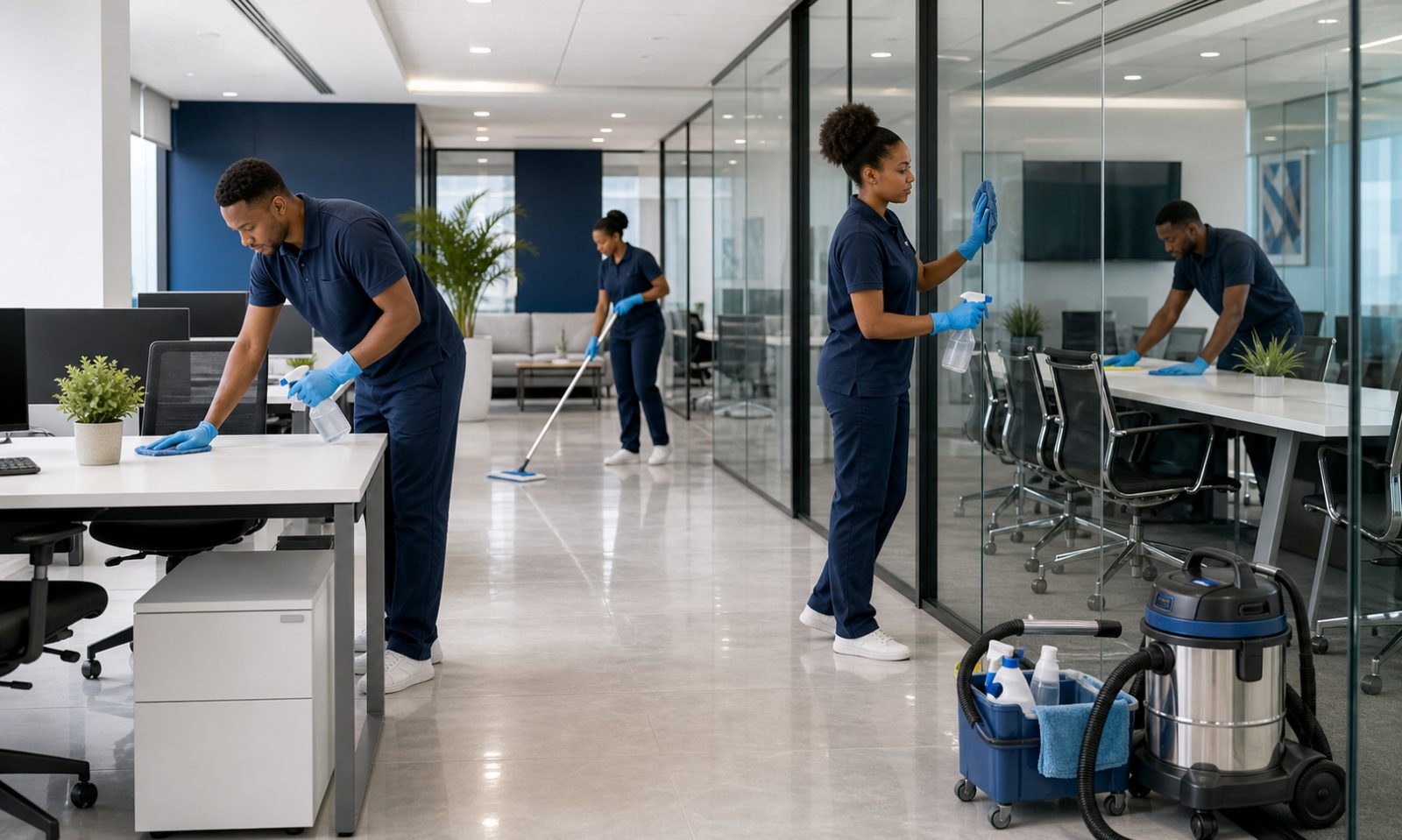
A manager does not judge their cleaning provider on what they see being done, since they never see the work. They judge it on the state of the offices in the morning, on the washrooms at midday, and on what happens the week a cleaner is absent. The whole trade consists in holding those three things.
A contract, not a job
The difference from one-off cleaning is structural. A visit restores a standard; a contract maintains one.
The contract fixes what should not be renegotiated every week: the scope by zone, the frequency of each task — some daily, some weekly, some periodic —, the hours of intervention, how access works, the number of staff, the point of contact on each side, what is included and what is ordered as an extra.
That precision protects both parties. Without it, the client compares what they see with what they imagined, and the provider defends work nobody ever wrote down. Price levels depend on the floor area, the frequency, the hours and the local market: no general scale exists, and a quotation without a visit is an estimate.
The site visit before the quotation
It measures what no stated floor area reveals: the number and state of the washrooms, the type of flooring, the density of occupation — thirty people in two hundred square metres do not soil like ten —, the eating areas, the internal glazing, the circulation routes, the service access, where equipment can be stored, and whether there is a water point.
It also establishes the client's operating constraints: what time they open, who locks up, whether there is a caretaker, an alarm, restricted areas, confidential documents left on desks. Those points determine feasibility as much as the floor area does.
Working outside opening hours
This is the trade's rule rather than an option: a shop is not cleaned while it is serving customers, and an office is cleaned badly between people who are working.
That imposes a particular organisation. Teams early in the morning or in the evening, therefore working hours that must remain sustainable and compliant with the applicable regulations. Journeys at hours when transport is scarcer. Management of keys, codes and alarms that engages the provider's liability. And real autonomy for the staff, since nobody on the client's side is there to arbitrate.
It is also what makes recruitment and retention decisive: a business that cannot keep its staff will not hold a night schedule.
The service log: proof that it was done
Since the work is invisible, it must be traceable. A service record — on paper or digital, depending on the business — logs the date, arrival and departure times, the zones covered, the periodic tasks carried out, any anomalies observed and the name of the person who attended.
That document serves three purposes. It lets the client know what was done without having to ask. It lets the provider answer a complaint with a fact rather than an assertion. And it reveals slow drift — a periodic task skipped twice running — before it becomes grounds for termination.
It also serves to report what is outside the provider's remit: a leak, a dead bulb, a faulty lock, a broken dispenser. A provider who passes that on becomes useful beyond its own scope.
Sensitive zones and institutional sites
Schools, medical practices, laboratories, government offices, catering areas: these sites impose stricter protocols and, often, formal traceability.
One principle must be understood before any protocol: cleaning and disinfecting are not the same operation, and the order matters. The World Health Organization's guidance on the cleaning and disinfection of environmental surfaces sets the order of operations: cleaning comes before disinfection. Applied to a dirty surface, a disinfectant does not produce the expected effect.
In practice, a provider therefore distinguishes frequently touched surfaces from ordinary ones, follows an order of progression that avoids recontaminating what has just been treated, separates equipment by zone — washroom equipment does not go into the offices — and follows the manufacturer's instructions for each product. The precise regulatory requirements applying to a given site depend on the country, the type of establishment and the competent authority: they are checked with the client and against local rules, not inferred.
Consumables, washrooms and restocking
Washrooms are where a contract is judged fastest, and consumables are what always run out at the wrong moment.
Many contracts include supplying and restocking paper, soap and bags, with stock monitoring. That is a service in its own right: it spares the client recurring purchases, and it spares the provider finding an empty dispenser on a Monday morning.
Water deserves particular attention, because it is both the working tool and a health matter. The World Health Organization points out that microbial contamination of faecal origin is the greatest risk to drinking-water safety, and promotes a water safety plan approach from catchment to consumer. For a provider that translates modestly but concretely: knowing where the water used comes from, maintaining tanks where there are any, and flagging any doubtful water point to the client rather than working around it.
Staff: assigned, covered, trained
Three commitments separate a contract that lasts from one lost after a year.
Assigned: the same people on the same site, because they come to know the sensitive zones, the instructions and the client's habits.
Covered: an absence is covered the same day, not the following week. That requires an organised reserve and a written method a stand-in can follow without ever having seen the premises.
Trained: on products and surfaces, on the order of operations, on protective equipment, and on the discretion expected in premises where confidential information circulates.
In the African context
Conditions vary sharply from one country, one city and one type of client to another: there is no single African market for premises cleaning, and a contract is not built the same way everywhere.
The first reality is the structure of demand. Depending on the market, solvent and regular clients are concentrated among companies, banks, international organisations, government bodies, clinics, private schools, shops and office buildings. These clients require invoices, sometimes certificates, often a tender — which strongly favours established providers. The International Labour Organization documents the scale of informal employment in its statistical study on women and men in the informal economy, and cleaning is one example: the coexistence of formal and informal work is real, but it places formalisation on the side of market access, not only of compliance.
The second is access and hours. In several cities, travel times at the start and end of the day weigh heavily on teams who must be on site before opening. That steers recruitment towards geographical proximity, and makes team transport a question of organisation as much as of cost.
The third is water and electricity. Where supply is not continuous, a team arriving before dawn may find a site without water or without enough light. Experienced providers keep a reserve, adapt the order of tasks and tell the client rather than leaving an incomplete job unexplained.
The fourth is the nature of the building and its environment. Dust for part of the year, the rainy season, heavily used lobbies, exposed glazing: the useful frequency is not the same across sites and seasons. A provider who adapts the schedule to the period rather than applying a uniform rhythm delivers better service at equal cost.
The fifth is an opportunity for professionalisation. The service log, consumable tracking and anomaly reporting turn an interchangeable supplier into a useful counterpart. Digital helps unevenly across markets: instant messaging allows an anomaly to be reported with a time-stamped photograph, and digital payment simplifies recurring invoicing. The International Telecommunication Union puts the share of the world's population using the Internet at 74 per cent in 2025, with 36 per cent for Africa, the lowest of the regions it measures: these tools matter where they exist, without replacing a log that is actually kept.
What a cleaning provider does not promise
It does not guarantee cleanliness between two visits, nor the repair of what is broken, nor the restoration of a degraded floor covering, nor a measurable sanitary outcome, nor work in areas it is not given access to. It stands in neither for the building's technical maintenance, nor for a disinfection provider where that is required, nor for the competent authorities.
What it does commit to can be checked: a visit before quoting, a contract setting out zones, tasks and frequencies, agreed hours, identified staff, a service log, consumable tracking and an invoice.
That is also what makes the provider credible: an identifiable business, a reachable contact who decides, real references, written contracts, invoices, serious management of keys and access, and genuine reviews. No tool is compulsory.
Artificial intelligence can help build a cleaning plan by zone, prepare a log template, organise schedules, summarise complaints or track consumption. It does not see the premises, does not establish that a task was done, does not replace an on-site check, and does not decide which protocols apply to an establishment.