
"Can you get that out?" The client points to a stain, often an old one, often on pale fabric. The honest answer is almost never yes or no: it depends on the fibre, on what the stain is, on its age, and on what has already been tried on it. That diagnosis is the real substance of the trade.
A material you can damage permanently
A badly cleaned floor can be done again. A badly cleaned textile cannot.
Three mistakes are irreversible. The wrong product on the wrong fibre: discolouration, stiffening, loss of body. Too much water without sufficient extraction: watermarks on drying, adhesive that lets go, odour that settles in. Excessive friction: matted or pilled fibres, localised shine that cannot be recovered.
That is why this trade is not an extension of housekeeping. It works on a material that reacts, in an object the client keeps for years and which often costs more than the service.
Diagnosis: fibre, stain, history
Before any product, you identify. The fibre first — the care label where there is one, appearance and touch otherwise — because a synthetic and a natural fibre are not treated the same way.
Then the stain: what is it, how long has it been there, what temperature has it been exposed to, and above all what has already been tried on it. A household product applied by the client the previous week completely changes the prognosis, sometimes permanently.
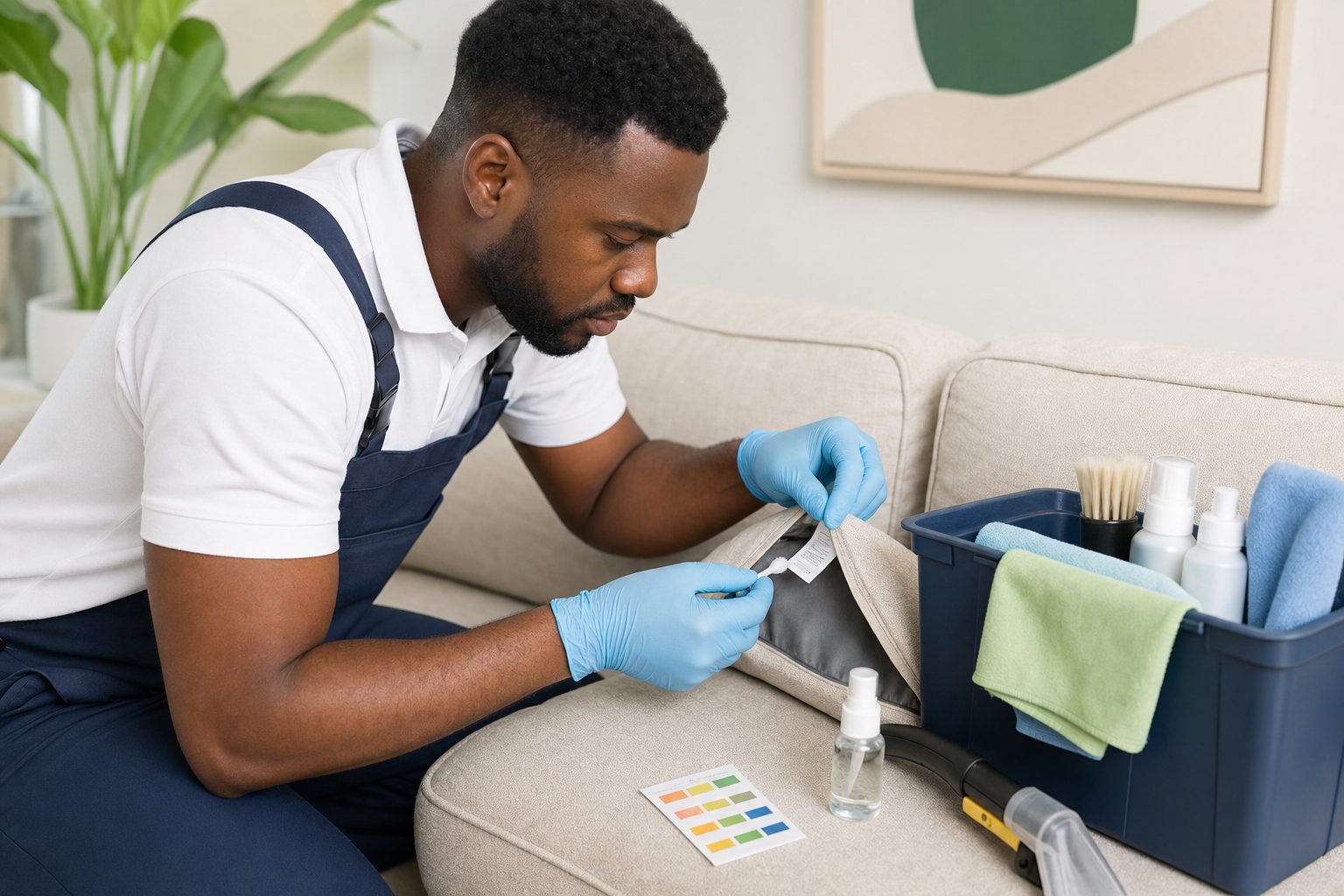
Finally the hidden-area test: under a seat cushion, behind a backrest, on a hem. You apply, you wait, you check that the colour does not move and the fibre does not react. That test takes a few minutes and avoids the accident.
You also look at the object itself: seams, filling, frame, the foam inside a mattress. A tired sofa may not withstand a deep treatment, and it is better to say so.
Stating the limits before starting
This is the professional practice that defines the trade, and it is commercially counter-intuitive: you announce what will not come out before being paid.
Some marks are permanent — bleaching, burns, dyes that have migrated into the fibre, old stains deeply set. A professional identifies them, explains, and offers what is genuinely achievable: an even, freshened whole rather than a promised disappearance.
That honesty has direct economic value. A service sold on an impossible promise ends in dispute, refund and a bad review; a service sold on an achievable result ends in a recommendation.
Method, products and protection
The dominant technique is extraction: a solution is injected, left to act for the intended time, then drawn back out with the soiling. What matters is less the machine than the dilution, the contact time, control of how much water goes in, and the quality of the final extraction.
The products used are professional chemicals and are treated as such. The international reference here is the chemicals convention adopted in 1990 by the International Labour Organization, together with its accompanying recommendation. It deals with labelling and classification, safety data sheets, employer obligations, information and training for workers, and the protection to be made available to them.
Translated into a workshop or a van: products labelled and stored, never decanted into an unmarked container, never mixed together, used at the manufacturer's dilution, with the protection the data sheet specifies and adequate ventilation in a closed room. Children and animals are kept away during the work.
Drying decides the outcome
A clean but badly dried textile becomes a problem within days: odour, watermark, microbial growth.
The World Health Organization devotes indoor air quality guidelines to dampness and mould. They point out that persistent dampness encourages microbial growth indoors, and associate that dampness with increased prevalences of respiratory symptoms, allergies and asthma. The principal recommendation there is preventing and reducing persistent dampness.
For the technician that imposes precise habits: extract as much as possible rather than relying on evaporation, ventilate the room, use a fan or a dehumidifier where possible, and state a time before the item can be used again rather than letting the client sit back down that evening. That time depends on the thickness, the fibre, the ventilation and the climate: it is estimated on site, not stated as a rule.
On site or in the workshop
The choice is technical, not commercial. A fixed sofa, a mattress, a glued carpet are treated on site. A rug is often better handled in the workshop, where it can be washed flat, rinsed thoroughly and dried in good conditions.
Working on site requires minimum conditions to be checked before coming: access, a power socket, a water point, room to manoeuvre, the ability to ventilate. Working in the workshop requires collection, identified storage and return — therefore traceability, because an entrusted rug is a valuable item.
What is charged, and what is not
Pricing follows the reality of the work: the area or number of seats, the starting condition, the fibre, the time on site, travel, any collection. Price levels depend on the local market and the actual condition: no general scale means anything, and a price given over the phone remains an estimate.
A common practice is not to charge for a diagnosis that concludes the work is not worth doing, or not to charge if the announced result is not achieved. That is a strong commitment and it is honoured: it is stated beforehand, written down, and does not turn into a discussion afterwards. Deposit, cancellation and refund terms belong to the contract and the applicable law, never to a universal rule.
In the African context
Conditions vary sharply from one country, one city and one season to another: there is no single African context for this trade, and the local climate alone is enough to change the method.
The first reality is humidity and drying. Depending on the region and the season, the ambient air is already heavy with moisture, which markedly lengthens drying time and makes extraction — more than injection — decisive. A technician working in the rainy season does not promise the same timings as in the dry season, and gains from saying so rather than discovering it alongside the client.
The second is dust. In several cities, a significant share of the soiling in fabrics comes from fine, abundant dust for part of the year. That steers the work towards serious mechanical dust removal before any injection: wetting dust produces mud in the fibre, and the result is worse than before.
The third is the relationship to the object. Where a sofa or a rug represents an investment kept for a long time and passed on, demand is more about restoration and extending life than about replacement. That is a real opportunity for a repair-and-maintenance trade: a professional who extends a piece of furniture's life creates measurable value for their client.
The fourth is access and equipment. Depending on the home, a power socket, a water point and room to manoeuvre are not a given, and the electricity supply is not always continuous. Checking those conditions when booking avoids a wasted journey; having an alternative avoids a cancellation.
The fifth is training and structuring. The International Labour Organization has published a guide on upgrading informal apprenticeship in Africa, describing how many trades are transmitted in the course of work, alongside someone more experienced. Many textile technicians learn that way. An opportunity attaches to it: in a trade where a mistake is visible and permanent, whoever can explain their method, show past work and state their limits stands out immediately. Digital helps unevenly across markets — messaging serves to receive a photograph of the stain before the appointment, which improves the preliminary diagnosis, and mobile payment settles the bill at the door. The International Telecommunication Union puts the share of the world's population using the Internet at 74 per cent in 2025, with 36 per cent for Africa, the lowest of the regions it measures: a photograph helps where that channel exists, without ever replacing the hidden-area test.
What a textile technician does not promise
They do not guarantee that an old stain will disappear, nor that an altered colour will return, nor an identical result on two different fabrics, nor a drying time independent of climate and ventilation, nor that an already weakened piece will hold. They stand in neither for an upholsterer, nor for a dyer, nor for a furniture restorer.
What they do commit to can be checked: a diagnosis carried out before any application, a hidden-area test, limits stated before starting, a method suited to the fibre, products used according to their data sheet, careful extraction, a stated drying time and instructions for putting the item back in use.
That is also what makes the business credible: real and recent work in photographs, with the limits owned, a number that answers, prices explained by range, a receipt, clear payment methods and genuine reviews.
Artificial intelligence can help prepare a quotation, sort references of fibres and treatments, draft care instructions or organise rounds. It does not identify a fibre remotely, does not know what has already been applied to a fabric, does not replace the hidden-area test and guarantees no result.