
The request often arrives in a hurry: a case of illness in a company, premises being taken back, a landlord demanding action, an announced inspection. The client wants reassurance fast. The professional knows that what will genuinely reassure is not what impresses.
Clean first, disinfect afterwards
This is the trade's founding principle, and it is counter-intuitive for many clients: disinfection does not replace cleaning, it follows it.
The World Health Organization, in its guidance on the cleaning and disinfection of environmental surfaces, points out that surfaces must be cleaned before being disinfected. The reason is simple: soiling, organic residue and greasy films neutralise the product or stop it reaching the surface. A disinfectant applied to a dirty surface spends its action on the dirt.
The practical consequence is that prior cleaning is part of the service. It is not a box to tick or an extra: it is what makes the following operation useful. A provider offering to disinfect without cleaning is selling an appearance.
Dilution, contact time, surface
Three parameters determine effectiveness, and none of them can be guessed.
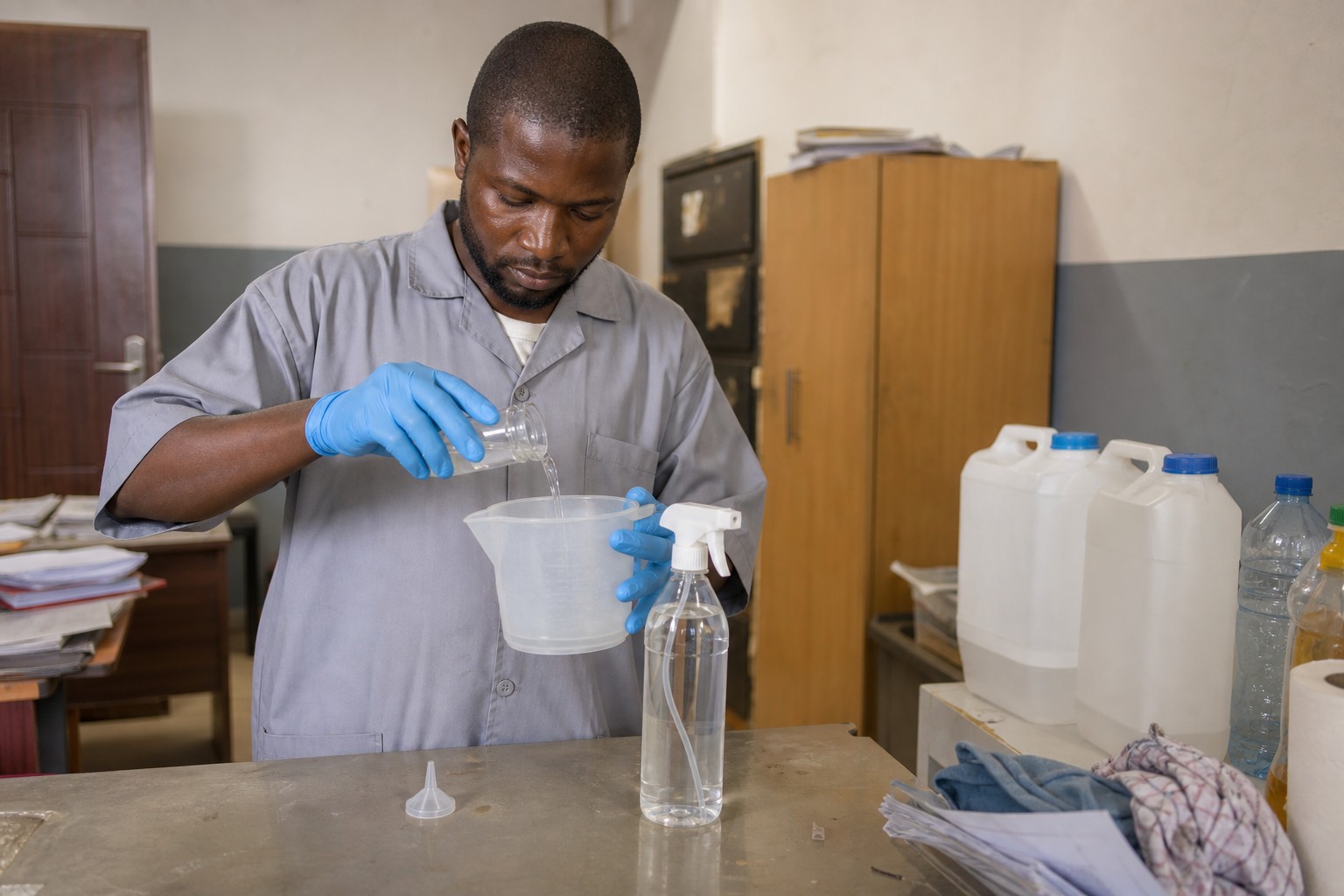
Dilution is measured. It is read on the manufacturer's documentation and prepared with a measuring jug, not by eye. Overdosing improves nothing: it damages surfaces, increases people's exposure and costs more.
Contact time is the figure that rushed jobs ignore. A product needs to remain wet on the surface for a period defined by its manufacturer. Wiping too early cancels the operation.
The surface, finally: not all are treated the same way. A food preparation worktop, a screen, a textile, stainless steel, varnished wood, a child's toy call for different products and precautions. A surface damaged by an unsuitable product is harm, not a side effect.
These values — dilution, duration — belong to each product and each situation. They are read on the manufacturer's data sheet and checked against the rules applicable to the site; they do not transfer from one job to another, and no general figure has any value here.
Products: authorisation, labelling, data sheets
A disinfection provider handles professional chemicals, and that imposes a framework.
Convention No. 170 of the International Labour Organization, adopted in 1990 with Recommendation No. 177, deals precisely with safety in the use of chemicals at work. It covers the classification and labelling of products, safety data sheets, employer responsibilities, information and training for workers, and appropriate protective equipment.
Translated into daily practice: use only products authorised in the country of operation for the intended use, keep their safety data sheets and make them available to operators, never decant into an unmarked container, never mix two products — some combinations release dangerous gases —, store under cover and out of reach, and train every operator before sending them out alone.
The choice of product follows its authorisation and its instructions, not a preference: which is why an article like this one names none and gives no dilution.
Protecting occupants
A successful job is one after which people can safely come back.
That means announcing beforehand — not afterwards — what will happen: which rooms are treated, at what time, how long the premises must stay unoccupied, what needs to be put away or covered, and what to do on return. Food, crockery, toys and personal effects are protected or removed.
The re-occupancy time depends on the product, the application method, the volume and the ventilation. It is established from the product's documentation and announced precisely for the job concerned. Proper airing is an integral part of it.
Vulnerable people — young children, older people, people with respiratory conditions — and pets deserve explicit attention, which means asking before the job rather than discovering it on site.
Protecting the operator
This is the most exposed person, and often the least protected.
The equipment depends on the product and the method: it is specified on the safety data sheet and is actually worn, including for a small area. Ventilating the room during application, limiting exposure time, having a water point available for rinsing, and a course of action in case of splashing are part of the minimum. Training beats habit: an operator who knows why they wear equipment still wears it on the tenth job.
The intervention report
This is the deliverable that marks out a professional provider, because it is the only thing that remains.
It records the date and times, the premises and surfaces treated, the method used, the products used and their dilution, the contact time observed, the re-occupancy delay announced, any observations, and the name of the person who attended.
That document serves the client well beyond peace of mind: it is what a landlord, an insurer, an employer or an inspection may ask for. A photograph of fog does not replace a report, and a provider who issues nothing in writing leaves their client stranded the day proof is required.
What disinfection does not replace
A one-off disinfection does not correct a permanent cause. Poorly maintained washrooms, a leak, absent ventilation, badly managed waste storage or doubtful water will recreate the problem within days.
Water deserves a mention here. The World Health Organization points out that microbial contamination of faecal origin is the greatest risk to drinking-water safety, and promotes a water safety plan approach from catchment to consumer; it also notes that storage containers can become breeding grounds and that covering them reduces that risk. A serious provider therefore reports what they observe — an uncovered tank, a washroom out of service, a blocked drain — rather than treating the surface of a problem whose origin lies elsewhere.
That is also the boundary between this trade and routine cleaning: disinfection is a one-off or periodic act, it does not replace regular cleaning, and it dispenses with no daily hygiene measure.
In the African context
Conditions vary sharply from one country, one city and one type of establishment to another: there is no single African context for this trade, and regulatory requirements are not the same across jurisdictions.
The first reality is institutional demand. Depending on the market, regular clients are clinics and practices, schools, hotels, restaurants, companies, government bodies and landlords. These clients want a document, sometimes as part of an inspection. That makes the intervention report the trade's central product rather than an administrative extra, and it immediately distinguishes a structured provider.
The second is access to products. Depending on supply chains, product availability and traceability vary, and the temptation to use an unidentified or repackaged product exists. That is precisely what the logic of labelling and data sheets forbids: a product with no label and no instructions can neither be dosed correctly, nor used safely, nor appear in a credible report.
The third is client expectation. In several markets, demand was strongly shaped by recent health episodes, and part of the clientele associates disinfection with an image — fog, a coverall. The commercial work then consists in explaining, without condescension, why prior cleaning and contact time are worth more than visual effect. That is an opportunity to stand out for anyone who can explain it simply.
The fourth is the material environment. Where running water is not continuous, where ventilation depends on opening windows, where temperatures are high, the method adapts: bring your own water reserve, allow for evaporation when judging contact time, choose slots compatible with airing, and build the re-occupancy delay into the client's own schedule.
The fifth is professionalisation. A recent trade, much in demand and lightly regulated, attracts improvised operators; whoever invests in training, keeping data sheets, protective equipment and a systematic report builds a durable position. Digital helps unevenly across markets: messaging allows the report and re-occupancy instructions to be sent immediately after the job, and digital payment simplifies invoicing periodic contracts. The International Telecommunication Union puts the share of the world's population using the Internet at 74 per cent in 2025, with 36 per cent for Africa, the lowest of the regions it measures: these channels matter where they exist, without replacing a document actually handed over.
What a disinfection provider does not promise
They promise no total or lasting elimination of micro-organisms, no protection against future contamination, no measurable result without analysis, and no effect on causes they do not treat — a leak, ventilation, water, waste. They make no health diagnosis and stand in neither for a health professional, nor for the competent services, nor for routine upkeep of the premises.
What they do commit to can be checked: a visit before quoting, prior cleaning included, authorised and identified products, a measured dilution, an observed contact time, a re-occupancy delay announced before the job, equipped and trained operators, and a report issued every time.
That is also what makes the provider credible: an identifiable business, verifiable references, safety data sheets available, contracts and invoices, and genuine reviews. No tool is compulsory, and no photograph counts as proof of effectiveness.
Artificial intelligence can help prepare a report template, organise job schedules, draft re-occupancy instructions or sort enquiries. It does not choose a product, sets neither dilution nor contact time, does not know the authorisations applicable in a country, guarantees no safety, and does not replace reading the manufacturer's documentation.