
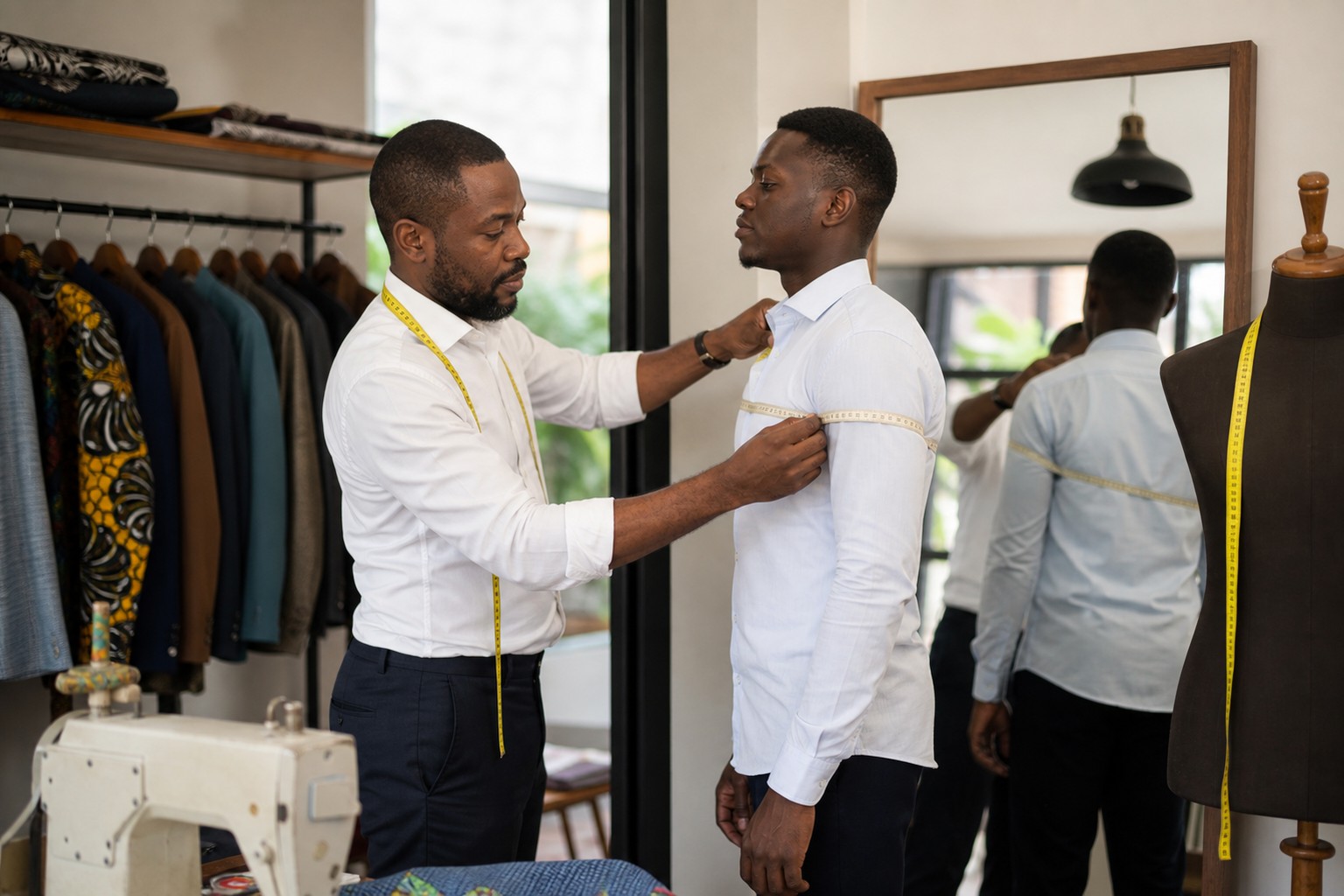
By the time the scissors enter the cloth, the essential part is settled. What is being made, for what use, in which material, for what date: all of it was decided earlier, and a tailor is judged as much on the clarity of those decisions as on the regularity of the stitching.
What the client brings, and what still has to be decided
A request rarely arrives complete. A photograph found online, a garment someone likes and wants "the same but better", a ceremony date: that is a starting point, not an order. The first task is to turn it into something that can actually be made. For what use — one ceremony, or a garment worn every week? Lined or not? Which fastenings, which pockets, which finishes? How will it be washed, and by whom?
Those answers change the making more surely than the model does: a garment worn once and a garment washed weekly are not assembled the same way.
The second task is to write down what was agreed. Model, material, colour, measurements taken, fitting date, delivery date, what is included and what is not: an order that is written down avoids the end-of-job conversation in which two people of good faith remember different things. The form matters little — a notebook is enough — but the absence of a record is always paid for by the same side.
Measurements: taken on a person, not on a standard
There is no universal table of body measurements. Sizes do not mean the same thing from one brand to another, one market to another, one cut to another: that is precisely why bespoke exists. So a tailor does not work from a stated size, but from what is measured on the person standing in front of him.
What gets measured depends on the garment: a shirt, a jacket and a long dress do not call for the same points. To these are added observations that are not figures — posture, the way a shoulder sits, the ease wanted — which explain why a garment right on the numbers can still hang badly.
None of this is a judgement. A tailor records, he does not comment; measurements exist to build a garment, never to qualify a body. A client who knows no remark will be made about them comes back, and talks about the workshop.
Distance orders deserve particular care. Measurements taken alone and without method often produce a garment that has to be remade; asking instead for the flat dimensions of a garment that fits is more reliable. The risk should be stated to the client, not discovered by them.
Fabric and yardage: what is decided before buying
Many clients bring their own fabric. That practice is prepared for: the yardage needed is stated before the purchase, not after. It depends on the model, the width of the cloth, the direction it must be cut in and, where a pattern has to be matched, on an extra quantity the client has no reason to guess at. Insufficient yardage shows up later on the garment, as a join placed where it should not be.
Other points are said at that moment: fabric can shrink at the first wash, and the same colour vary between batches — buying the shortfall later guarantees nothing. Trimmings — lining, thread, buttons, zip — are part of the same purchase, and their quality is noticed when a fastening gives out before the garment does.
There is no best fabric in the abstract. A material is judged by the use it will be put to: the structure wanted, comfort, warmth, care, behaviour under the iron. A tailor explains those trade-offs; it is not his job to decree that one fibre is superior to another.
From pattern to assembly
The pattern is the trade's invisible centrepiece. Depending on the workshop, it is drafted for the order, adapted from an existing block, or taken from a previous client file. It is what turns measurements and a model into surfaces to be cut, with the seam allowances that will make later alterations possible.
Then comes cutting, the only truly irreversible move in the chain. After it, a change no longer costs the same: changing your mind about a length before cutting costs almost nothing, changing it afterwards can mean recutting a whole piece, and that is said beforehand, not after.
Assembly follows a precise order in which each step makes the next possible: a workshop running several orders at once organises its days by stage rather than by garment, and that is where deadlines are kept or lost.
The fitting, and what an alteration can still correct
The intermediate fitting, when the garment is assembled but not finished, is the moment when adjustment still costs little. A length, a waist, a shoulder height can be taken in there. Skipped to save time, it is paid for in reworking after delivery, when everything is already fixed.
On an existing garment brought in for alteration, the work starts with an examination, never with a price given over the telephone. Some alterations are simple; others shift the garment's overall balance, because a change in one place moves the proportions elsewhere. Some requests are impossible: without a fabric reserve, you cannot let out what was cut too tight.
Saying clearly what cannot be done is part of the trade. An alteration accepted when it cannot hold ruins a garment and loses a client.
One piece, a small run, a uniform
Making one outfit and making fifty identical ones are neighbouring but distinct jobs. A group order — a team, a school, a hotel, an association — calls for one approved sample before the run starts, a set of sizes, enough batch consistency for the last piece to resemble the first, and an answer to the question of repeat orders: what happens when someone joins later?
A uniform adds requirements of its own — identification, consistency, comfort across a full day, behaviour under repeated washing, possibly marking. Nothing obliges an organisation to adopt one: it is a choice, framed where applicable by local rules that should be checked rather than assumed.
Between the two sits the small run made in advance. It shortens lead times but ties up money in cloth and hours, on sizes and models that may or may not find a buyer. It is a cash decision as much as a style one.
The workshop: machines, movements and safety
Straight stitcher, overlocker, iron or press: each machine has a role and a use foreseen by its maker. They are maintained, adjusted and used with their guards in place. A guard removed "because it gets in the way" is the most ordinary cause of a workshop accident, and an industrial machine calls for training, not a five-minute demonstration.
The rest plays out in details the International Labour Organization gathered in its collection of ergonomic checkpoints: work surface height, seating, light on the needle, tools within reach, breaks in an activity made of repeated movements. Simple improvements, not a medical protocol, but they change how a day ends.
Many sewing workshops sit inside a home or next to one. The ILO devoted a study to this home-based work, long invisible in statistics as in social protection; it points out that the place changes nothing about the nature of the work, but that it complicates the separation of hours, safety, and recognition of the trade.
Finally, the date. The promise most often broken in this trade is not quality, it is the deadline — and for a wedding, a funeral or the start of a school year, a date cannot be made up later. Better to announce a deadline that can be held, given the orders already committed, and to warn early if it slips. Digital tools change none of that: a client file, photographs, a messaging thread, mobile payment where it is widespread are conveniences, not the trade.
In the African context
Working conditions vary a great deal between countries, cities, markets and occasions: there is no single African tailoring, and two workshops in the same city do not serve the same clientele or work with the same materials.
The first reality is the place of made-to-measure. In many cities, having a garment sewn is not a luxury but an ordinary way of dressing, alongside ready-to-wear and second-hand. That gives workshops a steady clientele and orders of every size, from everyday clothes to ceremonial outfits.
The second is the diversity of demand. Depending on the region, the family and the event, one workshop may sew wedding outfits, school uniforms, workwear and everyday pieces in the same week. Dress traditions differ from country to country and keep changing; freezing them would be as false as ignoring them, and the printed fabrics widely worn in several countries of West and Central Africa are one example of that, not a definition.
The third is supply. Depending on the market, fabrics are imported, woven locally, or both; the availability of a reference, batch consistency and lead times all vary. A workshop that promises a precise colour without holding it in stock is taking a risk it does not control.
The fourth is how the trade is passed on. Sewing is very largely learned in a workshop, alongside someone more experienced, outside formal schemes. The International Labour Organization has documented this informal apprenticeship in Africa and the ways of upgrading it: it genuinely trains people, but it often leaves the apprentice without a qualification recognised outside the workshop where they learned.
The fifth is structuring. ILO work on the informal economy shows that a large share of these activities operates without registration or social protection. Formalising, where possible, opens access to orders from institutions, companies and schools, which require an invoice — as do diaspora orders, which call for written records, progress photographs and a stable address.
What a tailor does not promise
He does not promise that a garment copied from a photograph will be identical to the photograph: the material, the drape and the body are not the same. He does not promise to make up for insufficient yardage, nor to let out a garment with no fabric reserve. He does not promise that an alteration will right a badly cut garment. He does not guarantee a shade identical to a screen, nor the availability of a fabric he has not bought.
What he can promise is sturdier: a written order, measurements taken on the person, a yardage stated before the purchase, a fitting before the finishes, a deadline that can be held, and a word before it falls due if it cannot.