
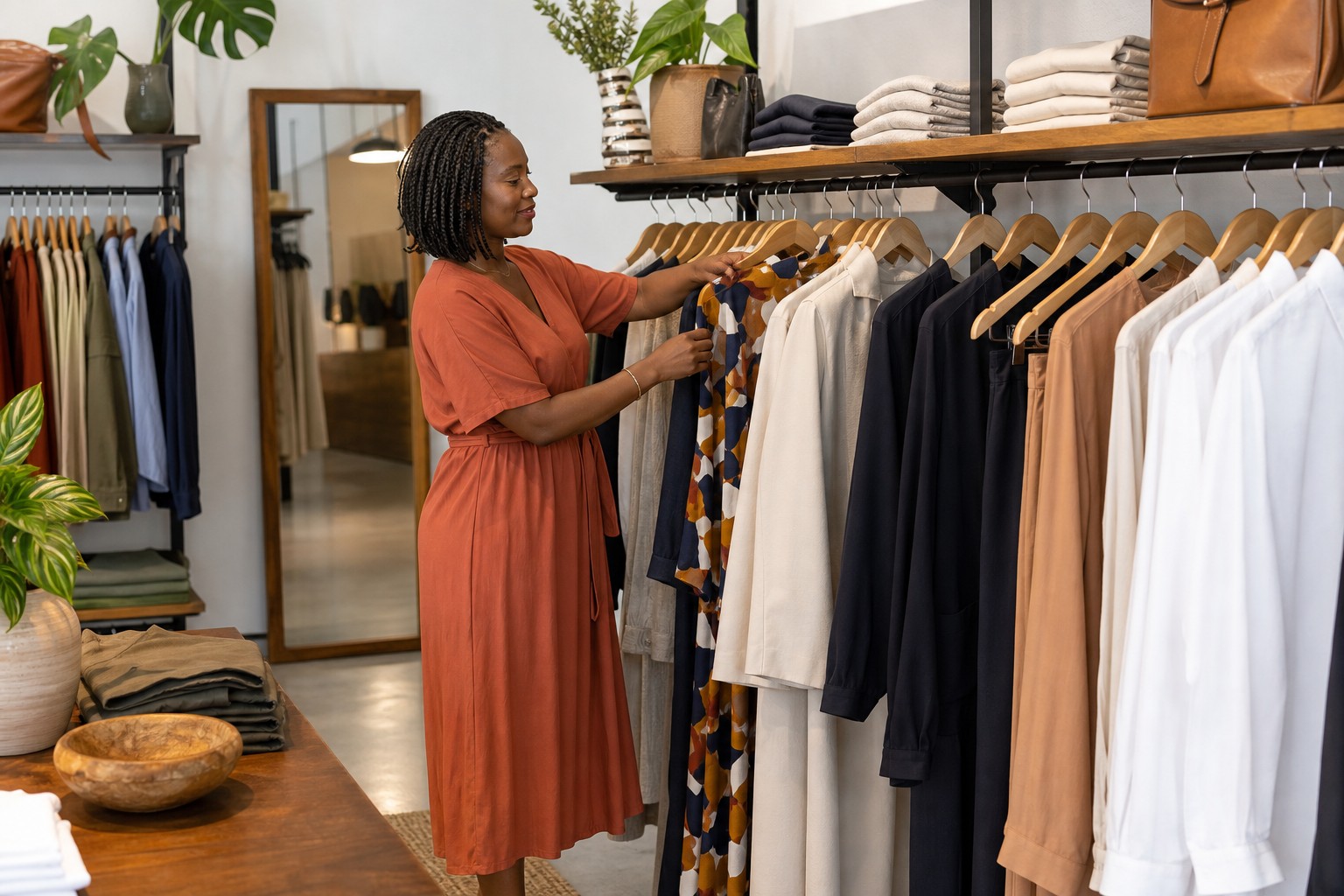
This trade is readily imagined as selling. It is mostly buying: a boutique's room for manoeuvre is decided the moment it commits its money to pieces nobody has asked for yet. Everything else — the window, the advice, the fitting room — exists to give those decisions their chance.
Buying months before selling
Ordering is betting. You choose models, colours and sizes on the basis of what you have seen sell, what your customers ask for, the season and the events ahead. Between the order and the rail comes a delay during which the money is tied up, and during which nothing guarantees the demand will be there.
Almost every decision in the trade follows from that constraint. Taking few pieces per reference limits the risk but exposes you to running out of a size in the first week. Taking many secures availability and turns a mistake into long-lived stock. No universal rule settles it: it depends on the supplier, the repeat-order lead time, the cash available and the clientele.
The relationship with suppliers deserves the same care as the one with customers. What is agreed — quantities, sizes, lead times, what happens if there is a delay or a piece does not match — is better written than remembered, including with a trusted supplier, and above all with one.
Building a range rather than a rail
A range is not an accumulation. It is organised around a few plain questions: who is the shop for, for what uses, with which pieces returning season after season and which pieces catching the eye without necessarily selling in numbers.
The question of sizes is the most concrete of all. Deciding which sizes you carry is deciding who you serve. A range running only from the smallest to the middle excludes part of the clientele, and that exclusion is read on the rail before anyone says it. A boutique may own a narrow positioning; it cannot pretend it is not one.
Then comes restocking. A piece that sells is only useful if it can be reordered: knowing, before buying, whether a reference will still be available in a few weeks changes entirely how you promote it. Promising a customer you will "find her size" without having checked is the surest way to lose her.
What the fitting room is really for
Trying on is not a formality: it is the moment the garment meets an actual person. The salesperson's role there is to help, to offer another cut or another size, and to stay on the subject of the garment — never to comment on the body of the person trying it. There is no body shape to correct, no silhouette to reach, and a size is not a mark out of ten.
Saying that a piece does not suit is part of the service. A garment sold against the customer's interest comes back, or worse, does not come back and is never worn: either way the shop has lost, and the customer remembers being pushed.
Two follow-ons are prepared in advance. The first is alterations: few shops do them on site, many work with a nearby workshop, and it is better said before the sale. The second is the exchange policy, which obeys no universal rule: what matters is that it is decided, displayed, written on the receipt and applied the same way to everyone.
Selling a designer's pieces
Many boutiques carry local designers. Two arrangements coexist, and they carry completely different risks: outright purchase, where the shop pays for the pieces and bears the unsold stock, and consignment, where the designer stays the owner until the sale. In both cases it is better to write down who bears what: unsold pieces, damage, theft, payment terms, how long pieces stay on the rail, how they are taken back.
Naming the designer on the label belongs to the same logic. It identifies them to the customer and removes any ambiguity about where the pieces come from.
The reverse exists too, and should be named: copying. Selling pieces bearing a third party's trademark or logo without permission exposes the shop, whatever the owner's good faith. The World Intellectual Property Organization sets out the elementary function of a trademark, which is to indicate the origin of a product; regimes and remedies vary between countries, but the principle does not. A supplier who will not say where the pieces come from has already answered the question.
What is left: unsold stock, markdowns and second life
Every shop gets it wrong. What distinguishes solid businesses is not the absence of mistakes but what they do with them: a piece that does not move ties up space, money and attention, and its value never recovers by itself. Markdowns, end-of-line sales, bundles or selling on to another trader are ordinary tools, not confessions of failure.
This is where sustainability comes in, and it deserves to be raised honestly. Writing that a garment is "ecological", "ethical" or "responsible" commits to nothing as long as nothing verifies it. What can be verified, on the other hand, can be said: where the piece comes from, who made it when that is known, how long it lasts in use, whether it can be repaired and altered, whether ordinary care damages it, what happens to unsold stock.
Second-hand belongs to the same reasoning. Depending on the city and the market, it accounts for a considerable share of clothing, and a shop selling new coexists with it rather than ignoring it. A piece whose origin and useful life are owned up to compares better with a second-hand garment than a piece sold with an adjective.
The stockroom and the days spent standing
Retail has a physical side the window does not show: taking in deliveries, checking what arrived, labelling, storing, handling, refilling the rail, stocktaking. That calls for an organised stockroom, where a size can be found without emptying three boxes.
The rest is about working conditions, often overlooked in small structures. Around its programmes for improving work in small enterprises, the International Labour Organization built a simple approach: start from what exists, fix first what costs little and hinders a lot. For a shop, that looks like very little — a seat for the quiet moments, enough light in the fitting room and the stockroom, loads stored at a sensible height, real breaks in a day spent on your feet.
The online window
A physical shop almost always has an online extension, if only a page and a messaging number. The International Telecommunication Union measures each year the progress of internet use worldwide, and how uneven it remains between countries and social groups: reason enough to treat the online channel as a complement, not a replacement for street trade.
What works is simple: faithful photographs, available sizes stated, quick replies to messages, a piece put aside when someone asks, mobile payment where it is widespread. What does not work is just as simple: photographs that improve on the colour, stock displayed that no longer exists, messages left unanswered.
No channel is compulsory, and no online presence walks anyone through the door by itself.
In the African context
Working conditions vary a great deal between countries, cities, neighbourhoods and income levels: there is no single African fashion retail, and two shops on the same avenue do not serve the same clientele.
The first reality is competition between channels. Markets, shops, online sellers, tailors and second-hand coexist in proportions that change from one city to another. A boutique defines itself by what it brings that the other channels do not: a selection, a fitting, advice, a stable address to come back to.
The second is supply. Depending on the country, pieces come from imports, local designers, manufacturing workshops or all three; lead times, shipping costs and consistency vary, and a gap cannot always be filled within the same season.
The third is cash. Buying ahead means putting money up front, in contexts where trade credit is not always available. That explains tight ranges, frequent small restocks and close attention to how fast stock turns.
The fourth is the place of local designers. Carrying them gives them a physical outlet they do not always have, and gives the shop pieces that cannot be found elsewhere. It calls for written agreements, failing which the disagreement arrives on payment day.
The fifth is formalisation. ILO work on the informal economy shows that a large share of retail operates without registration or social protection. Formalising, where possible, opens access to suppliers who require an invoice, to orders from companies and institutions, and to traceable payments — including for diaspora orders, which want to know who they are paying.
What a boutique does not promise
It does not promise that the colour in a photograph will be the colour of the piece, nor that a missing size will reappear. It does not promise to find a model again after an end of line, nor that a garment will suit because it matches a stated size. It does not promise that an item is sustainable, ethical or ecological merely because a label says so. It promises neither transformation nor an appearance guaranteed by a purchase.
What it can promise: displayed prices that do not move with the customer, sizes genuinely in stock, a fitting without pressure, an honest opinion even when it loses a sale, a written exchange policy, and the origin of the pieces it sells.