
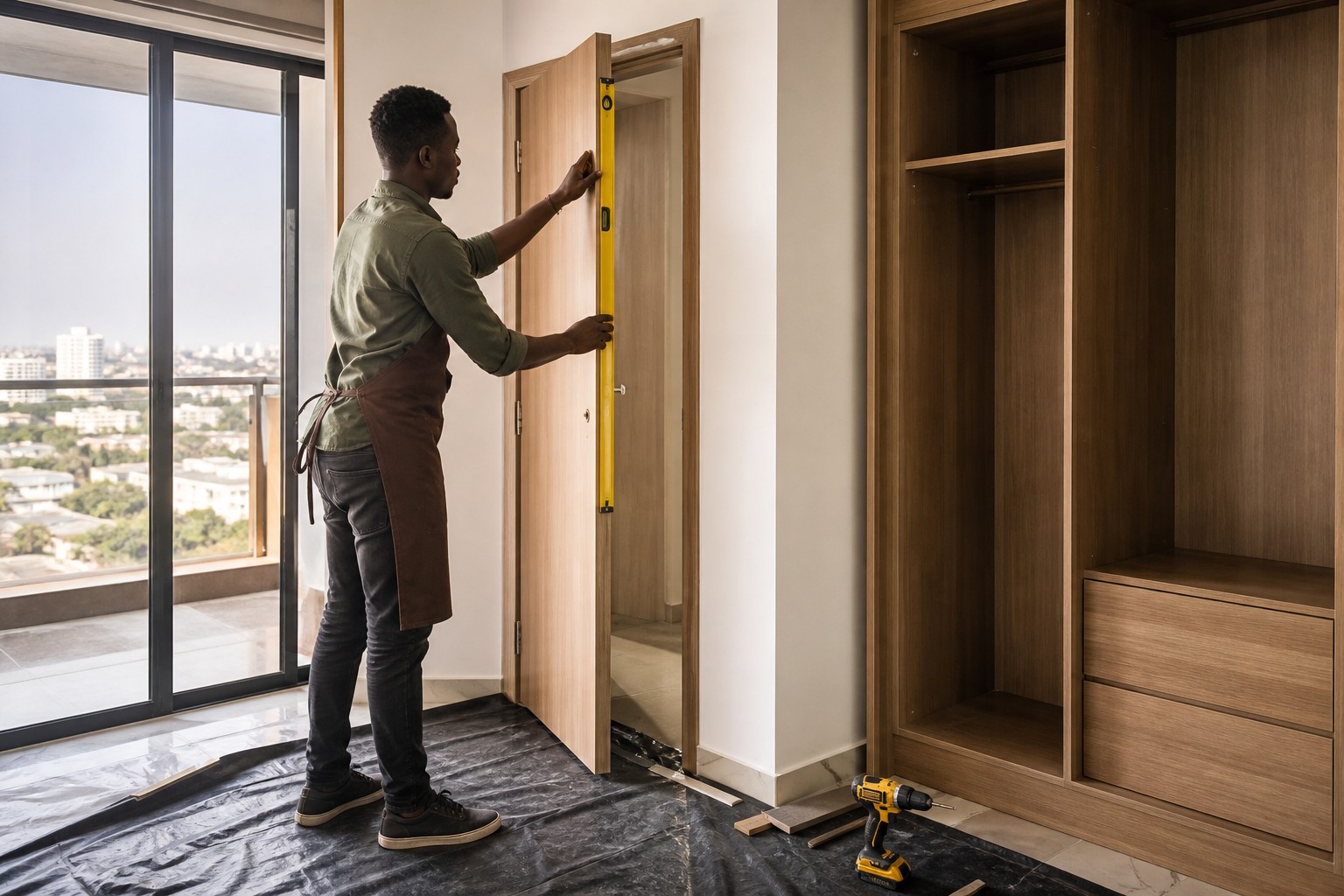
"The wardrobe recess is two metres forty wide." The sentence sounds like enough to start making something. It is not: two metres forty at the top, perhaps; at the bottom, to within five millimetres, nothing says it is the same. A straight wall is an exception, not a rule.
Bespoke means measured
The word is used so often it has lost its meaning. It has one, though, and a very concrete one: the unit is made to the real dimensions of the place it will go, not to a standard size adjusted at the last minute.
That implies something many clients discover with surprise: you never build from dimensions given over the phone. Not out of distrust, but because a dimension alone says nothing about what matters — whether the walls are plumb, whether the corners are square, whether the floor is level, whether there is a skirting board, a switch, a duct, a returning partition.
It is also what separates this trade from buying a unit in a shop. An industrial unit adapts to a room through clearances and trims; a bespoke unit follows the room, provided the room has been surveyed.
The survey at the client's home
This is the visit that decides everything, and it serves far more than measuring.
Dimensions are taken at several points rather than once, plumb and square are checked, and whatever will constrain the layout is noted: an electrical supply, exposed pipework, a radiator, the swing of a door, a varying ceiling height. You also look at what the unit will be fixed to — not all substrates are equal, and some call for a particular fixing solution.
Finally, the real use is discussed: who will use it, to store what, how many times a day. A heavily used dressing room and a decorative bookcase call for neither the same materials nor the same hardware.
Many workshops offer this survey and the quotation that follows. That is a legitimate commercial choice; what matters is that the client knows whether it applies before making the appointment.
From approved drawing to the first cut
Between the survey and the workshop there is a document: a dimensioned drawing, with the materials, the finishes and the hardware planned.
That drawing exists so that decisions are made before it is too late. Once the first panel is cut, a change costs material and time; before, it costs only a conversation. It is the moment to discuss an extra shelf, a hinge side, a worktop height suited to the person who will use it.
Its approval by the client marks the start of the manufacturing lead time and, where a deposit is planned, triggers it too. The terms — amount, conditions, consequences of cancellation — belong to the contract and the applicable law: no rule is universal, and no percentage holds everywhere.
Choosing the material by use
This is the most useful conversation of the survey, and it is not settled by "solid wood is better".
Every material has a domain: wood-based panels are perfectly suited to much interior storage, provided their edges and feet are protected from taking up moisture; solid timber earns its place where there is stress, traffic or exposure, and it can be repaired — which a swollen panel cannot.
The real criterion is therefore not the prestige of the material but use, exposure and budget, in that order. A professional who explains those trade-offs lets the client decide for themselves, which is better than selling top-of-the-range everywhere.
Hardware deserves the same attention. It is what fails first on a heavily used unit, and it is an item where economising shows quickly.
Fitting by the maker
A bespoke unit is not finished in the workshop: it is finished when it is in place and works.
Having it fitted by the person who made it changes the nature of adjustment. A clearance to correct, an edge to touch up, a runner to shift: whoever designed the piece knows where they can work on it without weakening it. An outside fitter does not.
Fitting also brings fixings into play, and that is where the trade meets its limits. When the anchoring has to be made in a doubtful substrate, when a partition clearly cannot carry the intended load, or when something has to be drilled whose nature is uncertain, the question goes beyond carpentry: it belongs to a qualified professional for anything structural, according to the locally applicable framework.
The fitter's own safety follows the same logic. The international principles applicable to sites — suitable equipment, competent personnel, prevention of falls during work at height — are set out in the International Labour Organization's code of practice on safety and health in construction.
Lead times, handover and repairs
A manufacturing lead time is not a polite estimate: it depends on supply, on the workshop's order book and on the finishes chosen. Announcing it honestly, even if that means announcing longer, beats meeting it half the time.
Handover happens in front of the client: every door opened and closed, clearances adjusted, fixings checked, everything clean. Any reservations are noted and put right — that is the moment to raise them, not three months later.
Finally comes what distinguishes work in timber: it can be repaired. A damaged edge, a tired hinge, a drawer that catches can all be put right. Offering that upkeep, rather than waiting for replacement, brings clients back.
In the African context
Conditions vary sharply between countries, cities and types of housing: there is no typical African joinery, and the species available a few hundred kilometres apart may be entirely different.
The first reality is the building stock. A significant share of homes is built and extended progressively, and the openings are rarely square — not through negligence, but because they were built in stages. Surveying on site is therefore not a comfort precaution there: it is the condition for the unit to fit. It is also what makes bespoke work economically relevant where industrial furniture adapts poorly.
The second is climate and what it does to timber. Depending on the region and season, humidity, heat and the swing between dry and rainy seasons move the material; some areas also face strong pressure from wood-boring insects. The choice of species, treatment and edge protection is not cosmetic: it decides the lifespan. A carpenter who knows what holds up locally provides something no imported catalogue can.
The third is supply. Depending on the market, panels and hardware depend on imports with variable lead times, while local timber is sometimes plentiful. That steers design towards what can actually be built with what exists, and gives value to the ability to repair rather than replace. The United Nations Environment Programme, through its Global Alliance for Buildings and Construction, highlights the weight of the building sector in global energy use and emissions: extending the life of a piece rather than replacing it takes on its full meaning there.
The fourth is how the craft is transmitted. The International Labour Organization has published a guide on upgrading informal apprenticeship in Africa, describing precisely this mode of training in the workshop, alongside someone more experienced, outside formal schemes — and examining how to recognise and improve it rather than ignore it. That is how many carpenters learn, and a workshop that structures that transmission achieves stable quality without requiring a certificate.
The fifth is professionalisation. The same organisation documents the scale of informal employment in its statistical study on women and men in the informal economy. In that context, a workshop that provides a dimensioned drawing, a detailed quotation, a lead time it keeps and an invoice reaches clients — companies, shops, managing agents, demanding private clients — who do not order any other way. Digital helps unevenly across markets: messaging serves to send a photograph of the location and approve a drawing, social media are often the main portfolio, and mobile payment eases deposits. The International Telecommunication Union puts the share of the world's population using the Internet at 74 per cent in 2025, with 36 per cent for Africa, the lowest of the regions it measures: these channels matter where they exist, without ever replacing the survey.
What a carpenter does not promise
They do not guarantee that a unit made to dimensions supplied by the client will fit, nor how timber will behave in a damp room they have not seen, nor that a fixing will hold in a substrate that does not allow it, nor that a defect in the room will disappear — a floor that is not level remains a floor that is not level. They stand in neither for a qualified professional on anything structural, nor for an electrician, nor for an interior designer on the layout of volumes.
What they do commit to can be checked: an on-site survey, a dimensioned drawing approved before manufacture, stated materials, a lead time running from approval, fitting by the workshop, a handover with reservations noted, and an invoice.
That is also what makes a workshop credible: real, dated work, a detailed quotation, lead times kept, a repair service, and genuine reviews. None of that depends on a particular tool: a notebook kept up beats software abandoned.
Artificial intelligence can help prepare a quotation, sort references, draft a service description or organise a workload. It does not measure the room, does not know whether a wall is plumb, does not say what a substrate can carry, and a rendering it produces is no proof that a piece can be built.