
A client compares prices per square metre. That is exactly what the trade allows — and exactly what misleads them, because two units at the same headline price can contain very different things behind the same word: "window".
A material that does not forgive
Aluminium imposes a discipline that timber does not, and that shapes the whole trade.
A profile cut too short is lost: you do not recover it, you do not lengthen it, you replace it. An opening fitted out of plumb will never close properly, and no later adjustment will compensate for a distorted frame. The very narrow margin for error is paid in material and in lead time.
In exchange, the material offers qualities that explain its place: it does not move with humidity, it is not attacked by wood-boring insects, it needs little upkeep, and it allows slim sections for large glazed areas.
The choice between aluminium and timber is therefore not a question of range but of use and exposure. Timber remains warmer and is easier to repair; aluminium holds up better where humidity, driving rain or insects are a problem. An honest professional sets out that trade-off rather than selling their material on principle.
The survey, and why it is not a formality
You do not fabricate from dimensions given over the phone. That is not distrust: a dimension alone says almost nothing.
The survey serves to measure at several points rather than once, to check the plumb and square of the opening, to examine the substrate that will take the fixing, to note what constrains the fitting — a returning wall, patched masonry, a threshold, a water outlet — and to decide the opening direction according to how the room is actually used.
It also serves to measure what is already there when it is a replacement: removing the old unit almost always reveals something, and it is better to anticipate that than to discover it on fitting day.
A quotation drawn up without a survey ends up being revised. Many workshops offer that visit; what matters is that the client knows whether that applies before booking.
Glazing: the item that explains the gap between two quotes
This is the heart of this article, because it is where a client is taken advantage of without ever seeing it.
Glazing is not "glass". It is characterised by its thickness, by whether it is single or made up, laminated or not, clear or tinted, treated or not. Those characteristics change how the unit behaves — its resistance, its insulation, its acoustic comfort, its safety if broken — and they change the price considerably.
Yet they are invisible once the unit is fitted. That is precisely why a serious quotation itemises them in writing, instead of writing "sliding window" and a price. A client comparing two offers without that line is not comparing two units: they are comparing two numbers.
One point deserves particular attention: glazed areas accessible at ground level, glazed doors, balustrades and anything that can be walked into call for glazing suited to the risk of breakage. The exact type and the applicable requirements depend on the unit, its location and the rules in force in the country: that is determined case by case, with the glass manufacturer, and checked locally.
Profiles: what the choice changes in use
Nor is a profile simply a bar of aluminium.
Depending on the range, it differs in section, in rigidity, in the quality of its seals and hardware, and in whether there is a break between outside and inside. That last characteristic matters particularly for an air-conditioned room: without it, the frame conducts, and the difference is paid in consumption and condensation.
Hardware deserves the same attention as in timber joinery: rollers, locks, handles and lifting systems are what fail first on a heavily used opening, and it is the item where economising becomes visible within a year.
The United Nations Environment Programme, through its Global Alliance for Buildings and Construction, highlights the weight of the building sector in global energy use and emissions. A well-designed and well-fitted opening is therefore not only a matter of comfort: it bears on what the building will consume for years.
Workshop fabrication, fitting by the same team
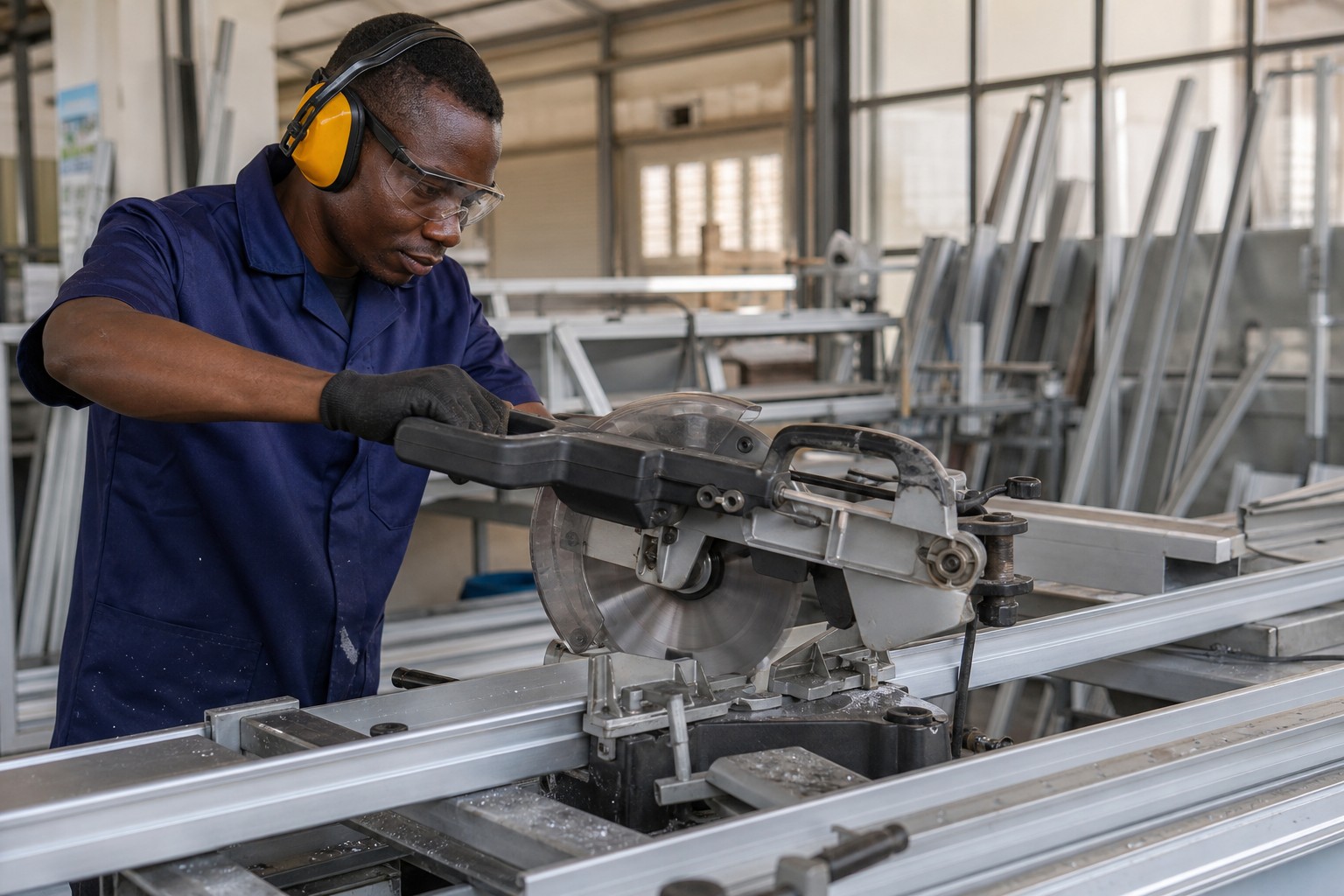
An aluminium unit is fabricated in the workshop, with machines, measurement and jigs — and it is finished on site.
Having it fitted by those who made it changes what happens when an adjustment is needed, and one almost always is. Whoever knows the unit knows what they can rework without weakening it. They also know what they built, which makes a warranty possible: delivering in kit form and letting a third party fit it means no longer being able to answer for anything.
Fitting involves safety, and it falls under the same principles as the other building trades: suitable and inspected means of access, trained personnel, prevention of falls during work at height, handling of loads — a large glazed unit is heavy and sharp. Those principles are set internationally by the International Labour Organization's code of practice on safety and health in construction. Whatever cannot be done safely is not taken on.
Finally, when the fixing requires anchoring in a doubtful substrate, or when an opening must be enlarged, the question leaves joinery behind: it belongs to a qualified professional for anything structural, according to the locally applicable framework.
Lead times, deposit and supply
A lead time rarely starts at signature: it starts when the profiles and glazing are ordered, which is itself often triggered by a deposit. Saying so clearly avoids the trade's most frequent misunderstanding.
The terms — deposit amount, conditions, consequences of cancellation, handover, warranty — belong to the contract and the applicable law: no rule is universal, and no percentage holds everywhere.
Price levels depend on the local market, the profile range, the glazing chosen and the difficulty of fitting: no price per square metre is a reference from one country to another, or even from one unit to another.
Taking on someone else's work
It is a common request: adjusting an opening that closes badly, replacing hardware, changing broken glazing on a unit fitted by someone else.
A professional can accept, on one condition they must state before starting: they do not warrant a unit they neither fabricated nor fitted. They answer for what they did — the adjustment, the part replaced — and not for the overall design or the original installation.
Saying so beforehand avoids the classic situation where the client considers, after a small job, that the whole thing has become the last tradesperson's responsibility.
In the African context
Conditions vary sharply between countries, cities and types of building: there is no typical African aluminium joinery, and the constraints of an office block have nothing in common with those of a house on the outskirts.
The first reality is climate and exposure. Depending on the region, direct sun, driving rain, sea air on the coast and temperature swings put units under strain. That is one reason for the place aluminium has taken where timber demands upkeep few clients provide — but it imposes in return a demanding attitude to seals, frame drainage and the quality of the surface treatment, particularly near the sea.
The second is demand linked to security and comfort. In several markets, openings serve a double function — closing and protecting — which explains the place of grilles, reinforced sections and suitable glazing. A professional who addresses that dimension explicitly, rather than by default, provides a real service; they do not thereby sell a guarantee against intrusion.
The third is supply. Depending on the country, profiles, hardware and glazing depend largely on imports with variable lead times, which makes the deposit and the supply schedule serious subjects rather than commercial formalities. It also gives value to the ability to repair and replace a part rather than the whole unit.
The fourth is the building stock. A significant share of it is built and extended progressively, and openings there are rarely square. Surveying on site is therefore not a comfort precaution: it is what stops a unit made to precise dimensions arriving at a site that is not.
The fifth is training and structuring. The International Labour Organization has published a guide on upgrading informal apprenticeship in Africa, describing how many trades are transmitted in the workshop, alongside someone more experienced, outside formal schemes — and examining how to recognise and improve those paths rather than ignore them. That is how many aluminium workers learn. The opportunity is direct for a workshop that structures itself: a written survey, a quotation itemising glazing and profiles, a lead time tied to supply and an invoice open access to company projects, shops and managing agents, who do not order any other way. Digital helps unevenly across markets: messaging serves to send a photograph of the existing opening before the survey, social media are often the portfolio, and mobile payment eases deposits. The International Telecommunication Union puts the share of the world's population using the Internet at 74 per cent in 2025, with 36 per cent for Africa, the lowest of the regions it measures: these channels matter where they exist, without replacing the survey.
What an aluminium fabricator does not promise
They do not guarantee a unit made to dimensions supplied by the client, nor that a fixing will hold in a substrate that does not allow it, nor the weathertightness of an opening fitted into failing masonry, nor the behaviour of glazing different from the one on the quotation, nor the design or fitting of a unit made by someone else. They stand in neither for a qualified professional on anything structural, nor for a glazier on the supply of the glass itself, nor for an architect on the design of openings.
What they do commit to can be checked: an on-site survey, a quotation itemising the glazing and the profile range, a lead time announced from supply, fabrication and fitting by the same team, a handover with the opening sections adjusted, and an invoice.
That is also what makes a workshop credible: real, dated work, a readable quotation, lead times kept, a parts replacement service, and genuine reviews. A photograph of finished work is worth more here than any sales pitch.
Artificial intelligence can help prepare a quotation from a survey, organise a workload, draft a service description or sort enquiries. It does not measure the opening, does not say whether a substrate can take a fixing, does not choose glazing in the manufacturer's place, and a rendering it produces is no proof that a unit can be built.