
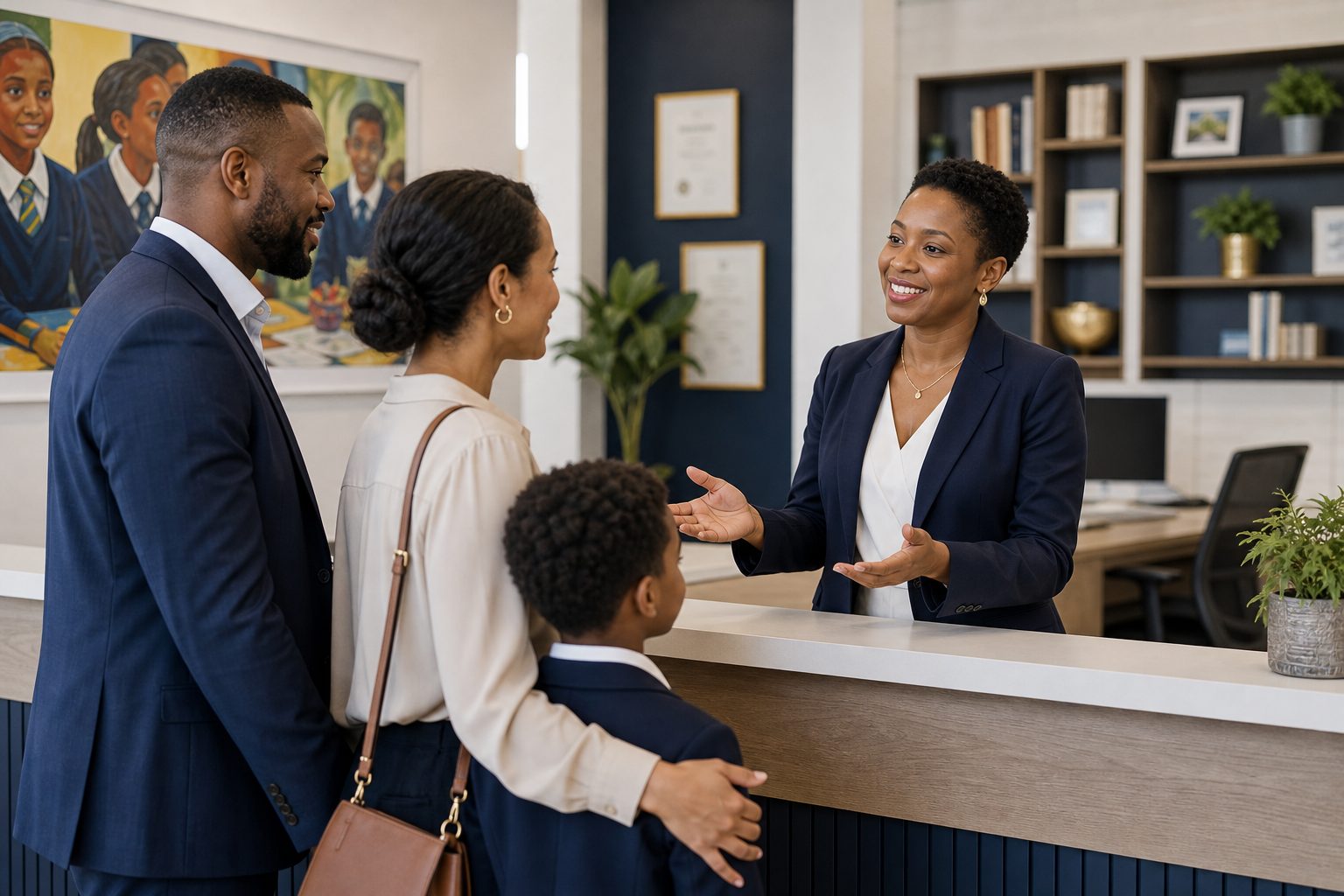
A family walks in with a three-year-old. If all goes well, that child will leave the same school at eighteen with an examination behind them. In between they will have changed buildings, rhythms, teachers, subjects and ways of learning — but not school. Few institutions accompany anyone for that long. That continuity is what defines an all-through school, and it is also its main difficulty.
Several schools inside one
A multi-stage school is not a bigger school: it is three or four schools sharing an address, a management and a reputation.
The International Standard Classification of Education, maintained by the UNESCO Institute for Statistics, makes the point: it distinguishes successive levels — early childhood education, primary education, lower secondary, upper secondary — precisely because they are different things, with their own objectives, methods and teacher qualifications.
On the ground that means one institution must simultaneously hold realities with almost nothing in common. In nursery, the work is language, motor skills and living together, with one adult as a reference point. In primary, a single teacher carries most of a class's learning. In secondary, the pupil changes teacher every hour and becomes responsible for their own work. A head who applies the same operating rule to all three is wrong three times over.
The transition: where pupils are lost
If an all-through school has one advantage over others, this is it — and if it wastes it, it has none.
Moving from one stage to the next is a documented moment of fragility everywhere: expectations change, adults change, working methods change. A child who was doing well at the end of primary can fall away within months in secondary, not because they lost their ability, but because nobody explained that the way of learning had just changed.
A school covering both stages has the rare chance to organise that transition instead of enduring it: bringing teachers from both levels together, passing on more than marks — what blocks, what works, what to watch — preparing pupils for new expectations before they meet them, and following the new arrivals through their first term.
It is the one thing an all-through school can do that a standalone school cannot. Not doing it means adding schools together rather than building one.
Spotting it before the report card
The most useful skill of a teaching team is not teaching: it is noticing.
A pupil never disengages abruptly. They start by not handing in one piece of work, then by going quiet in class, then by missing a day, then two. Each of those signals is visible to an adult, but each is seen by a different adult — and if those adults do not talk to one another, disengagement only surfaces on the report card, which is to say too late.
Schools that genuinely track their pupils put very simple things in place: a regular meeting between the teachers of one class, an identified point of contact per pupil, a quick alert when absences repeat, and contact with the family before sanctions rather than after. None of this requires substantial resources; all of it requires an organisation and a habit.
The scale of what is at stake is documented. In June 2022 the World Bank, with UNESCO, UNICEF and several partners, estimated that 70% of ten-year-olds in low- and middle-income countries were unable to read and understand a simple text — against 57% before the pandemic — and that the figure reached 89% in Sub-Saharan Africa. Those numbers do not describe children incapable of learning: they describe difficulties that were not caught in time.
Teachers make the school
An all-through school can have new buildings and a poor reputation; the reverse is rarer.
The joint Recommendation of the International Labour Organization and UNESCO concerning the Status of Teachers, adopted in Paris on 5 October 1966, remains the international reference on the subject. It covers teacher preparation and qualification, recruitment, employment conditions, professional freedom in the exercise of the job, responsibilities, in-service continuing education, and class size — which it wants compatible with individual attention to pupils. It also provides for consultation of teachers' organisations on policy and school organisation. This is a recommendation, not a convention: it is not legally binding, but it is the common reference on what quality teaching requires.
For a school, that translates into concrete decisions: recruiting on qualification as much as on availability, supporting new teachers rather than leaving them to find their own way, building meeting time into timetables, and treating a stable team as worth more than one renewed every September. In a job where the relationship counts as much as the content, every departure costs a year of knowing the pupils.
Qualification requirements vary sharply between countries, between the levels taught and between types of school: a head needs to know what applies locally rather than transposing something read elsewhere.
Parents are not customers like any other
A family enrolling a child for fifteen years is not buying a service: it is delegating part of its educational authority. The relationship that follows has no equivalent in any other sector.
It requires regular communication and not only when something goes wrong: a written report at fixed intervals, meetings organised rather than endured, an explanation of the methods used, and a quick answer when a parent is worried. It also requires a clear boundary: the school decides on pedagogy, the family decides on upbringing, and the two talk to each other.
And it requires consistency. A parent who has seen the school keep its word on a small matter in primary will trust it on a large matter in secondary. The reverse is equally true, and gets talked about in the neighbourhood.
A place that has to be safe
Taking in minors, and particularly minors of very different ages on the same site, brings responsibilities that have nothing to do with pedagogy.
They cover material questions — the state of the buildings, access security, separating play areas for younger and older children, circulation at arrival and departure, supervision of movement — and human ones: expected adult conduct, a known procedure when an incident occurs, protection of pupils, confidentiality of family information.
The precise obligations — building standards, supervision ratios, reporting procedures, pre-employment checks — belong to each country's regulation and sometimes to each local authority. No national model applies everywhere; the competent authority of the territory sets the rule, and it falls to the school to know it.
An organisation visible in the details
The quality of a school is read in signs families notice before results: whether lessons start on time, the state of the toilets, how quickly a call is answered, how clear the rules are, how a cover lesson is organised when a teacher is absent.
These look secondary. They are in fact the visible expression of an organisation, and they build a school's reputation far more than the results of any single year.
What a school has to prepare for
A school does not only prepare for the next examination: it prepares for a choice of pathway, for a trade, for an adult life whose exact content nobody knows.
The African Union puts that concern at the centre of its work: it aims to transform education systems to meet the human capital needs of Agenda 2063, and in 2025 opened a Decade of Education and Skills Development, with attention to digital education and to the professional development of teachers.
For a school the translation is not ideological but very concrete: equipping progressively, training teachers on tools before buying the tools, and not mistaking the existence of a computer room for its pedagogical use.
Presenting a school
A family looking for a school asks precise questions, and asks them before travelling: which levels do you take, where are you, how does enrolment work, how many pupils per class, and what does my child's day look like.
A professional presentation answers exactly that: the name of the school and its project in one honest sentence, the stages and levels genuinely taken, a precise address with a landmark, the hours of the school day, the enrolment period and process, the documents required, the average class size, how pupil tracking and parent communication are organised, the activities offered, an introduction to the teaching team, the real facilities — classrooms, library, playground, laboratory, computers — and a contact that genuinely answers.
Two pieces of information weigh especially heavily. The levels taken, written unambiguously: it is a family's first filter. And how you report back to parents — how often, in what form, who receives them — because that is what families actually compare between schools.
Photographs should show the school as it is, at the hours it is alive: the real classrooms, the real playground, the real team. A gap between the picture and the visit is paid for immediately.
In short
An all-through school is a long-duration institution. Its value is not measured by one class or one year, but by its ability to hold a thread: accompanying a child from one stage to the next without losing them at the join, noticing before it is too late, keeping a team stable enough that someone remembers them, and reporting honestly to families.
Requirements for opening, teacher qualification, safety and curriculum depend entirely on the country and its competent authorities. What does not vary is what a family wants: for their child to be seen.
Do you run a school? Set out your stages, your hours, your enrolment process and how you track pupils: that is what families look for before visiting.