
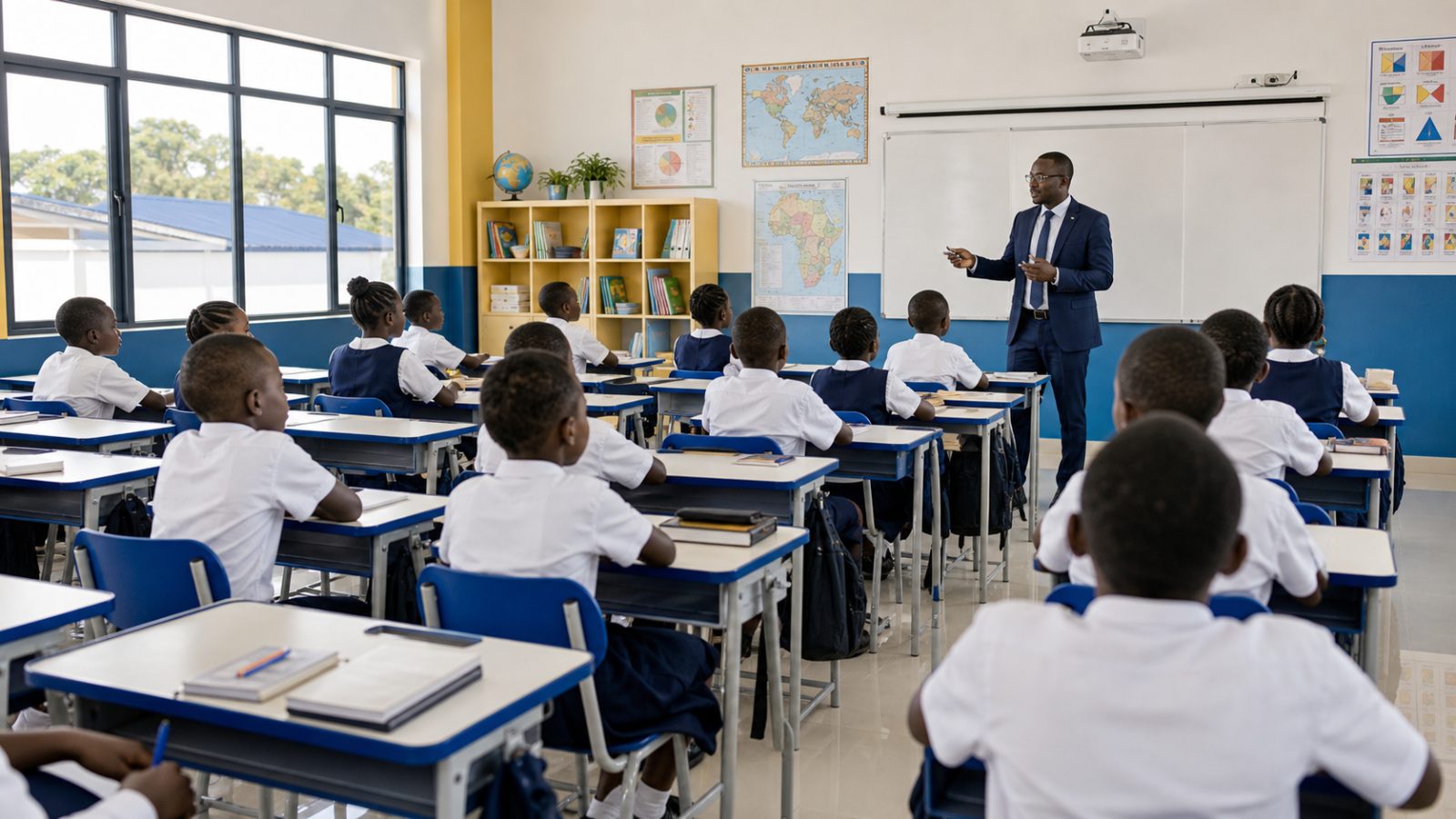
Two neighbouring schools teach exactly the same curriculum, prepare for the same state examination and use the same textbooks. Six years on, their pupils are not at the same level, and families in the district know perfectly well which is which. That is the whole subject: when the content is imposed, the difference is made entirely in the implementation.
A national framework, not a private project
In the Democratic Republic of the Congo, the organisation of education rests on framework law No. 14/004 of 11 February 2014 on national education. That text sets the fundamental principles of the system: it organises education into successive levels — nursery, primary, secondary and higher — establishes free and compulsory primary education, and distinguishes categories of establishment: public, approved private and non-approved private.
It also provides what, for a head, constitutes the daily frame of the work: a national curriculum, an approval regime whose conditions the State sets, and an inspectorate responsible for verifying compliance.
These elements completely change the nature of the job compared with a school free to define its own educational project. The head of a Congolese school does not decide what is taught in the fifth primary year, nor what examinations will close the cycle. They decide everything else — and "everything else" is most of what a pupil actually experiences.
It has to be said plainly: this framework is Congolese. Every country organises its system differently, with its own levels, examinations and approval rules. What is described here applies to the DRC and should not be transposed elsewhere without checking with the competent authorities of the country concerned.
What the school actually decides
When the curriculum is fixed, considerable room for manoeuvre remains, and that is where a school's reputation is made.
The school decides the progression: in what order and at what pace the curriculum is covered, what is consolidated before moving on, what is revisited when a class has not kept up. It decides the method: how a concept is explained, what exercises are set, how you check it has been understood rather than recited. It decides internal assessment: frequent tests or rare ones, marked work with comments or a bare grade, remediation or moving on.
Above all it decides what happens when a pupil does not keep up. That is the point where two schools teaching the same curriculum diverge most. One moves on because the calendar demands it; the other stops, goes back, organises support. By the end of the cycle the gap is visible.
Curriculum covered is not curriculum learned
This is the most costly confusion in the job, and an easy one to make because it is comfortable.
A teacher who has worked through every chapter has met their formal obligation. That says nothing about what the pupils retained. A serious school distinguishes the two and measures the second: through assessments covering material seen several weeks earlier, through application exercises rather than recall, and by tracking pupils who repeatedly fail the same kind of question.
The distinction is especially decisive in primary, where foundational learning conditions everything that follows. A pupil arriving in secondary without reading fluently will not face a difficulty in language: they will face one in every subject, simultaneously.
The state examination shapes the whole schooling
In a system where a national examination closes secondary education, that examination acts as a magnet on the years preceding it.
That is an advantage: it provides a common objective, a legible standard and an honest point of comparison between schools. It is also a risk: a school can be tempted to organise everything around the paper — repeated drilling, selecting which pupils are entered, cramming in the final weeks — at the expense of what is not assessed.
The professional balance is to prepare genuinely for the examination without reducing teaching to it: working on the methods expected, running mock papers under real conditions, analysing recurrent errors — while continuing to teach what will not come up and will be useful anyway.
Approval, inspection and compliance
A private school applying the national curriculum lives in a permanent relationship with the supervising authority.
Approval is not a formality obtained once: it commits the school to meeting conditions over time — compliant premises, qualified staff, respect for the curriculum and the calendar, upkeep of school records. Inspection verifies that compliance, and a well-run school prepares for those visits as routine rather than as an event.
Record-keeping deserves a particular mention because it is underestimated. Enrolment registers, attendance lists, reports, transcripts, teacher files, minutes: these documents do not only serve the administration. They serve families when a pupil changes school, and the pupil themselves years later when they need to prove their schooling.
Teachers inside a constrained system
The curriculum is fixed, but the teacher remains the determining factor.
The joint Recommendation of the International Labour Organization and UNESCO concerning the Status of Teachers, adopted on 5 October 1966, addresses precisely these questions: preparation and qualification, recruitment, employment conditions, professional freedom in the choice of methods and materials, responsibilities, in-service continuing education, and class sizes allowing individual attention. The text is not legally binding — it is a recommendation, not a convention — but it is the common international reference.
Reading it is instructive in a system with an imposed curriculum: what the text protects is not freedom over content, but professional freedom over how to teach. In other words, exactly the margin that remains — and that makes all the difference.
For a school, that means investing in what is genuinely modifiable: supporting new teachers, organising exchanges between colleagues in the same subject, allowing someone the time to prepare lessons properly, and not overloading classes to the point where individual attention becomes impossible.
Placing the school on a comparable scale
The International Standard Classification of Education, maintained by the UNESCO Institute for Statistics in its 2011 version, provides a globally agreed framework for categorising education programmes and qualifications and comparing systems across countries.
For a Congolese school, that grid has a concrete use: it allows you to explain to a family moving abroad, or to a pupil who will continue elsewhere, what international level the completed cycle corresponds to. It is information schools rarely provide and that the families concerned spend a long time looking for.
What a Congolese school shares with the continent
The challenges facing a Congolese school are not unique to it. The African Union places the transformation of education systems at the heart of the human capital needs of its Agenda 2063 and in 2025 opened a Decade of Education and Skills Development, with particular attention to digital education and the professional development of teachers.
For a school, that translates less into declarations than into investment choices: equipping where you will know how to use it, training before buying, and avoiding the showcase computer room nobody uses.
Presenting a school following the national curriculum
A Congolese family looking for a school asks very concrete questions, often in this order: which cycles, where, what is the school's status, what examination results, and how do we enrol.
A professional presentation answers exactly that: the name of the school and its identity in one sentence, the cycles taken, a clear statement of status — public, approved private, non-approved private — the address with a district landmark, the hours, the enrolment period and process, the documents required, class sizes, the sections offered in secondary, an introduction to the team, the real facilities, and a contact that answers.
Two pieces of information count more than the rest. The school's approval status: it is a question families ask, and one better answered clearly by the school itself. And preparation for the state examination: what you actually put in place, rather than a pass rate without context.
Photographs should show the classrooms as they are, the yard, the equipment genuinely available. An image more flattering than reality backfires at the first visit.
In short
A school applying a national curriculum practises a trade of implementation. It chooses neither the content nor the examination, but it chooses the pace, the method, the way it assesses, what it does with struggling pupils and the quality of its team. That, and nowhere else, is where the difference between two neighbouring schools is built.
The framework described here — cycles, free and compulsory primary education, categories of establishment, approval, inspection, national curriculum — is that of the Democratic Republic of the Congo. Every country has its own, and it falls to each school to refer to the competent authorities of its own territory.
Do you run a school? State your cycles, your status, your enrolment process and how you prepare for examinations: that is what families look for first.