
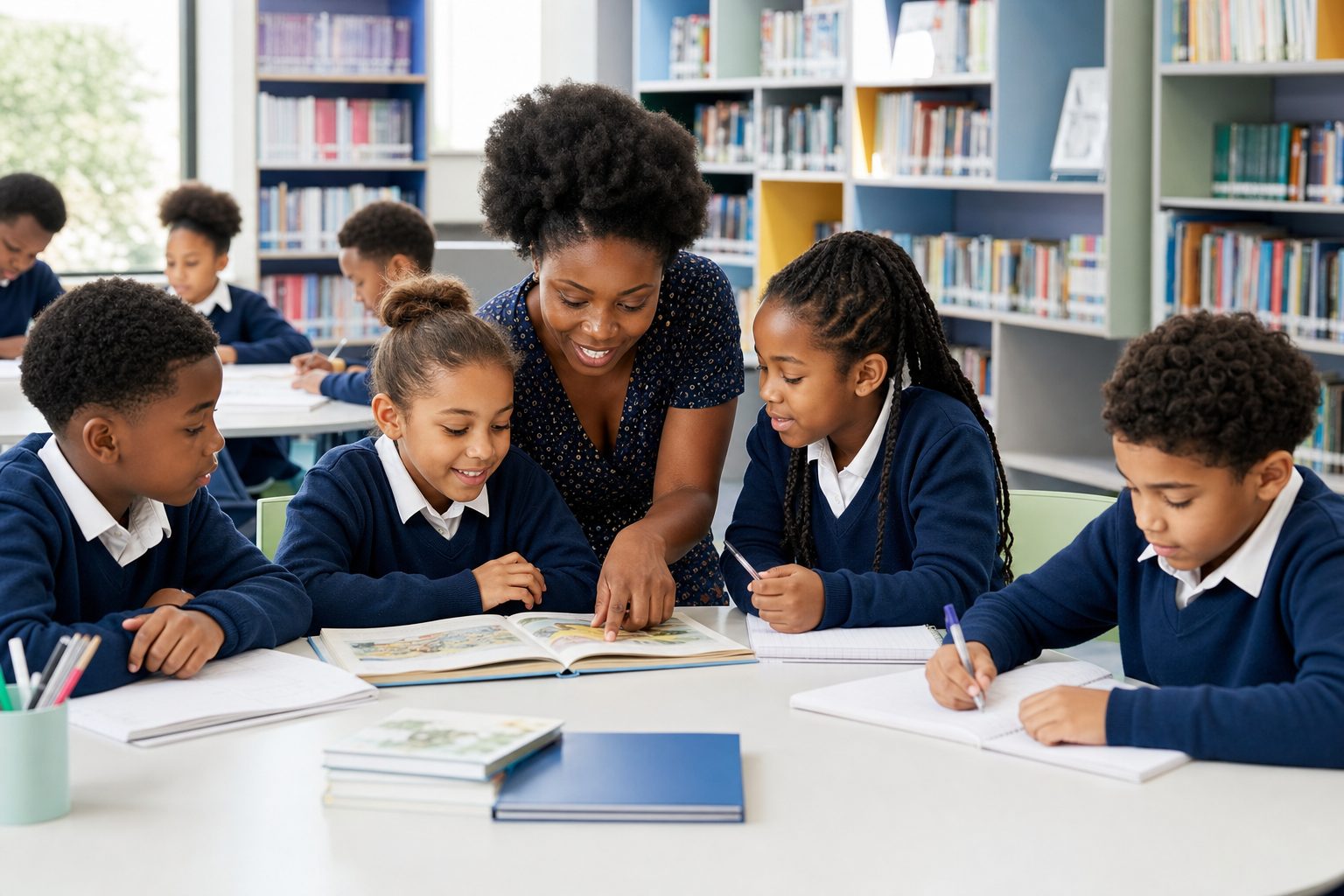
A ten-year-old reads a text aloud without stumbling. Another, sitting beside them, is still decoding word by word and has no attention left over to understand what they are reading. In two years' time, in secondary school, the first will follow a history lesson and the second will not — not because they are less able, but because reading still costs them all their effort. That is what is at stake in a primary school.
The level where everything is decided
The International Standard Classification of Education, maintained by the UNESCO Institute for Statistics in its 2011 version, places primary education immediately after early childhood education and before lower secondary. That position in the sequence is not merely administrative: primary is the level where the tools every later level will need are installed.
Reading fluently, writing legibly and correctly, counting and reasoning about quantities: these are not subjects among others. They are the instruments with which everything else is learned. A pupil who has them can make progress in a subject they are meeting for the first time; a pupil who does not will hit the same wall everywhere.
What the figures say, and what they do not
The scale of the problem is documented. In June 2022 the World Bank, with UNESCO, UNICEF and several partners, published an estimate that has become a reference: 70% of ten-year-olds in low- and middle-income countries are unable to read and understand a simple text, against 57% before the pandemic. The same publication puts the figure at 89% in Sub-Saharan Africa, 78% in South Asia and 80% in Latin America and the Caribbean.
What the indicator measures is precise: the share of ten-year-olds who cannot read and understand a simple text. What it does not measure is those children's capacity to learn. It describes a system that has not installed an acquisition, not pupils incapable of acquiring it.
For a primary school, the useful reading of that data is operational: the question is not whether some pupils are struggling — every class has some — but which ones, on precisely what, and when it was noticed.
One teacher, and that is an advantage
Primary has a feature secondary does not: most often a single teacher carries the bulk of a class's learning.
That is sometimes presented as a limitation. It is in fact the level's main asset. A teacher who has their class all day sees what no assessment system shows: that one pupil never puts a hand up any more, that another copies without understanding, that the one at the back has not eaten, that the girl in the second row writes very slowly because she cannot see the board properly.
That continuous observation is the main early-detection tool a school has. It still has to be organised: the teacher needs time to look at exercise books rather than only mark them, someone to raise it with, and a system in which what they notice triggers something.
Spot early, act small
The difference between a school that treats difficulties and one that merely records them comes down to a few inexpensive practices.
Assessing during learning rather than at the end: a dictation corrected in class the same day achieves more than a marked test returned three weeks later. Being specific: "he cannot read" allows no action, "he confuses similar sounds and does not segment long words" allows one. Acting in short bursts: fifteen targeted minutes several times a week beat an ambitious scheme never implemented. And checking that the action had an effect, rather than assuming.
There are also causes that are not pedagogical and that only the school may spot: uncorrected sight or hearing, chronic tiredness, a difficult family situation, emerging absenteeism. A school does not diagnose these — it has neither the competence nor the standing — but it is often the first to notice, and its role is to raise it with the family and refer to the appropriate professionals.
Repeating a year is not remediation
This is one of the most widespread reflexes and one of the least effective when used on its own.
Making a child repeat an entire year because they have not mastered two or three concepts means putting them through again what did not work, hoping for a different result. Without targeted work on what is actually blocking, the effect is small and the cost to the pupil high: another year, a gap with their friends, a lasting dent in how they see themselves.
The reasonable professional position is not to rule such decisions out, but never to take them instead of remediation work, and to base them on a precise finding rather than an annual average.
Primary teachers
The joint Recommendation of the International Labour Organization and UNESCO concerning the Status of Teachers, adopted in Paris on 5 October 1966, remains the international reference. It covers teacher preparation — general studies, pedagogical training and practical teaching in accredited institutions — recruitment, employment conditions, professional freedom over methods and materials, responsibilities, in-service continuing education available to all, and class size, which it wants compatible with individual attention to pupils.
That last point is especially decisive in primary. A class of thirty-five is not a class of twenty-five with ten more pupils: it is a different organisation, in which the time available per child shrinks to the point of making individual detection very difficult. A school that cannot reduce its numbers can at least organise differently — small-group work in targeted slots, a second adult present at critical moments.
Qualification requirements for teaching in primary vary by country and by type of school; they belong to the competent authorities of the territory.
Parents, the first allies
In primary the relationship with families is closer than at any other level: the parent walks the child in, waits at the gate, signs the book, helps with homework.
That closeness is a resource if the school uses it. Explaining what is being worked on and why, saying precisely what a parent can do at home — ten minutes of reading, asking about the day, checking the school bag — and flagging a difficulty early without dramatising it is better than waiting for the report card.
It also calls for caution: not all families have the same availability, the same schooling or the same language. A school that makes learning depend on work done at home widens the very gaps it claims to close. What must be learned must be taught in class; what is asked at home must remain within everyone's reach.
A continental priority
The African Union places the transformation of education systems at the heart of the human capital needs of its Agenda 2063 and in 2025 opened a Decade of Education and Skills Development, with particular attention to digital education and to the professional development of teachers.
For a primary school the concrete translation is training rather than equipment: an interactive whiteboard in a class where children cannot read changes nothing, while a teacher trained to spot reading difficulties changes a great deal — with or without a screen.
Presenting a primary school
A family looking for a primary school asks few questions, but asks them seriously: how many pupils per class, who teaches, what hours, how will we be told if something is wrong.
A professional presentation gives the name of the school and its approach in one honest sentence, the levels taken, the average class size, the hours of the school day, enrolment arrangements and period, the documents required, what a typical day looks like, how difficulties are spotted and handled, how and how often you report to parents, an introduction to the teaching team, the real facilities — classrooms, playground, library, washrooms — the activities offered, and a contact that answers.
Two pieces of information make a particular difference. Class size, which families look for first and few schools publish. And the tracking arrangements: describing concretely what happens when a pupil falls behind is the most convincing argument a primary school can make, and the one most rarely written down.
Photographs should show the real classrooms, the real playground and the real equipment. As for any setting taking in minors, publishing images of pupils requires families' written consent, and many schools prefer to show the premises.
In short
A primary school installs the foundation on which all later schooling rests. Its success is measured not by a progression rate but by a more demanding question: how many of its pupils genuinely read fluently at the end of the cycle, and among those who do not, how many had been spotted in time.
Requirements on qualification, class size, curriculum and opening depend entirely on the country and its competent authorities. What does not vary is the deadline: what was not installed in primary will have to be installed later, with more difficulty, by someone else.
Do you run a primary school? State your levels, your class sizes, your hours and how you track pupils: that is what families look for before meeting you.