
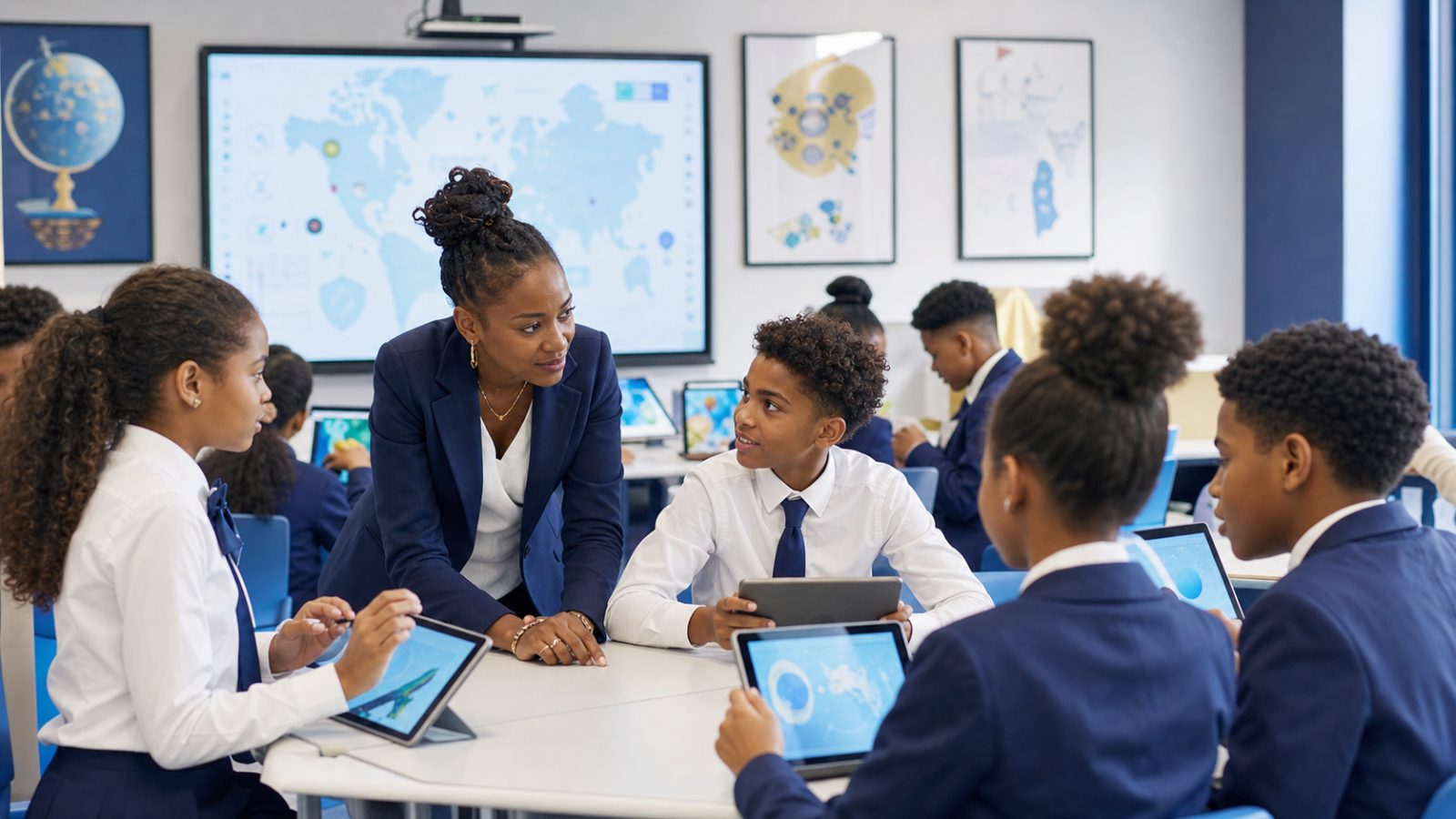
A twelve-year-old arrives in November. He comes from an education system that uses neither the same year structure, nor the same curriculum, nor the same language of instruction. In eighteen months his parents will be posted elsewhere and he will leave. The school has one problem to solve: how to make those eighteen months useful, and how to make sure they count wherever he goes next.
A school whose roll changes all year
This is the trait that governs everything else. In a conventional school, September fixes the classes for the year. In an international school, arrivals and departures spread across all twelve months, following families' professional postings.
That rules out a number of habits. You cannot build a progression that assumes everyone has been there since September. You cannot base assessment on continuous marking that began before half the class arrived. Nor can you rely on stable class groups to organise school life.
It does, however, require three arrangements that serious international schools all have: a practised, fast admission procedure, an entry assessment capable of placing a pupil from elsewhere, and support through the first weeks that goes beyond a tour of the buildings.
Placing a pupil from another system
This is the most delicate professional act in the job, and the one families understand least.
A child who arrives does not bring a level, they bring a pathway: years completed in a given system, with its own expectations. Two children of the same age may have been exposed to very different content — one has done geometry and no statistics, the other the reverse — without either being "behind".
The International Standard Classification of Education, maintained by the UNESCO Institute for Statistics in its 2011 version, provides here the common framework for categorising programmes and qualifications and comparing systems across countries. It does not say what a child knows; it says what level what they followed corresponds to. That is the starting point, not the conclusion.
The real work is then to assess what has actually been acquired, subject by subject, and to decide on a placement — knowing that placing too high installs lasting failure and placing too low produces boredom and then disengagement. Experienced schools explicitly plan to revisit that placement a few weeks after arrival, rather than treating the initial decision as final.
Language is a subject before it is a vehicle
Bilingual teaching is not teaching in which two languages are spoken: it is teaching in which the language of schooling is, for some pupils, a language still being acquired.
That has very concrete consequences across every subject. A pupil failing in science may be failing to understand the question rather than the reasoning. A teacher who does not make that distinction records a scientific gap that does not exist, and advises badly.
Schools that take the subject seriously provide dedicated language support for newcomers, train all their teachers — not only language teachers — to tell what belongs to language and what belongs to the subject, and accept an adjustment period during which assessment takes account of that double difficulty.
Real bilingualism also shows in organisational details: which language documents to families are written in, which language parents' meetings are held in, which language is actually spoken in the playground.
A team from different backgrounds
The teaching staff of an international school is itself mobile and composite: teachers trained in different systems, with different pedagogical habits, and often limited lengths of stay.
That is both a strength and an organisational problem. A teacher trained in a highly structured system and one trained in a highly autonomous system do not assess alike, do not conceive homework alike, do not react alike to a pupil who challenges them. Without harmonisation, the pupil experiences three contradictory pedagogies in one day.
The joint Recommendation of the International Labour Organization and UNESCO concerning the Status of Teachers, adopted on 5 October 1966, remains the international reference on teacher preparation, qualification, employment conditions, professional freedom and continuing education. It is not legally binding, but it recalls a principle useful here: a teacher's professional freedom concerns methods, within a common framework set by the school.
In practice that means an international school must invest more than others in harmonisation: written common assessment rules, real meeting time, and support for newly arrived teachers — who are discovering a school, a curriculum and often a country all at once.
Qualification and permission-to-teach requirements for foreign staff vary sharply between countries; they belong to the competent authorities of the territory and must be verified, not assumed.
What has to remain transferable
This is an international school's most concrete responsibility, and the one families judge most harshly: what the child takes away when they leave.
A useful school record is not a list of marks. It contains the detail of content studied, contact hours by subject, the grading system used and its scale, a description of the level reached, and a statement of the curriculum followed. Without those, the next school can do nothing but reassess everything — which costs the child weeks.
The same logic applies to end-of-schooling qualifications, with higher stakes. The Global Convention on the Recognition of Qualifications concerning Higher Education, adopted by UNESCO's General Conference in November 2019 and in force since 5 March 2023 after the twentieth ratification was deposited, is the first United Nations treaty on higher education with a global scope. It establishes principles of fair, transparent and non-discriminatory recognition of qualifications, and covers among other things prior learning and study periods completed remotely.
For a school preparing pupils for further study abroad the consequence is clear: you must be able to document precisely what was done, and never claim that a pathway automatically grants access to an institution or a country. Access depends on competent authorities and receiving institutions; a school can prepare and document, it cannot guarantee.
Fees, social mix, and what you do about it
An international school is expensive to run: small classes, expatriate staff, equipment, languages. That mechanically produces high fees and a particular school population.
The subject deserves honest treatment rather than avoidance. A school claiming international openness that educates only a very narrow milieu can acknowledge it and act: scholarships, tiered fees, places for local pupils, partnerships. These are governance choices, not communication arguments.
The question connects to a continental concern: the African Union places the transformation of education systems at the heart of the human capital needs of its Agenda 2063 and in 2025 opened a Decade of Education and Skills Development. An international school established on the continent is not outside that frame: how it recruits its local teachers, how it relates to the national system and how it opens its places is part of its real contribution.
Presenting an international school
A family arriving in a country looks for answers within minutes, often from abroad and before they have even moved.
A professional presentation gives the name of the school and its identity in one sentence, the levels taken and the curriculum followed, the languages of instruction and the share of each, the admission process — entry assessment, documents, timescales — whether mid-year entry is possible, the school calendar, class sizes, the language support offered to newcomers, the composition of the teaching team, the real facilities, ancillary services such as transport and catering, and a contact that answers quickly, including from another time zone.
Three pieces of information weigh especially heavily for this audience. The curriculum followed, named precisely: it determines transferability. Mid-year admissions, which families look for first and rarely find. And the calendar, because it often differs from that of the host country.
Photographs should show the real classrooms, the real pupils and the real facilities. In a market where families compare at a distance, a gap between the picture and the visit is penalised immediately.
In short
An international school is an institution designed for instability. It admits mid-year, assesses pathways from elsewhere, teaches in a language some pupils are still learning, harmonises a team trained in different systems, and prepares departures as much as arrivals.
Its quality is measured not only by what it teaches, but by what a child takes away on leaving. Conditions for opening, permission to teach and recognition of pathways depend on the competent authorities of each country, and no system serves as a universal model.
Do you run an international school? State your curriculum, your languages of instruction, your levels and your mid-year admission process: that is what families look for first.