
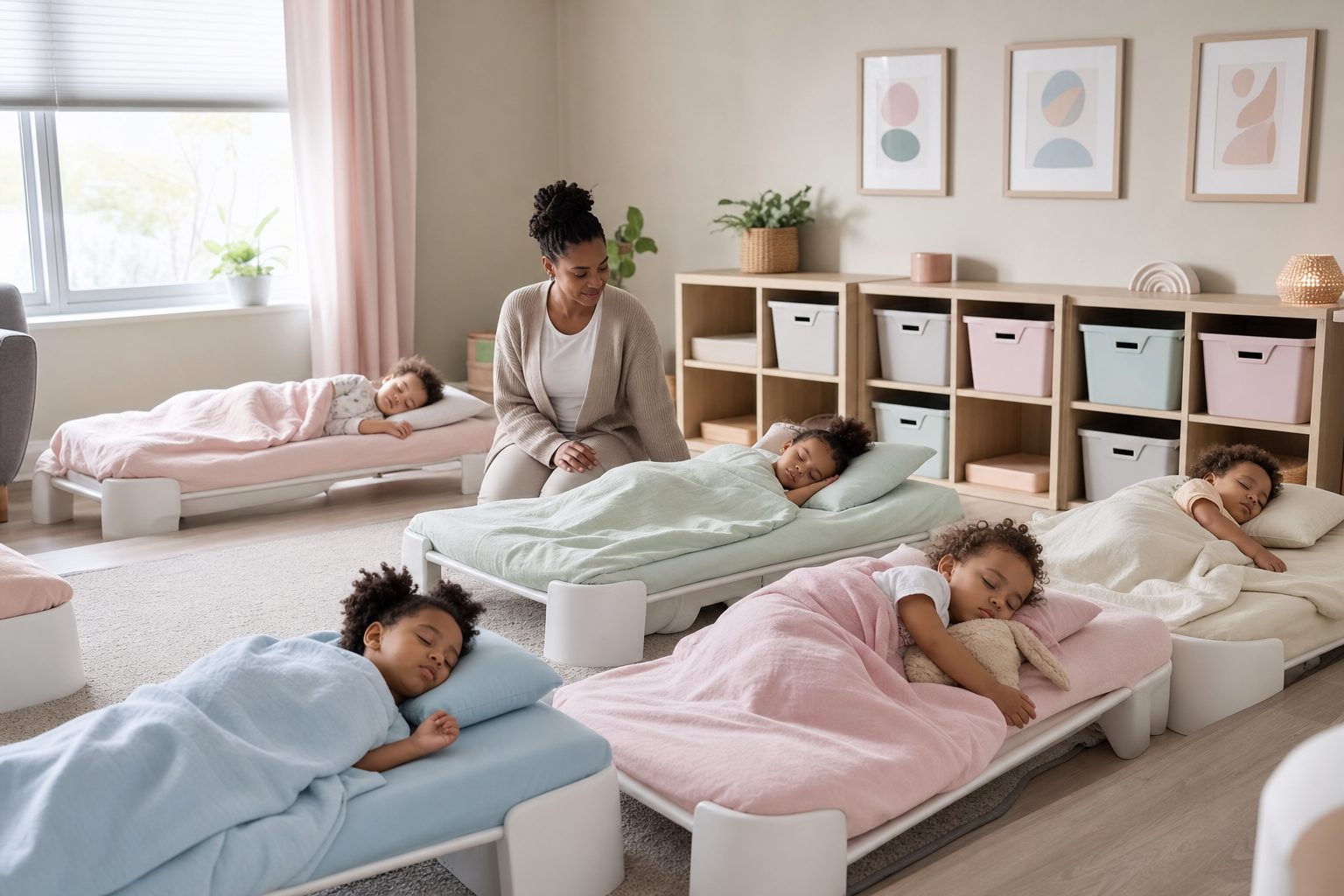
At eleven o'clock, eight children are asleep on low beds. A practitioner moves without noise, pulls up a blanket, sits beside the one who is struggling to settle. Nothing happening in that room resembles teaching. Everything happening in it is nonetheless skilled work, and it conditions what the child will be able to learn in the years that follow.
An educational setting that holds no lessons
The International Standard Classification of Education, maintained by the UNESCO Institute for Statistics in its 2011 version, recognises a first level devoted to early childhood education, situated before primary education. A daycare centre genuinely belongs to the educational landscape: it is not childminding with a pedagogical veneer.
But that level has nothing in common with those that follow. There are no subjects, no assessment, no annual progression. What is built there is more fundamental and less visible: emotional security, language, motor skills, the capacity to be with others, autonomy in everyday actions.
It is a difference of nature, not of degree. A manager who organises the setting like a small school has mistaken the object; one who treats it as mere childminding misses the essential.
Why these years count so much
The international reference on the subject is Nurturing care for early childhood development, published in 2018 by the World Health Organization, UNICEF and the World Bank Group with several partners.
It sets out what a young child needs: a safe, secure and loving environment, with the right nutrition and stimulation from their parents or caregivers. It stresses that the period from pregnancy to age three is the most critical, when the brain grows faster than at any other time — 80% of a baby's brain being formed by that age.
For a daycare centre that figure is not a marketing line: it is a definition of the standard required. People looking after a child between one and three are not supervising, they are taking part in a period whose gaps are not easily made up.
The rhythm is the curriculum
What structures a day in a daycare centre is not a timetable but a succession of physiological and emotional needs.
The morning arrival first, which is a technical moment and not a formality: it is where separation is handled, where information about the night is passed on, where the child moves from one setting to another. A team that rushes arrival pays for that moment all morning.
Then come play and exploration, care — changing, hygiene, the gradual learning of autonomy — the meal, rest, staggered waking, and the parents' return at the end of the day, which is a second transition just as important.
These periods are not interchangeable and cannot be compressed. A rushed meal, a shortened nap or a hurried arrival are paid for in tears, in conflict and in tiredness for the whole group. Organising a daycare centre consists very largely of protecting those periods against the unforeseen.
An adult who counts, not merely adults present
The quality of a daycare centre depends less on its equipment than on the number of adults available and the stability of the team.
A very young child needs landmarks: the same faces, the same gestures, the same way of being picked up. The key-person principle — an identified practitioner who particularly follows a small group of children and links with their families — is not an administrative arrangement, it is what allows a one-year-old to feel safe.
That implies management choices: limiting staff turnover, avoiding moving teams between groups without reason, arranging cover by people the children know where possible, and giving the team time to hand over information.
Staff qualification requirements, supervision ratios and opening authorisations vary sharply between countries and local authorities. They belong to the competent authorities of the territory and must be checked before opening; no national model applies everywhere.
Hygiene and the health of very young children
A two-year-old puts everything in their mouth, does not wash their hands unaided, and passes on whatever they catch to a whole group within hours.
That requires permanent organisation which is anything but incidental: handwashing at defined moments for adults and children alike, cleaning and disinfection of surfaces, toys and washrooms, laundry management, clear separation of changing and eating areas, a known protocol for fever or symptoms, and written procedures for recurring situations.
To that are added food — adapted to ages, notified allergies and family diets — and the possible administration of treatments, which follows strict rules specific to each country. A daycare centre never decides a medical question on its own: it applies what has been prescribed and documented, and refers everything else to a health professional.
The safety of the space
Designing a daycare centre means creating a place where children who have just learned to walk can explore without injuring themselves.
That translates into very concrete material choices: furniture at their height and stable, no small objects within reach, protected corners, secured sockets and cleaning products, suitable flooring, controlled doors and gates, a fenced yard visible from inside. It also translates into human rules: who may come in, who may leave with a child, how identity is checked, what happens if nobody collects a child by closing time.
These obligations belong to local regulation, which can be precise and demanding. They must be known, applied and documented — not reconstructed after an incident.
Reporting to parents is the job
A daycare centre is the only educational setting whose users cannot tell you about their day.
That gives handover a particular importance. A parent collecting their child needs simple, factual things: did they eat, did they sleep and for how long, how did the day go, was there an incident. A vague handover — "it went fine" — repeated every evening ends up worrying rather than reassuring.
Settings that work well organise that handover rather than improvising it: a written record for factual information, a real moment of conversation at collection, and an appointment when a subject exceeds what can be said in a doorway.
They also hold a boundary: the centre observes and flags, it does not diagnose. Noticing that a child says no words at two and raising it with the family is part of the job; concluding anything about their development is for a health professional. Good practice is to describe what you observe, factually, and to refer.
What early childhood represents across the continent
The African Union places the transformation of education systems at the heart of the human capital needs of its Agenda 2063, and in 2025 opened a Decade of Education and Skills Development, with attention to the professional development of education staff.
For an early years setting that horizon translates very concretely: qualifying the people who look after very young children is an investment, not a cost. It is the point on which a daycare centre can genuinely differentiate itself, and the one families perceive fastest.
The economics of a daycare centre
A daycare centre has a fixed capacity, set by its floor area and its staffing. It can neither take more nor make up for an empty place.
Its costs are mostly human and barely vary with the number of children present: the team must be there whether the group is full or not. That produces very different management from a shop: occupancy rate, the rhythm of enrolments and departures, and regularity of attendance count for more than volume of activity.
There is also a specific seasonality: entries often cluster in certain periods, and departures to primary school free places in waves. A setting that anticipates those movements keeps its balance; one that discovers them endures them.
Presenting a daycare centre
A family looking for a daycare centre asks very concrete questions, and asks them with legitimate anxiety: who am I entrusting my child to.
A professional presentation gives the name of the setting and its approach in one honest sentence, the ages taken, the capacity and the number of children per group, the real opening hours and any flexibility, enrolment arrangements and periods, what a typical day looks like, how meals and sleep are organised, the composition of the team and its qualifications, a description of the premises — play, rest and changing areas, outdoor space — how settling-in for new children is organised, how you report to parents, and a contact that answers.
Three pieces of information count more than all the others. The ages taken and the capacity, which filter immediately. The real hours, because a family first chooses what fits their work. And the settling-in period: how you handle the first days says everything about your conception of the work.
Photographs should show the real spaces, clean and tidy, during opening hours. It is prudent to publish images of children only with families' written consent, and many settings prefer to show the rooms rather than faces.
In short
A daycare centre is an educational setting whose main activity is not teaching but caring: protecting a rhythm, offering stable landmarks, ensuring hygiene and safety, enabling play and exploration, and reporting honestly to parents who are entrusting what they hold most precious.
Opening conditions, staffing ratios, required qualifications and health rules depend entirely on the country and its competent authorities: those are what must be checked, and no national model transfers. What does not vary is what a family is looking for: the certainty that someone, in that room, knows their child.
Do you run a daycare centre? State the ages you take, your capacity, your hours and your settling-in period: that is what families look for before calling you.