
"We'd need a PA for Saturday." The sentence says neither how many people, nor in what volume, nor what will be played, nor whether there will be speeches, recorded music, a band, or all three. No equipment can be chosen on that basis: the trade starts with the questions.
A need, not an equipment list
A sound provider does not sell speakers; they answer an intention. Carrying a speech in a conference room, supporting a ceremony, covering an outdoor concert or serving a reception call for neither the same systems, nor the same layout, nor the same number of technicians.
The preliminary study therefore establishes: the type of event, the venue, the number of people expected, the shape of the space, the audio sources planned — voices, instruments, recorded playback, a remote contribution —, the number and type of microphones, the monitoring needs of those speaking or playing, the programme and its timings, and what the venue already provides.
That study is work. It determines the quote, and a provider who quotes without it is quoting at random.
The venue decides
The technical visit is not a formality: two rooms of the same capacity can call for opposite solutions.
You look at the volume and its shape, the materials and how they behave — a very reverberant space imposes different choices from a treated room —, the glazed surfaces, the available height, existing rigging points where there are any, the possible position of the control area and its sightline to the stage, cable routes, the paths the audience will use, the unloading access, and the permitted build times.
Outdoors, wind, rain, neighbours and the frequent absence of existing structures are added. The visit also establishes who else is working and in what order: sound often depends on a structure someone else puts up.
Layout and cabling
The layout consists in placing the system so the audience hears evenly, positioning the monitors, choosing where the control position goes, and defining cable routes.
Two requirements meet. Technical coherence: what is played must cover the area the audience occupies, without dead zones or overwhelming the front rows. And people's safety: no cable crosses a walkway unprotected, no equipment blocks an access or an exit, nothing is placed where the public passes.
A cabling plan written before the build saves time and avoids last-minute mistakes. It also serves the strike, which usually happens tired and in a hurry.
Power: what is prepared, and what is never improvised
This is the trade's main safety subject, and the one where the professional boundary must be sharp.
What is the provider's business: assessing the power their system needs, asking the venue what is actually available, checking that suitable distribution and protection exist, planning backup power where the event requires it, and calling in a qualified electrician as soon as the connection goes beyond a socket provided for the purpose.
What is never their business: modifying an electrical installation, working on a distribution board, bypassing a protective device, improvising a supply, or chaining extension leads to compensate for missing capacity. Those operations belong to qualified personnel and to the rules applicable to the venue and the country.
Where a generator is needed, the provider reasons organisationally: real requirement, an appropriate location away from the public, operation by a competent person, fuel planned, noise and emissions taken into account in the layout. The rest is for specialists.
Rigging, lifting, striking
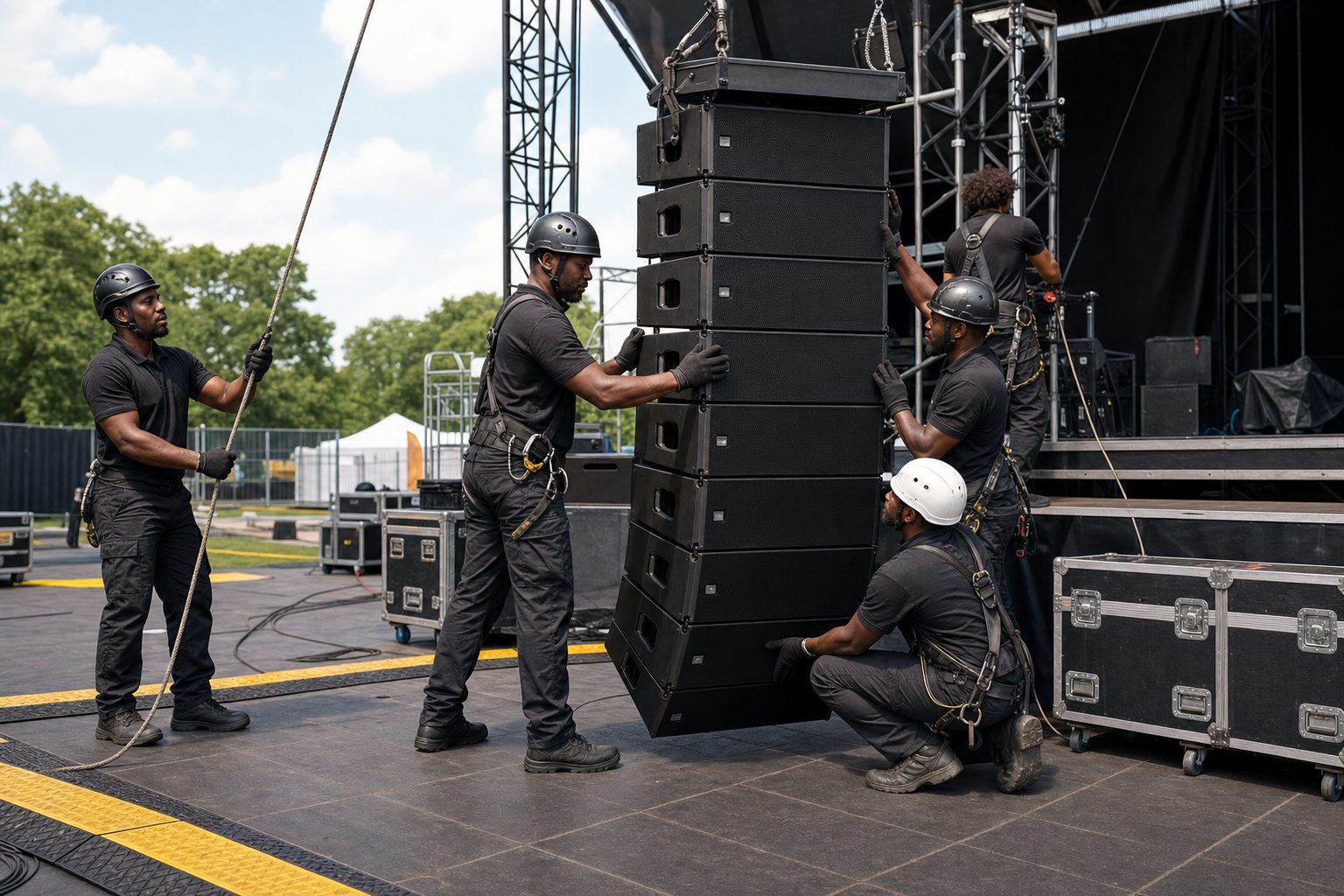
Assembling and lifting a sound system, setting up stands, flying equipment: these are team operations, with loads and sometimes work at height.
The International Labour Organization's code of practice on safety and health in construction addresses exactly this kind of situation at the level of principles — work at height, lifting appliances, manual handling, protective equipment, competent personnel. A serious sound provider applies that logic to their own site: suitable and checked equipment, trained staff, a clear zone during lifting, and no improvisation on a rigging point.
The strike follows the same rules, with one added difficulty: it happens late, after a long day, often while others are striking too.
Testing before doors open
A system is not ready because it is plugged in. Checks happen before the audience arrives: every source, every microphone, the wireless links, the monitors, the evenness of coverage, the starting level, and how the system behaves in the actual room.
It is also the moment for a rehearsal with those who will speak or play, and for the briefing: who gives the cue, how the sequence runs, whom to alert if something goes wrong. A speaker discovering their microphone in front of an audience loses three minutes and a little credit.
Redundancy is prepared here: a spare microphone, a backup source, an extra set of cables. You do not plan for everything; you plan for what most often fails.
Running the show, and the sound level
During the event, an engineer stays at the control position. That is the difference between equipment delivered and a service provided: someone listens, adjusts, corrects a monitor, handles a transition, swaps a failing microphone without the room noticing.
Sound level is not only a matter of comfort. In 2022 the World Health Organization published a global standard for safe listening venues and events, offering a common framework for venues and music events and addressed to public authorities as much as to the private sector, with the aim of protecting audiences' hearing without degrading artistic quality. The precise limits applicable to a given event depend on local rules and on the venue: the provider's role is to know which apply, to monitor the level during the show, and to be able to refuse an unreasonable request.
In the African context
Working conditions vary sharply from one country, one city and one type of venue to another, and there is no single African context. Several realities nonetheless recur in some contexts and bear directly on this trade.
The first is electrical supply. In some areas continuity is not a given, which makes backup power not an option but a quote line to raise at the study stage for any event whose running order depends on sound. The provider then organises around a precise question: what happens if the power stops during the main speech? The answer is prepared, costed and told to the client — it is not improvised on the night.
The second is the nature of venues. Many events are held in spaces never designed for sound reinforcement: highly reverberant multipurpose halls, courtyards, open ground, marquees, places of worship, hotels. The absence of planned rigging points calls for self-supporting systems and a ground-stacked layout, which changes the study completely compared with an equipped hall.
The third is logistics. Depending on the city, traffic and road conditions weigh more heavily on arrival time than the distance covered. Equipment is heavy, sensitive to dust and humidity, and its transport is planned from real travel time, with a margin for the build.
The fourth is how the sector is structured. The International Labour Organization documents the scale of informal employment in its statistical study on women and men in the informal economy, and sound provision is one example: it is practised occasionally, with borrowed equipment, as much as by established providers holding stock, trained crews and insurance. Both realities coexist in the same markets, and a structured provider stands out through what they can show: a written study, a cabling plan, maintained equipment, an engineer on site and a report afterwards.
Digital contributes to this, unevenly across markets. Instant messaging serves to receive an enquiry, obtain a photograph or video of the venue before the visit, and confirm a quote; mobile payment simplifies collection; social media serve as a portfolio. The International Telecommunication Union puts the share of the world's population using the Internet at 74 per cent in 2025, with 36 per cent for Africa — the lowest of the regions it measures: these tools matter where they exist, and never replace the technical visit.
The report — and what a sound provider does not promise
After the strike, a written report closes the job: equipment deployed, how it ran, any incidents and how they were handled, equipment to service, recommendations for next time. It is what allows progress, justifies an invoice and speeds up preparation for the next event. The equipment itself returns to the workshop for checking before being committed again.
A sound provider guarantees neither the absence of failure, nor the acoustic quality of a venue they did not design, nor a level above what the venue's rules allow, nor a date's availability before confirmation. They stand in neither for a qualified electrician, nor the organiser, nor the venue, nor the competent authorities.
What they do commit to can be checked: a study of the need, a site visit, a quote with a readable scope, a cabling plan, checked equipment, tests before doors open, an engineer present throughout, a strike and a report.
Artificial intelligence can help prepare a technical sheet, structure a quote, sort enquiries, summarise a report or organise a schedule. It replaces neither the site visit nor an engineer's judgement on the spot, guarantees no electrical safety and confirms no availability.