
"We'd like something beautiful, for about two hundred people, at the end of the year." That is often the first sentence. It is not enough to book a venue, a caterer or a crew. The whole trade consists in turning that intention into a verified, costed and dated project — before promising anything.
The brief: what has to be established before any promise
An incomplete brief does not produce an approximate quote: it produces assumptions, and every assumption becomes a misunderstanding on the day.
The elements to establish are always the same: the nature of the event, the objective pursued, the date envisaged and any flexibility, the venue or area, the expected number of participants, the audience, the format, the duration, the services actually requested, the known constraints, and the budget the client has.
That last point deserves to be raised early and without embarrassment. Not to sell more, but because the same date, the same guest count and the same venue can produce very different projects. An agency that dares not talk about money at the first meeting produces a proposal that will be refused, then redone.
Feasibility first, then the quote
Between "that's possible" and "that's confirmed" lies the agency's work.
Before proposing, you check what can be checked: the real availability of the date, of the venue considered, its capacity against the expected numbers, the availability of the necessary vendors, of the equipment, the preparation lead times, access and delivery conditions, the site's technical constraints, any authorisations required, and the fit between the programme imagined and the budget available.
A date is never announced as secured before actual confirmation from the venue and the vendors concerned. That is the rule that avoids the costliest mistake in the trade: having promised what someone else has already booked.
From quote to scope
A readable proposal is not judged on its total but on its ability to answer one simple question: what is included?
It therefore separates what is supplied, in quantity or scope where relevant, the set-up, transport, the crew planned and for how long, the strike, additional services, and above all what stays out of scope. The conditions for changes are written in the same place.
One distinction deserves to be explicit: the agency's fees and the vendors' budget are not the same thing. The client must be able to arbitrate item by item. Price levels themselves depend on the market, the type of event and the business: no general scale means anything.
Booking: from enquiry to commitment
In events, a date is a resource: two clients cannot occupy it. Hence the value of naming each step precisely — an enquiry, a possible hold, a quote issued, an acceptance, a payment where one is planned, then a confirmed booking.
Those steps are not equivalent, and the exact moment a commitment becomes binding depends on the contract and the applicable law. Likewise, a deposit, an earnest payment, a bond, an advance and a guarantee are not legally equivalent notions everywhere: their effect on cancellation depends on what was agreed and on the country's rules. A serious agency writes its conditions down rather than invoking custom.
A single schedule of record
Enquiries arrive by phone, by messaging, by email, through the website, through a salesperson, sometimes straight to the manager. That is exactly how double booking is born: the same date promised twice, the same equipment assigned twice, the same crew expected in two places, the same vehicle committed at the same hour.
The remedy is not a particular piece of software. It is a rule: one source is authoritative, and nothing is confirmed to a client until it is recorded there. Paper, spreadsheet, shared diary or dedicated tool, depending on the size of the business — what matters is being able to answer at any moment: which events are confirmed, which enquiries are pending, which crews and equipment are committed, which deadlines are coming, what remains to be done.
Who does what
An event brings together distinct trades: the venue, a caterer, decoration, sound, lighting, photography, video, security, entertainment, transport, cleaning. The agency coordinates them; it does not replace them.
Catering is the clearest illustration. The United Nations international classification of activities in fact isolates event catering as a class of its own, distinct from ordinary restaurant service: it is a trade, with its own obligations, not a side service of the organiser.
What the agency must know and write down is therefore: who does what, who confirms, when each arrives, and what each depends on — the lighting crew cannot work before the structure is in place. As for the precise responsibilities of the organiser, the client, the venue and each vendor, they are read in the contracts and in the applicable law, not in a general custom.
The running order, and the event day
The professional does not discover the plan on the morning itself. An operational document — often called a running order or run sheet — gathers the timings, the sequences, the people responsible, the contacts, the arrival times, the set-up, the interventions, the transitions and the strike. Paper or digital: no format is a standard.
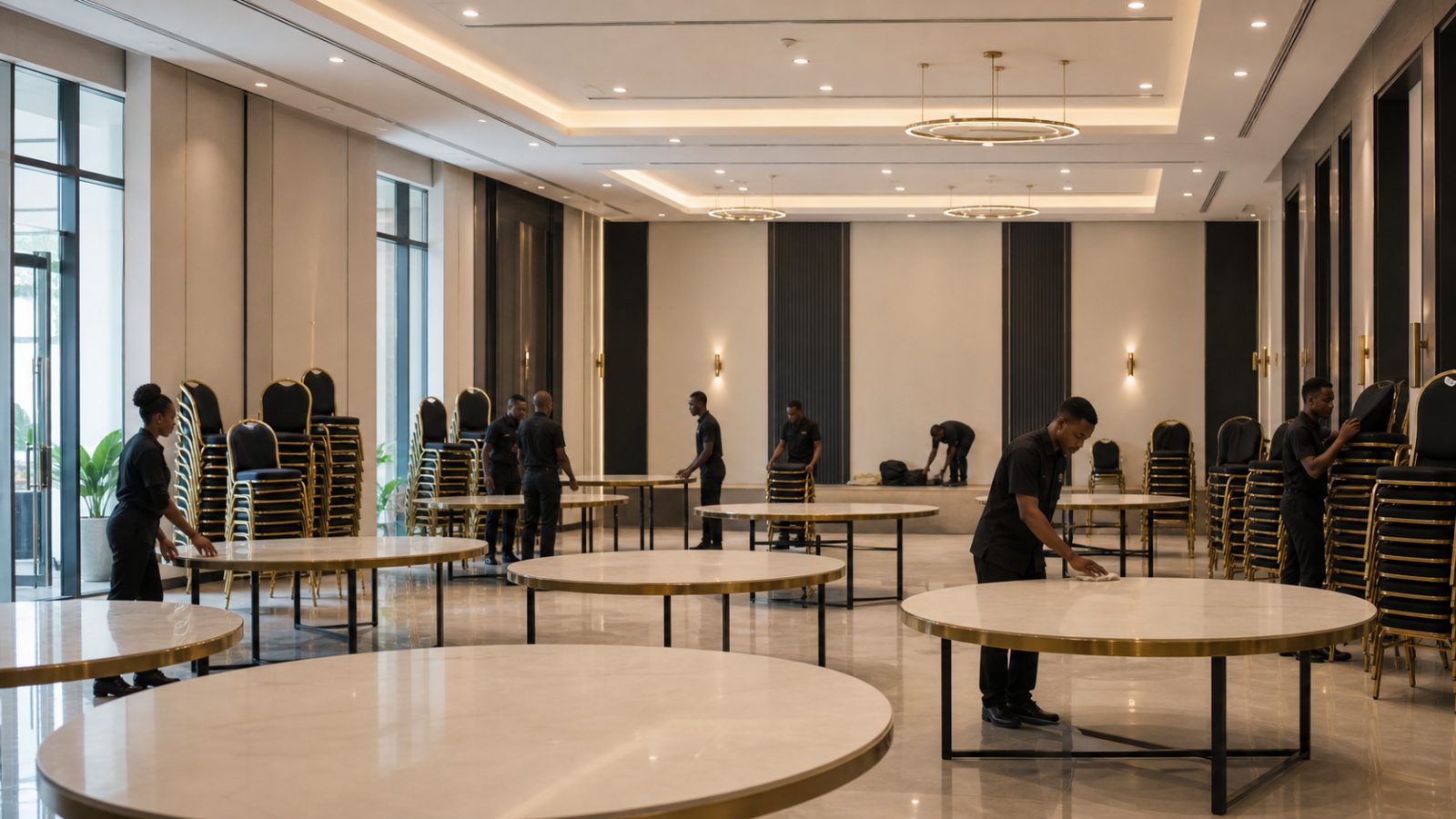
The day then follows a known pattern: arriving early, checking the venue, following the set-up, verifying, briefing the teams, welcoming, coordinating, watching, resolving incidents, then striking. An agency's value is measured less by what it does than by what the client did not have to do.
The fallback plan
No professional eliminates risk. They prepare realistic alternatives for what most often fails: the weather for an outdoor event, a delay, an absence, a breakdown, a power cut, faulty equipment, a transport problem, a supplier who does not deliver.
A useful fallback is decided at the framing stage, not improvised the night before: a substitute location, planned protection, a possible shift in the programme, backup power where the event requires it. And it is told to the client, because an unannounced fallback always looks like a failure.
Public safety and participants' data
Two subjects where the agency must know what it does not decide alone.
On safety, the World Health Organization has published a reference document on public health at mass gatherings — Public health for mass gatherings: key considerations — which stresses planning, coordination between authorities and organisers, the health services provided on site, and unplanned gatherings. In practice, an agency finds out the venue's permitted capacity, the circulation routes and exits, the arrangements the site provides, the emergency contacts and how responsibilities are shared. The applicable rules depend on the country, the city, the type of event and the venue: no requirement is universal.
On data, an event quickly collects names, phone numbers, addresses, a guest list, registrations, photographs. The African Union Convention on Cyber Security and Personal Data Protection provides a continental framework for these questions. Professional practice comes down to little: collect only what is used, limit who has access, protect the files, do not share them without reason, and do not keep them indefinitely.
In the African context
Working conditions vary sharply from one country and one city to another, and there is no single African context. Several realities nonetheless recur in some contexts and change how coordination works.
The first is the supplier ecosystem. In many cities the offer is plentiful but unevenly formalised: an excellent caterer may have no website, a decorator may work without a standard contract, a technician may be reachable only by messaging. An agency's work then lies as much in building and vetting its network as in negotiating: who has already delivered, who answers when called, who invoices. That vetting is a value in itself, and it cannot be subcontracted.
The second is the variety of venues. A dedicated hall, a hotel, a restaurant, an outdoor space, a community venue or a family home: each imposes different constraints on access, set-up and timings, and some provide neither kitchen, nor storage, nor backup power. Where electrical continuity is not a given, that becomes a budget line to raise at the framing stage — and a subject for qualified professionals. In several cities, traffic also weighs more heavily on the build hour than the distance covered.
The third is the nature of demand. Depending on the market, weddings and family ceremonies coexist with corporate events, conferences, trade shows, cultural or religious events, and hybrid formats combining attendance with online broadcast. These segments share neither decision cycles nor invoicing requirements.
The fourth is the channel. In several cities, instant messaging has become the dominant entry point for enquiries, which raises the question of the single schedule directly: whatever is decided in a private conversation has to be recorded somewhere. Mobile payment, for its part, solves collecting a deposit without travel. The International Telecommunication Union puts the share of the world's population using the Internet at 74 per cent in 2025, with 36 per cent for Africa — the lowest of the regions it measures: these channels are very useful where they exist, and replace neither a phone call nor a contract.
After the event — and what an agency does not promise
The trade does not stop when the last guest leaves: strike, handing the venue back, equipment inventory, cleaning, payments and invoices, handling any complaints, delivering photographs, a debrief. A complaint is handled like everything else: listen, document, check, compare against the agreed scope, answer, correct where justified, close. No compensation is automatic — it depends on the contract.
An agency guarantees neither a venue's availability before confirmation, nor the absence of incidents, nor the weather, nor a number of participants, nor a return on investment. It stands in neither for the venue, nor for the vendors, nor for the competent authorities.
What it does commit to can be checked: a written brief, verified feasibility, a quote with a readable scope, a single schedule, a shared running order, confirmed vendors and a proper close-out. That is also what makes an agency legible to a client: a stable professional identity, a site carrying the event, its date, its venue, its programme, an enquiry form, a calendar, quotes, contracts, invoices, payment methods and genuine reviews.
Artificial intelligence can help structure a brief, prepare a schedule, summarise exchanges, draft communication variants, sort enquiries or prepare a checklist. It books nothing, confirms no availability, validates no vendor without verification, does not change a budget on its own, guarantees no safety and invents no authorisation.