
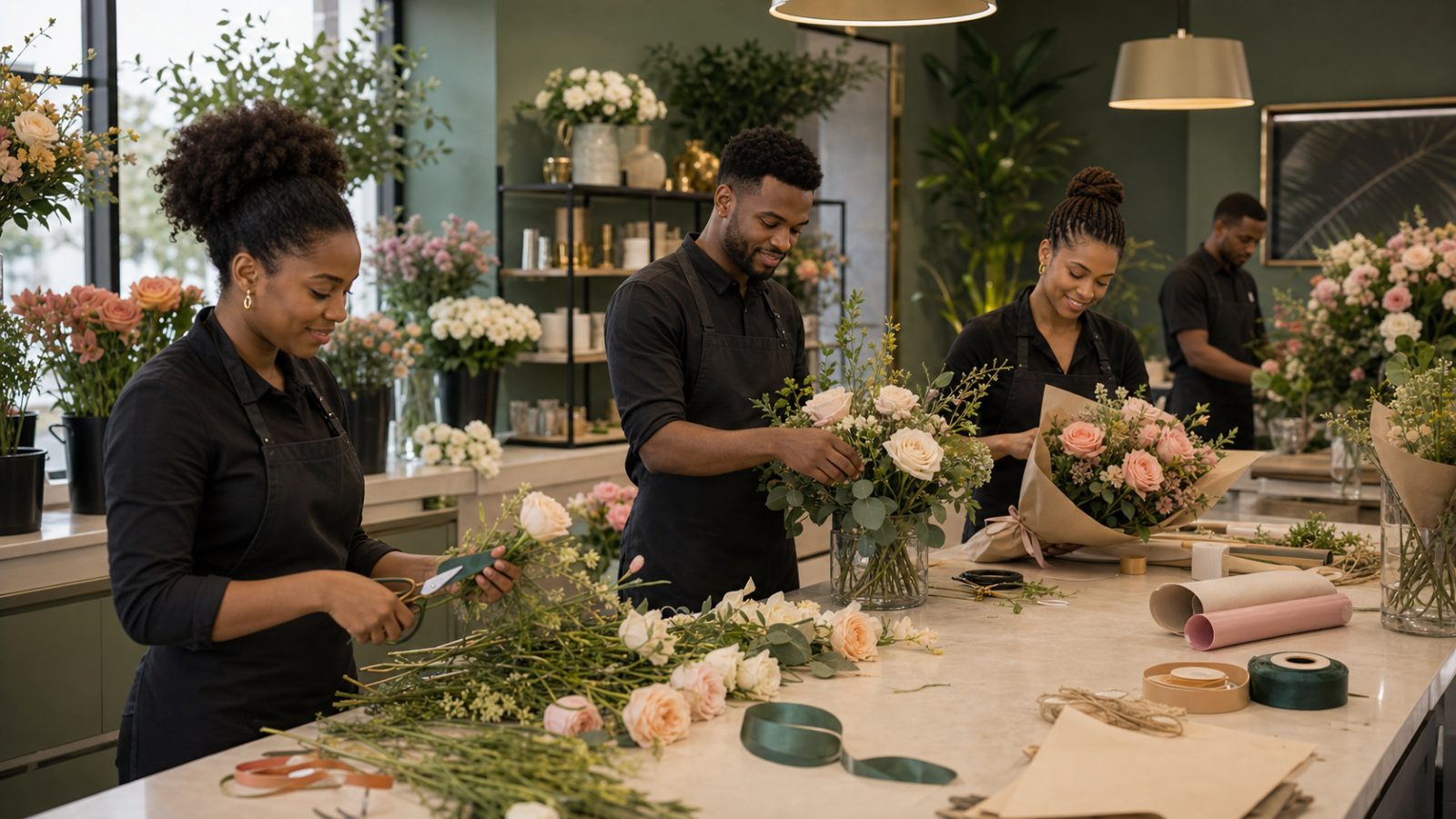
A flower shop looks like an ordinary retail business. It is not: what is not sold today is not worth the same tomorrow, and will be worth nothing the day after. That constraint governs buying, arranging, pricing and even how the day is organised.
A living, perishable, seasonal material
Three characteristics set cut flowers apart from almost any other merchandise.
They are alive: they keep drinking, opening and fading, and how long they last depends as much on holding conditions as on their original quality. They are perishable: stock that does not turn over does not depreciate slowly, it is lost. They are seasonal and variable: the availability, size, colour and price of the same variety change with the period and with what actually arrives.
Hence a rule good workshops apply without arguing: you arrange with what is fresh today, not with what the catalogue promised.
Sourcing and sorting
Buying is the trade's first technical act. It means knowing your suppliers, ordering to a regular delivery rhythm, matching quantities to foreseeable demand — busy days, orders already taken, the season — and accepting to buy less rather than throw more away.
On arrival, you check: actual freshness, the state of stems and foliage, how far the buds have opened, absence of transport damage. Whatever will not last is set aside or downgraded immediately, before it enters an arrangement.
Then comes preparation: recutting, cleaning the lower stems, placing them in clean water in cleaned buckets, sorting the stock daily. How a bouquet turns out is largely decided here, in gestures the customer will never see.
From the occasion to the arrangement
An order rarely begins with a choice of flowers. It begins with a situation: a birthday, condolences, a birth, an apology, a thank-you, a company reception desk.
The professional therefore establishes a few things before arranging: the occasion, the recipient and what is meant to be said to them, the budget available, the date and time of delivery, the place, and any preferences or prohibitions — a colour associated with mourning in a family, a flower unsuited to a circumstance.
They then propose two or three arrangements rather than one, explaining what differs between them. That is advice, not selling: proposing smaller and fresher beats bigger and tired.
Vase life, care and what is promised
The question every customer asks is how long it will last. It deserves an honest answer rather than a promise.
What depends on the florist: freshness on leaving, the quality of preparation, clean water and containers, the consistency of the varieties assembled — some last a long time, others do not, and mixing them without saying so creates disappointment.
What then depends on the customer: putting the flowers in water on arrival, recutting, changing the water, keeping them away from heat or direct sun. Hence the value of providing care advice with every order, written rather than recited.
Many workshops make a minimum vase-life commitment, with replacement if an arrangement deteriorates too quickly. That is good commercial practice — provided the period announced is sustainable, written down, and the conditions are clear. No duration has universal value: it depends on the varieties, the season and the local climate.
Orders, lead times and delivery
Lead time is not the same for everything: a bouquet made from the day's stock, an arrangement requiring a particular order, or an installation to be set up are not planned the same way. Announcing a realistic lead time is part of the trade.
Delivery is a commitment in its own right, and often the most sensitive point. For a birthday or a ceremony, the hour matters as much as the bouquet: arriving after the moment is missing the order even if the flowers are perfect. An imprecise address, an absent recipient, a traffic jam: these cases are prepared for — confirming the contact, announcing a time window, having a fallback — rather than discovered on the doorstep.
Price levels, any delivery charge and the ordering conditions depend on the local market, the season and the arrangement: no general tariff means anything. A deposit, an advance or a cancellation are matters for the contract and the applicable law, never for a rule valid everywhere.
Subscriptions and business customers
Alongside occasion-driven sales, a often steadier share of the business comes from regular customers: company receptions, professional offices, hotels, restaurants, shops, which renew their arrangements at a fixed interval.
That segment changes the workshop's economics. It gives visibility on volumes, therefore on buying; it smooths cash flow; it justifies an organised round rather than scattered deliveries. In return it demands absolute regularity: a subscription is judged on the week you forgot to come.
Floral event work: where the florist stops
Many workshops produce floral décor for weddings, ceremonies or receptions. It is worth stating precisely where the boundary with event decoration lies, since that is another trade.
The florist designs, makes, transports and installs the plant material: table arrangements, arches, bouquets, floral stage pieces, then collects back what needs collecting. The event decorator composes the whole room — surface treatments, textiles, furniture, decorative lighting, signage — and coordinates the people involved.
On the same wedding, the two often work together. What matters then is knowing who supplies what, who installs when, and who answers for what. A florist taking on décor work must also anticipate what the plant material imposes: an arrangement is not installed too early in the heat, it needs water, and it does not travel well once built.
In the African context
Conditions vary sharply from one country, one city and one season to another: there is no single African flower market, and how a workshop is organised depends closely on what it can actually obtain.
The first reality is the nature of supply. Depending on the market, some flowers are grown locally — several countries on the continent produce cut flowers at scale, including for export — while others are imported. A workshop near a growing area handles fresher and cheaper material; one dependent on imports contends with different lead times, costs and uncertainties. The two situations call for neither the same range nor the same stock management.
That dimension has a regulatory side that is often overlooked. The International Plant Protection Convention, administered by the Food and Agriculture Organization of the United Nations and signed by more than 180 countries, governs the international movement of plants in order to limit the spread of pests, and makes international standards for phytosanitary measures its principal instrument. Cut flowers are among the goods covered by those requirements. In practice, a workshop that imports does not simply compare prices: it checks that its supplier meets the applicable formalities, because a blocked consignment is a lost order.
The second is climate. Heat, humidity, dust and the rainy season shorten vase life and call for adapted organisation: cooler premises where possible, clean water renewed, containers cleaned, protected transport, deliveries timed for the cooler hours. These are working habits, not luxury equipment.
The third is local flower culture, which varies a great deal. Depending on the city and local custom, flowers appear mainly at weddings, religious ceremonies, funerals, graduations or corporate events, with colours and symbolism that differ from one community to another. A florist who knows those expectations is not selling an imported catalogue: they propose what genuinely suits the occasion.
The fourth is formalisation, and the opportunities it opens. The International Labour Organization documents the scale of informal employment in its statistical study on women and men in the informal economy, and selling flowers is a common example: it is practised at the side of an avenue as much as in an equipped workshop. It also documents, in its guide on upgrading informal apprenticeship in Africa, how many trades are transmitted in the workshop alongside someone more experienced — a frequent path in floristry. A structured workshop stands out less through its shopfront than through what it can hold to: regular deliveries, honest sorting, announced lead times, a receipt, a remedy if something is wrong.
Digital genuinely contributes. Instant messaging serves to take an order, send a photograph of the arrangement before delivery and confirm an address; mobile payment lets a customer send flowers from a distance, which widens the clientele well beyond the neighbourhood; social media act as the shop window. The International Telecommunication Union puts the share of the world's population using the Internet at 74 per cent in 2025, with 36 per cent for Africa, the lowest of the regions it measures: these channels matter where they exist, without replacing a visible shop or a delivery that is kept.
What a florist does not promise
They do not guarantee a specific variety's availability before the delivery is confirmed, nor a vase life independent of conditions at the customer's home, nor a colour exactly identical to a photograph, nor a delivery insensitive to traffic. They stand in neither for the grower, nor for the event decorator, nor for the carrier.
What they do commit to can be checked: genuinely fresh flowers, sorting actually done, an arrangement suited to the occasion and the budget, care advice provided, a lead time announced and kept, delivery at the agreed hour, and a clear answer when an arrangement disappoints.
That is also what makes the workshop legible: a stable address and opening hours, real and recent work in photographs, a form or a number that answers, prices displayed by range, a receipt, clear payment methods and genuine reviews. No tool is compulsory, and no online presence guarantees orders.
Artificial intelligence can help prepare descriptions, sort references of past arrangements, organise a delivery round, summarise exchanges or keep a checklist before peak periods. It does not see the real state of the stock, confirms no flower's freshness, guarantees no vase life, and does not replace the judgement of the person holding the stem.