
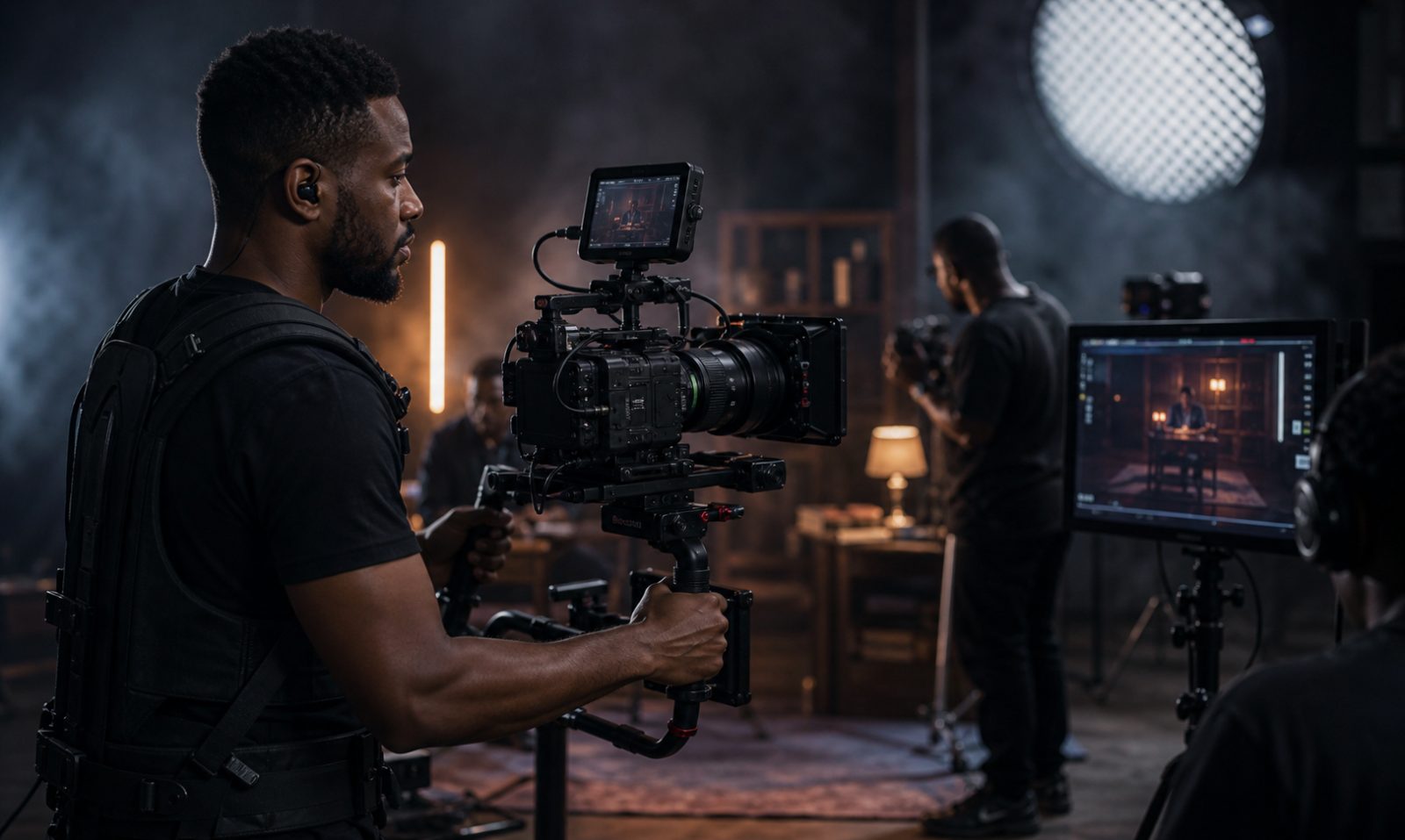
A client asks for "a short video". In their head, that means a day of filming. In the videographer's reality, it means an intention to clarify, a structure to write, a shoot to organise, sound to capture properly, several days of editing, rounds of client feedback, and delivery in three formats. Understanding this profession means understanding that gap.
Filming is only one stage
The videographer produces audiovisual content for a specific use: introducing a company, documenting an event, explaining a service, telling a story, feeding a channel or a social feed.
The work breaks down into three very unequal phases: preparation, the shoot, and everything that comes after. The shoot is the only one the client sees. It is also, almost always, the shortest.
As with other image-based professions, audiovisual production falls under copyright: the World Intellectual Property Organization explicitly lists films and musical compositions among protected works, with economic rights allowing the author to be paid for their use and moral rights protecting the author. A commissioned video is therefore not simply a delivered file: it is a work whose conditions of use are agreed.
Intention before image
The first task is clarification. Why this video? For whom? Where will it be shown? What effect should it have? How long should it run?
These questions determine everything: format, tone, pace, the kinds of shots, whether there are interviews, the role of music. A three-minute film for an institutional website and a thirty-second sequence for a social platform are not conceived in the same way.
Then comes the writing. Depending on the project, it takes the form of a script, a running order, a shot list or simply an interview guide. Even an apparently spontaneous piece of reportage rests on an intention written down somewhere.
Then practical preparation: recces, permissions, scheduling, availability of the people involved, equipment to plan for, and a fallback if the location or the weather changes.
The shoot
On location, the videographer handles several things at once.
Image: framing, light, stability, consistency between shots. A sequence filmed over two hours has to stay coherent even as the light changes.
Sound, very often neglected and yet decisive. A viewer forgives a mediocre image; they leave a video whose words they cannot make out. Suitable microphones, control of ambient noise, safety takes: sound is dealt with during the shoot, it cannot be repaired in the edit.
The people being filmed, who are almost never professionals. Putting them at ease, rephrasing a question, knowing how to prompt without steering the answer: this is a relational skill as much as a technical one.
Time, finally. A shoot rarely goes as planned, and you have to arbitrate on the spot between what is essential and what would merely be nice to have.
Editing, where the film is actually made
This is the longest stage and the most misunderstood.
The editor starts by viewing and logging: sorting through hours of material to extract what is usable. They then build a structure, adjust the pace, work the transitions, integrate music, mix the sound, grade the image, add titles and subtitles.
Every decision is a decision about meaning. Cutting two seconds earlier changes what the viewer understands. This is the moment the film really comes into existence.
Add to that the rounds of client feedback. A healthy framework sets out, in the quotation, how many rounds are included: without that, an edit can stretch on indefinitely.
Delivery
Delivery is not simply sending a file. Depending on where the film will be shown, several versions are needed: horizontal for a website, vertical for social platforms, a short cut, a subtitled version, sometimes a version without music.
To this are added archiving the rushes, backing up the edit project, and being clear about what the client may do with the film: which media, for how long, with what modifications if any.
Very different fields of work
The word "videographer" covers distinct practices:
- corporate video: company presentations, testimonials, recruitment films, internal communication;
- events: conferences, weddings, ceremonies, recordings of performances;
- platform content: short formats, series, regular publishing;
- documentary and reportage;
- music video and creative work;
- online training, in strong demand today;
- product and property video, often paired with photography.
Each has its own conventions, durations, economics and production rhythm. A videographer who states their fields clearly is more legible than an undifferentiated generalist.
Alone or with a team
Many videographers work alone: they prepare, shoot, edit and deliver. It is possible, but it forces constant trade-offs between quality and available time.
On heavier projects, the work becomes collective again: camera operator, sound engineer, assistant, editor, colourist, motion designer. Being able to assemble and coordinate a small team then becomes part of the expected skill set.
Showreel and portfolio
In this profession, you do not describe yourself: you show.
The showreel — a short compilation of the best moments — gives a general impression of style and level. But it is not enough: a client also wants to see complete films comparable to what they have in mind. Showing a full corporate video, with its context and its objective, convinces more than a string of beautiful shots.
A useful portfolio is therefore organised by project type, with a few lines of context for each: the request, the response, the outcome.
An activity that has to be structured
UNESCO estimates that 6.2% of workers worldwide are employed in the cultural and creative sectors, which account for 3.1% of global GDP. It also notes that 40% of workers in these industries earn less than their national minimum wage, and that informality and precarity remain deeply entrenched.
The message is clear: technical mastery protects no one if the business is not structured. Pricing a project properly — preparation, shoot, edit, feedback rounds, deliverables — issuing a precise quotation, contracting usage rights and meeting deadlines are all part of the profession.
The African context
The African audiovisual sector is growing strongly. UNESCO estimates that it employs around 5 million people and accounts for US$5 billion in GDP across the continent, with potential valued at over 20 million jobs and US$20 billion.
It also documents the obstacles, at continental scale: only 44% of countries have an established film commission and 55% a film policy; piracy is estimated to account for between 50% and more than 75% of lost revenue in the film and audiovisual industries. Nigeria alone is reported to produce some 2,500 films a year.
These figures describe an entire continent, or a country that is explicitly named; they cannot be transposed to a country that is not cited. They do indicate a real dynamic, and a concrete stake: in a sector where much activity remains informal, a professional who is clearly identifiable and reachable stands out immediately.
Presenting the work professionally
A client looking for a videographer wants to know: what kinds of films do they make? what does their work look like? do they work alone or with a team? what are the usual lead times? how does a project unfold, from request to delivery? which formats are delivered? how do you get in touch?
Explaining the working process is especially reassuring here, because the client commits to a result they cannot see in advance. Describing the stages, stating the number of feedback rounds included, giving realistic timelines: that is what turns a quotation request into a project.
In summary
The videographer conceives, films, edits and delivers audiovisual content designed for a specific use. The profession plays out as much in preparation and editing as on the shoot, combining technical skill, a sense of narrative and client relationship, within a copyright framework whose details vary by country.
It is an activity where showing the work and explaining the process is worth every argument.
Are you a videographer? Find out how to present your work online: your past projects, your fields, your working process and how to reach you.