
The term often brings to mind a painter at an easel. That image is a considerable reduction. The visual artist works with material and space in every form — painting, sculpture, installation, printmaking, ceramics, textile, photography, video, digital media — and the profession does not stop at producing works: it also involves documenting them, showing them, circulating them and making a living from them.
What the profession covers
A visual artist develops a personal practice within the visual arts. What defines them is not a technique but an approach: a way of seeing and questioning that unfolds from one work to the next.
UNESCO's 1980 Recommendation concerning the Status of the Artist explicitly places painting, sculpture, graphic arts, photography and multimedia within the visual arts. It affirms the artist's right to be considered, if they so wish, as a person actively engaged in cultural work, and consequently to benefit — taking account of the particular conditions of their profession — from the legal, social and economic advantages attached to the status of workers. It calls on States to act on training, social security, employment, income, tax conditions and mobility.
In other words: it is a profession, with its own conditions of practice — even if it resembles no other.
The approach, heart of the work
This is the hardest thing to explain and yet the most decisive.
An artistic approach is neither a theme nor a style. It is what connects the works to one another: a question being asked, a material being explored, a particular relationship to the body, to territory, to memory, to matter. It is built slowly, by accumulation and by elimination.
That coherence is what allows a body of work to be identified, exhibited, written about, collected. An artist whose every work seems to come from somewhere else remains hard to follow, including for those who would like to support them.
Being able to articulate one's approach — in a few clear sentences, without jargon — has become a professional skill in its own right. That text accompanies an application, an exhibition, a commission, a funding request.
Multiple disciplines
The field is wide, and many artists move across several parts of it:
- painting and drawing, on every kind of support;
- sculpture, from modelling to assemblage, from wood to metal;
- printmaking, with its own printing techniques;
- ceramics and work with clay;
- textile: weaving, dyeing, embroidery, often connected to local know-how;
- installation, which works with space and the viewer's relationship to the work;
- photography and video as visual art practices;
- digital practices, from generated images to interactive works;
- performance, where the body becomes the material.
Many artists combine these registers. Sculptural work can give rise to preparatory drawings, to photographic documentation, to an installation.
The studio
The studio is the place of the profession, and much more than a place of production.
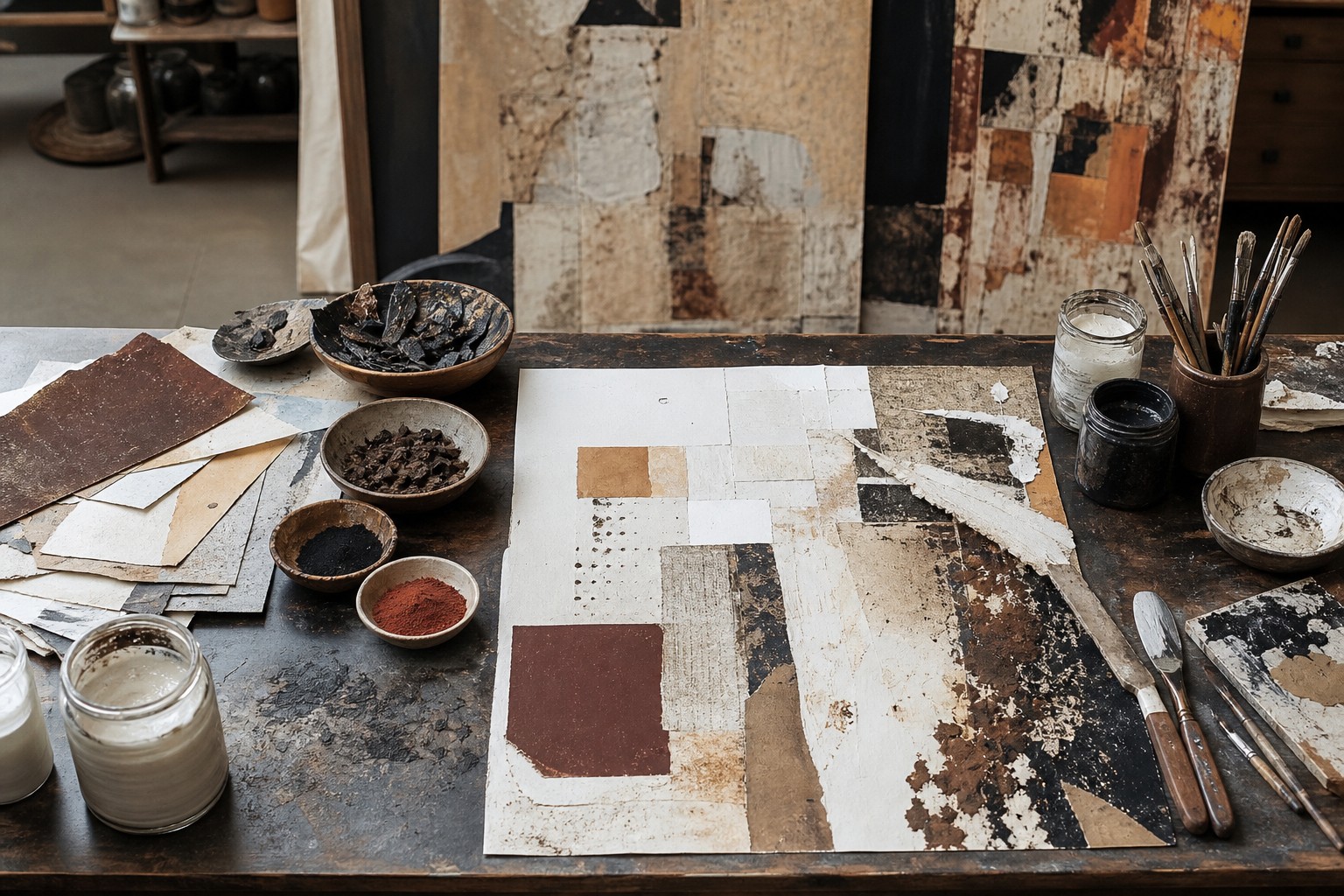
It is a working space — surface, light, storage, safety depending on the materials — but also a space of experimentation where trials, offcuts and abandoned directions accumulate. Many decisions come out of that organised disorder.
It is also a place of reception: gallerists, curators, journalists, collectors, schools. A studio visit remains one of the most decisive moments in an artist's professional life.
Running it is a concrete matter: rent or loaned space, cost of materials, storage of finished works, transport, insurance. The cost of the studio is often the first economic constraint of the profession.
Showing the work
A work that stays in the studio only half exists. Circulation is part of the job.
Exhibitions take very different forms: solo shows, group shows, fairs, residencies leading to a presentation, community or institutional events. Each has its own conventions, application deadlines and economics.
Commissions form another part of the activity: private commissions, corporate commissions, projects in public space, collaborations with institutions. They impose a framework — constraints, deadlines, budget, sign-off — that the artist has to negotiate without distorting the work.
Residencies offer time, a place and sometimes a production budget, in exchange for a presence and often a public presentation.
Relationships with galleries vary enormously between countries and art scenes. A gallery represents, exhibits, sells, makes introductions, and takes a share of sales. It is not the only route: many artists work directly, or combine both.
Documenting the work
This is probably the most neglected and most profitable task in the profession.
Every work should be documented precisely: title, year, technique, dimensions, quality photographs — overall view, details, installation shots. Without that, a work is almost impossible to propose, publish or sell at a distance.
This documentation feeds the portfolio, applications, gallery websites, catalogues, the press. A good photograph of a work has more professional value than a long explanation.
To this is added keeping an inventory: what has been produced, where it is, what has been sold, lent or exhibited. After a few years of production, that record no longer fits in one's head.
Copyright and ownership of the work
A frequently misunderstood point: selling a work does not mean transferring the rights attached to it.
The World Intellectual Property Organization notes that artistic works — paintings, drawings, photographs, sculpture — are protected by copyright, with economic rights allowing the author to derive financial reward from the use of their work by others, and moral rights protecting their non-economic interests, notably the right to claim authorship and to oppose changes to the work. Under the Berne Convention this protection is automatic, with no registration formality.
The precise terms — duration, exceptions, resale right, transfer — fall under national legislation and vary. An artist who sells, lends or allows a work to be reproduced has every reason to write down what is being transferred and for what use.
Making a living from the work
UNESCO estimates that 6.2% of workers worldwide are employed in the cultural and creative sectors, which account for 3.1% of global GDP. It also notes that 40% of workers in these industries earn less than their national minimum wage, and that informality, precarity and gender disparities remain deeply entrenched.
The economics of the profession are therefore rarely linear. Income is most often made up of several sources: sales of works, commissions, residencies, prizes and grants, workshops and teaching, collaborations.
That makes a few simple professional practices all the more necessary: a coherent and assumed price structure, invoices, written agreements for exhibitions and commissions, and follow-up on what is owed. These do not restrict artistic freedom: they protect it.
The African context
African art scenes are gaining international visibility, driven by fairs, biennials, galleries, art centres and a growing number of collectors on the continent itself.
UNESCO documents the potential of African cultural and creative industries while pointing to persistent obstacles at continental scale: informality, a gap between available training and real needs, and professional frameworks that remain incomplete. Its 1980 Recommendation concerning the Status of the Artist aims precisely at improving the professional, social and economic status of creators.
Situations vary considerably between countries and between cities; no national observation can hold for the continent. One practical consequence does stand out: in an environment where intermediaries are unevenly present, an artist whose work is documented and accessible, and whose path can be followed, widens their possibilities considerably — including internationally.
Presenting the work professionally
A gallerist, a curator, an institution or a buyer are all looking for roughly the same thing: to see the work, understand the approach, situate the path, and know how to make contact.
In concrete terms: a set of well-photographed and captioned works, a short clear statement of the approach, a biography or exhibition history, an indication of where the artist works, and a direct means of contact. Many opportunities are decided on that basis, before any meeting takes place.
This is not promotion: it is what makes the work consultable. An artist for whom no decent image, no text and no contact can be found remains, professionally, hard to champion.
In summary
The visual artist builds an approach, works it out in a studio, deploys it across multiple disciplines, then brings it into existence through exhibitions, commissions and documentation. It is a profession of creation and, just as much, a profession of organisation, set within a copyright framework whose terms vary by country.
Making a living from it means producing — and making that work visible, legible and reachable.
Are you a visual artist? Find out how to present your work online: your pieces, your approach, your exhibition history and how to reach you.