
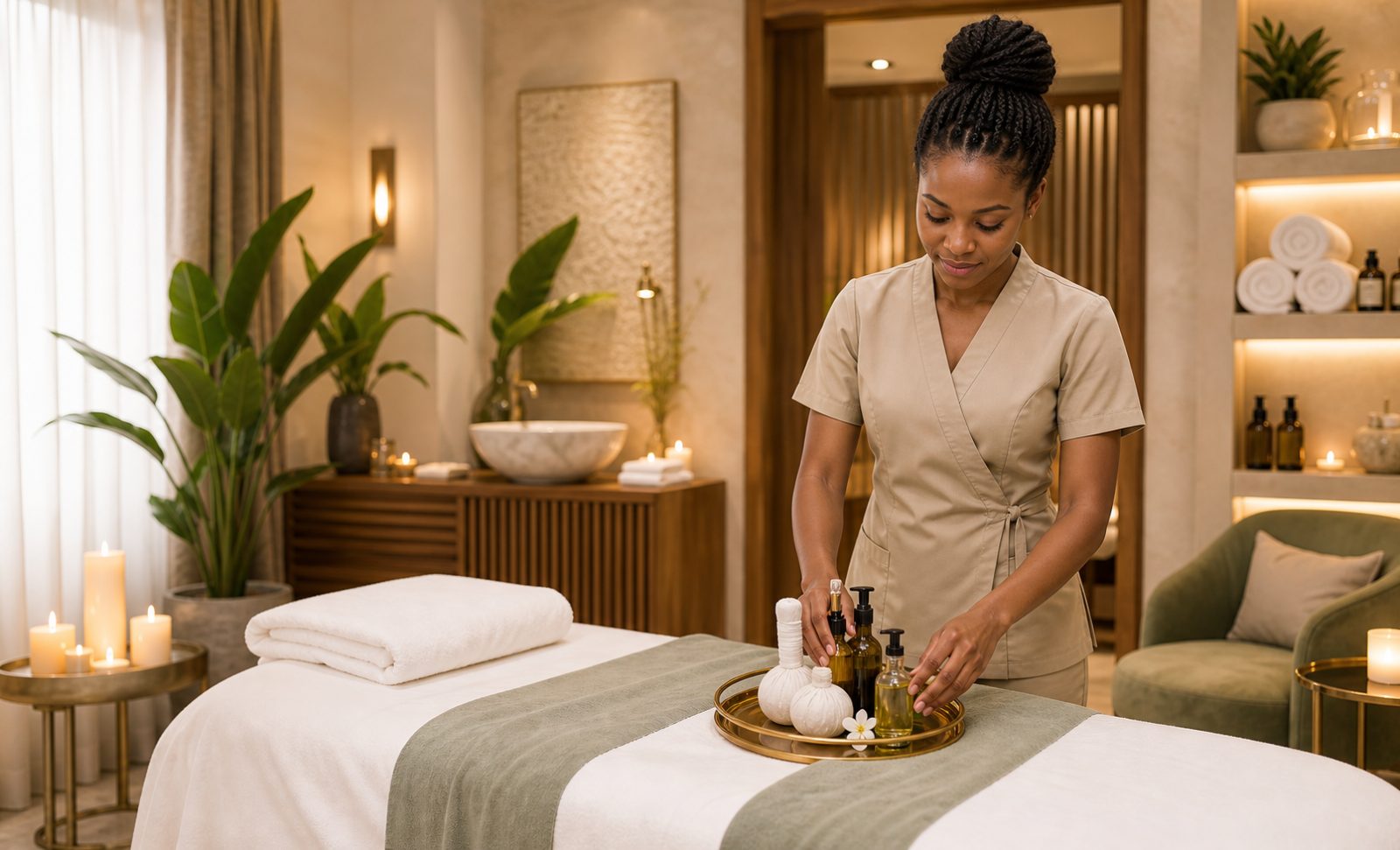
Ask someone why they are happy with their spa: they will tell you about the scent on arrival, about not being kept waiting, about the warmth of the room, about the silence. Almost never about the treatment protocol. That gap sums up the trade: in a spa, the technical service is only one link in a chain, and it is the whole chain that is sold.
What we call a spa
The word covers very different realities: a hotel wellness area, an institute with wet rooms, an urban massage centre, a space attached to a gym, an independent facility with pool, sauna and steam room.
There is nonetheless an internationally authoritative service definition. The ISO 17679:2016 standard, "Tourism and related services — Wellness spa — Service requirements", establishes the service requirements of a wellness spa, the main supporting processes and the quality of service to be provided to the client. It is designed to be usable by spas of all types and sizes, including where the spa forms part of another activity — accommodation, fitness centre, health facility.
The standard is equally useful for what it excludes. It covers neither accommodation nor food and beverage, does not apply to medical spas or thalassotherapy centres, and does not cover decisions relating to the medical professions or medical training. The boundary is drawn from the outset: a wellness spa is not a place of medical care.
The journey, not the treatment
A spa is designed as a journey in five stages, and any one of them can ruin the others.
Arrival: welcome, orientation, changing room, an explanation of what will happen. This is where the client puts the day down; if they have to work out where to go, they do not put it down.
Warming up: steam room, sauna, pool, quiet waiting time. This stage is not decoration — it prepares body and mind for the treatment.
The treatment itself, in the room, one to one.
Coming back down: tea area, rest space, quiet time. A treatment followed immediately by a noisy corridor and a till cancels part of its effect.
Departure: payment, any advice, booking the next visit, without haste.
The commonest mistake establishments make is to polish the middle of the chain and neglect the ends. Yet it is on the ends that the client's memory is built.
The roles that keep a spa running
A spa is almost never a single occupation. Depending on its size you will find:
- reception, handling bookings, arrivals, payments, orientation and the unexpected — a strategic post rarely recognised as one;
- treatment practitioners, beauty therapists and massage practitioners, who deliver the protocols;
- spa coordination or management, building the treatment menu, planning room use, managing stock and the team;
- technical maintenance, looking after water, air, heating and linen — invisible to the client and decisive for them.
In small structures that last function is usually absorbed by the others. It does not thereby disappear.
The body treatment practitioner
This is the spa's most identifiable role, and the most physically demanding.
The WorldSkills international standard for beauty therapy devotes around a quarter of its competences to body treatments — massage, wraps, scrubs, aromatherapy — and describes a professional working one to one with the client, in structures of every size attached to leisure and health-related organisations.
The daily reality is work with the hands, forearms and back, repeated, standing or leaning, across sessions that follow one another. The European data from the neighbouring hairdressing sector — close to 40% of workers reporting musculoskeletal complaints, five times the all-sector average — indicate clearly enough what awaits a manual trade practised without attention to posture, table height and spacing between appointments. Whether a practitioner's career lasts is decided there, not in technique.
Water and air: the invisible technical half
As soon as a spa has a pool, a hot tub, a steam room or a sauna, it is operating shared equipment, and operating it is a trade in itself.
The World Health Organization's guidelines for safe recreational water environments, whose volume 2 deals with swimming pools and similar environments, set out the full range of hazards to be covered: drowning and injury, microbial contamination, exposure to chemicals, and air quality. They also make one precise point that speaks directly to spas: in hot tubs it is harder than in pools to control the growth of Legionella and Pseudomonas aeruginosa. Frequent monitoring and adjustment of pH and disinfectant levels are essential there, as are programmed rest periods allowing disinfectant levels to recover.
Translated into operations: a spa with a pool keeps a log, takes regular readings, schedules downtime, maintains its ventilation and has someone explicitly responsible for it. None of that is optional, and none of it ever appears on the treatment menu.
Service quality that can be written down
The value of ISO 17679 to an operator is not a badge. It is having a list of what must exist: defined supporting processes, a described quality of service, requirements that apply whatever the size of the establishment.
In a trade where almost everything happens in how it feels, a written reference frees the operator from subjective judgement: room temperature, turnaround time between two clients, linen availability, what the welcome contains, product traceability stop being habits and become rules.
What a spa is not
A wellness spa does not diagnose, does not treat disease and replaces no health professional. The ISO standard itself explicitly places medical spas outside its scope.
That clarity protects everyone. It protects the client, who needs to know that a massage is not a therapeutic act. It protects the practitioner, whose responsibility stops where a health professional's begins. And it protects the establishment, which has no need to promise what it cannot deliver. Faced with pain, a known condition, a pregnancy or ongoing treatment, the right professional response is to refer to a health professional and, where appropriate, not to carry out the service.
The economics of a spa
A spa is a high fixed-cost business: floor space, water, heating, linen, products, staff. Every unused room is a straight loss, and a pool runs whether there is one client or twenty.
Hence three structuring levers. Filling the quiet hours, which explains weekday and daytime packages. The length of the slots, which must include the time to reset the room, failing which the diary overruns by the third client. And selling memberships and gift cards, which smooths cash flow and turns an exceptional visit into a habit.
Presenting a spa
A spa is booked in advance, often for an occasion, sometimes as a gift. Clients decide on what they can see and on what they understand.
A serious professional presentation includes: the establishment's name and positioning, the treatment menu with clear durations and prices, a description of the available spaces — pool, sauna, steam room, rest area — and the rules for using them, real photographs of the place, the address, opening hours, booking, packages and gift cards, the team, and the practical details everyone wonders about without asking: what to bring, how long to allow, from what age, how arrival works.
Photographs carry decisive weight here, because a spa is a place before it is a service. They must show the place as it is, not a catalogue image: in this sector, the gap between the photograph and the reality is the leading cause of disappointment.
In summary
A spa is a chain of attentions in which the treatment is only one link. It brings together reception, practitioners, coordination and technical maintenance, with a demand for consistency that the international standard ISO 17679 makes it possible to formalise.
It is a wellness trade, not a health one: it stops dead in front of anything belonging to a health professional. And it is a demanding operation, where water, air and linen cost money every day, quiet days included.
Do you run a spa? See how to present your establishment clearly online: your treatments, your spaces, your durations and how clients can book.