
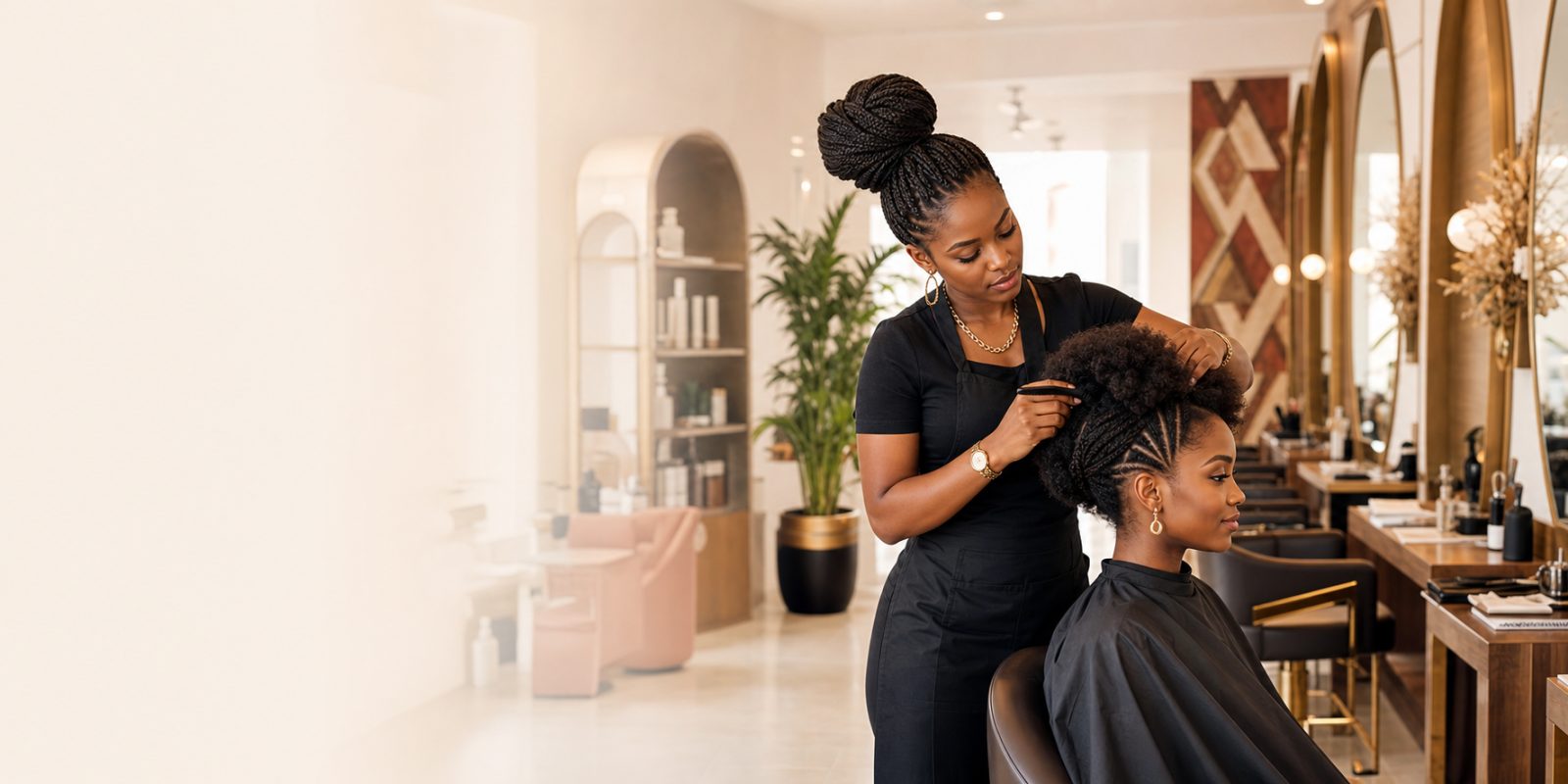
People walk into a hair salon for a cut, a colour, a blow-dry. They walk out with something else: an updated image of themselves. That part of the work explains why a hairdresser is not merely a technician, and why a salon is not merely a shop.
A place before it is a gesture
A salon begins with a layout decision. Where to put the basins, how many stations, what lighting, how much space between two clients, where to store products, how to keep the noise of hairdryers away from the waiting corner. None of this is decoration: every choice is paid for later in working comfort, in time lost or gained, and in the impression left on the client.
The WorldSkills occupational standard for hairdressing describes a trade practised in strikingly varied settings — salons of every size, mobile services, private homes, film and television sets, theatre, product companies — and notes that the professional works sometimes alone and sometimes in a team. The salon is not the only possible home for the craft; it is simply its most visible form.
The consultation is where the service really starts
The first professional act is not an act at all: it is a conversation. What does the person in the chair want? What do they think they want? What is achievable on their hair, in the time available, within the budget they have named?
Occupational standards give this stage a name: consultation. WorldSkills alone assigns it roughly a fifth of the total weight of the competences expected of a hairdresser — greeting, understanding the request, judging what is possible, explaining, and getting agreement on the gap between the wish and the achievable result.
It is also where final satisfaction is decided. A disagreement left unaddressed at the start becomes a complaint at the end. Experienced hairdressers put it differently: an hour of technique will not repair what five minutes of conversation failed to settle.
The main families of services
A salon rarely lives on one thing. Services fall into a few families, in proportions that shift with the clientele:
- cutting, which means reading the hair before choosing the tool and the method;
- colouring, the most technical family, working with products that react chemically and where correcting a colour that has gone wrong is a skill in itself;
- styling: blow-drying, shaping, finishing, fitting attachments and extensions;
- lasting transformations, perming and straightening, which change the structure of the hair;
- event work: weddings, photo shoots, competitions, sets — governed by constraints of time and appearance quite unlike an ordinary salon day.
To which one activity is often forgotten: advising on and selling aftercare products, which extend the service between two appointments.
A day in a salon
A salon day is not a queue. It is an interlocking. While a colour develops, a cut begins; while a blow-dry dries, the next appointment is welcomed. Running two or three staggered services without keeping anyone waiting is a competence in its own right — and the leading cause of bad days when it fails.
The rest of the time goes into what clients never see: cleaning the station between two people, washing and putting away, preparing mixes, managing stock, taking bookings, answering messages, handling the till. In a very small salon, one person does all of it.
The hairdresser's body is the working tool
This is the least-told reality of the trade. You work standing, arms raised, leaning forward, for hours at a stretch, with your hands in water and in products.
The European figures are blunt. According to the European Agency for Safety and Health at Work, hairdressing is the occupation most exposed to work-related skin disease: up to 70% of workers experience work-related dermatitis, at least ten times the average across all sectors. Close to 40% report musculoskeletal complaints, five times the average. The European ESENER-2 survey, for its part, put "having to deal with difficult customers" at the top of the risks most frequently reported by establishments in the sector.
None of this is inevitable, and it is precisely the subject of the European framework agreement signed in 2016 by the sector's social partners, UNI Europa Hair & Beauty and Coiffure EU: protection of the skin and the respiratory tract, glove use, reduced exposure to wet work, benches and chairs designed to avoid harmful postures, ventilation, lighting, flooring, hygiene facilities. Notably, the agreement applies to employers, employees and self-employed hairdressers — an acknowledgement that working for yourself shelters you from none of these risks.
Hygiene as a visible sign of seriousness
A client cannot judge a colouring technique. A client can judge a dirty comb.
Salon hygiene is first a matter of professional common sense: clean linen for each person, tools cleaned between clients, a clear worktop, a swept floor, products stored and labelled, closed bins. It is then a matter of local rules, which differ from country to country and which each professional must know for the place where they practise.
The important point lies elsewhere: hygiene is not an administrative burden to be endured, it is the first reassurance anyone can see. It is judged before the first pair of scissors opens.
Where and how the trade is learned
Routes into the profession vary widely by country: vocational qualification, formal apprenticeship, private school, certification by a recognised body, sometimes a licence or permit to practise. There is no worldwide rule, and presenting one country's system as the general norm would be wrong. For anyone planning to set up, the question is always local: what does my country require in order to practise, and in order to open premises?
Across much of Africa, the trade is largely passed on through workshop apprenticeship: you learn with a master, by watching, then assisting, then doing. The International Labour Organization has devoted a resource guide for the continent to this system, and notes that at its most informal end the master–apprentice relationship may remain entirely verbal, with no agreed term, no schedule of learning, no assessment and no certification. That is both the strength of the model — it genuinely trains, and it trains many — and its limit: what is not certified is hard to convert into recognised value later.
Different hair, different expertise
A salon does not receive "hair" but textures: straight, wavy, curly, coily, coloured, weakened, extended. Each family calls for different tools, different processing times, different products and different hands.
WorldSkills states explicitly that the internationalisation of the trade requires professionals to understand and work with diverse cultures, trends and hair types. That is a commercial competence as much as a technical one: a salon that says clearly which textures it masters attracts the right requests and avoids the appointments that were always going to go badly.
A salon is a business
In Europe the sector employs more than a million people, over 80% of them women, in establishments averaging fewer than three workers. The share of self-employment is far above that of the economy as a whole.
In practice: most salons are very small structures where the hairdresser is also the manager. They set prices, keep the diary, buy products, hire and train, pay the charges, decide opening hours and absorb the quiet months. Technical skill is not enough on its own; it turns into income only if the diary fills and the costs hold.
Making the salon legible from outside
A salon is a neighbourhood business whose decisive moment happens before anyone walks in. Someone looking for a hairdresser wants simple facts: where is it, what are the hours, is it by appointment, which services at what prices, which hair textures are handled, what does the place look like, who works there.
A professional online presence answers those questions without turning the salon into an advertisement: the salon's name, the specialities actually practised, the list of services, prices if you choose to display them, photographs of work and of the interior, the address, the opening hours, booking, a phone or messaging contact, the team, the networks where the work is published.
Photographs of finished work have a particular status here: they are the proof of skill. Clients do not judge a cut from a description; they judge it from visible results, preferably on hair that resembles their own.
In summary
Salon hairdressing combines three things: listening that decides whether the service succeeds, technique that handles hair and chemistry, and a small business that has to hold together. It is done standing, with your hands and with people, in a setting whose hygiene and organisation are visible to everyone.
Training, qualification and set-up requirements vary by country, and it is always the local rule that applies. What does not vary is this: a salon nobody can find, whose hours and services nobody knows, stays empty however good the work done inside it.
Do you run a hair salon? See how to present your business clearly online: your services, your work, your opening hours and how clients can book.