
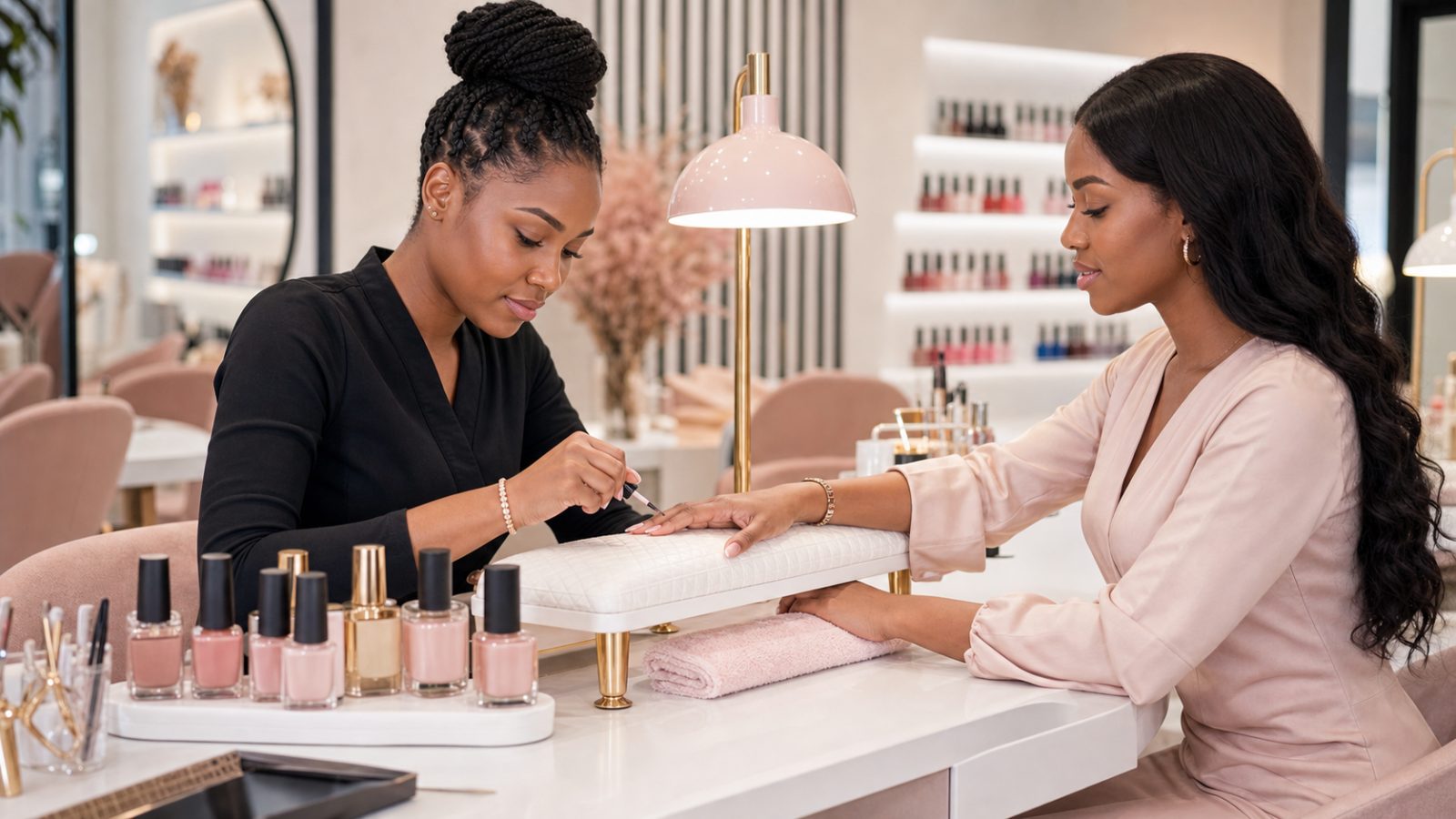
Nail salons are judged on photographs, and photographs show only a result. They show neither the two hours spent seated, nor the precision demanded on a few square millimetres, nor the products handled all day long. Nail technology is far more technical than its shopfront suggests.
More technical than it looks
Working on a nail means working on a surface a few millimetres across, curved, different on every finger and every person, while accounting for how it will grow out over the next three to four weeks.
The WorldSkills international standard for beauty therapy places feet, hands and nails among its major competence blocks — around 15% of the total — and explicitly includes manicures, pedicures, nail art and gel applications. This is not a sideline: it is an identified speciality that can constitute a professional's entire activity.
What the service actually covers
Behind the word "nails" sit quite different services:
- manicures and pedicures, centred on shaping, cuticle care and finishing;
- semi-permanent polish, which lasts several weeks and demands rigorous surface preparation;
- built applications — gel, acrylic, tips, forms — which rebuild or extend the nail;
- infills, the periodic maintenance of an existing set;
- removal, an operation in its own right and often underestimated;
- nail art, decoration applied by hand or otherwise.
Each has its duration, its price, its equipment and its level of risk. Blurring them into a single price list is the leading cause of appointments that overrun.
Application, removal, maintenance
Application starts with what clients notice least: preparation. Cleaning, pushing back cuticles, shaping, degreasing. This stage determines how long the set holds; a set that lifts after five days is almost always rushed preparation, rarely a bad product.
Then comes the build: applying in layers, controlling thickness, apex and curve, curing, filing to finish. The hand must be consistent across ten fingers, which is a difficulty in itself.
Removal is the trade's moment of truth. Taking off a cured material without damaging the natural nail takes time, patience and a willingness to give up speed. It is also the moment when the real state of the nail under the set becomes visible, and when a professional decides whether to reapply immediately or advise a break.
Maintenance, finally — infills every three to four weeks — makes up most of a nail salon's actual revenue. A nail technician's clientele is not passing trade: it is a subscription in all but name.
Nail art, between technique and signature
Nail art is what visually distinguishes one professional from another. It is also what travels: a photographed set circulates, gets shared, and brings clients back.
Technically it combines freehand drawing, applied materials, texture effects and embedded elements. Commercially it obeys a simple rule that is often poorly applied: it is charged by actual time, not at a flat rate. Complex decoration across ten fingers can double the length of an appointment; if it is not priced accordingly, it eats the day.
It is also where a speciality is built: understated styles, worked long nails, graphic patterns, seasonal designs. A professional known for a style attracts clients who come for that style, which is always more profitable than undifferentiated trade.
The workstation: the question of air
This is the most serious point in the trade, and the one most often waved away.
A nail technician handles volatile products every day and generates filing dust. The United States Occupational Safety and Health Administration stresses that nail salon workers are exposed to many chemicals daily, and that these exposures add up — the more so when several products are used at once, day after day, or when ventilation in the premises is poor. It notes that good ventilation and safe work practices are enough to keep exposure to gases, vapours and particulates to a minimum.
NIOSH, the US public research institute for occupational health, fills in the picture: artificial nail products contain many substances, of which ethyl methacrylate is the main one, and these can cause contact dermatitis, asthma and allergies. Its testing indicates that exhaust ventilation systems can reduce workers' chemical exposure by at least 50%. The practical recommendations that follow are concrete: extraction at the workstation, renewed air, chemicals stored separately in a ventilated area, gloves, long sleeves and eye protection against acrylic dust, and regular washing of hands, arms and face with mild soap and water.
None of this is spectacular, which is precisely why it gets neglected. Yet a nail technician builds a career over twenty years: the question is not whether exposure matters over one day, but over ten thousand.
The client's hand: where the trade stops
A nail professional works on appearance, not on health.
Over-aggressive preparation, a lifted edge left in place, a poorly decontaminated tool can create problems the trade has no business treating. Faced with a lifted nail, inflammation around the nail fold, unusual colouring or deformation, or pain, the right professional response is simple: do not apply, do not cover it up, and refer to a qualified health professional.
Decontaminating reusable equipment between clients follows the same principle. It is not a clinical protocol, it is the professional minimum: a tool that touches skin does not pass from one person to another without being cleaned and disinfected, and files and bits meant for personal use stay personal.
Products and their labels
A professional uses cosmetic products; she needs to know what she is holding.
In the European Union, Regulation (EC) No 1223/2009 requires every cosmetic product to have an identified responsible person, to have undergone a safety assessment before being placed on the market, and to carry mandatory labelling including that person's name and address, the content, the date of minimum durability or the period after opening, and precautions for use.
That framework is European and does not apply identically everywhere. The grid remains useful elsewhere: a product whose manufacturer and composition cannot be identified, sold without a legible label, has no place on a professional workstation.
The diary is the real management tool
A nail salon is not steered by hourly revenue but by occupancy.
Appointments are long — one hour to two and a half depending on the service — and do not lend themselves to improvisation. A single late client shifts the whole day. A slot cancelled the evening before almost never gets refilled.
Hence practices that are anything but incidental: stated durations service by service, appointment reminders, clear cancellation rules, filling the quiet hours, and above all pricing that reflects the time actually spent — removal included. Many professionals lose money on removal because they gave it away once.
Presenting a nail business
This is a trade that sells in images but is booked on information.
A complete professional presentation includes the business name, the services with their durations and prices, a clear statement of what is included and what is not — removal in particular — a gallery of real work, regularly refreshed, the address or the area covered, opening hours, booking, a direct contact, the networks where the work is published, and the cancellation terms.
The gallery does the commercial work: it shows the style, the standard of finish and the range. The information does the rest: nobody books two hours of their time without knowing how long it takes and what it costs.
In summary
Nail technology is a precision craft practised on a very small surface, with products that demand real attention to ventilation and protection, inside a business model built on long appointments and a clientele that returns every three to four weeks.
The style is visible, the technique is judged on how long the set holds, and the seriousness is read in two invisible details: what happens during removal, and the quality of the air above the workstation.
Are you a nail technician? See how to present your business clearly online: your services, their durations, your work and how clients can book.