
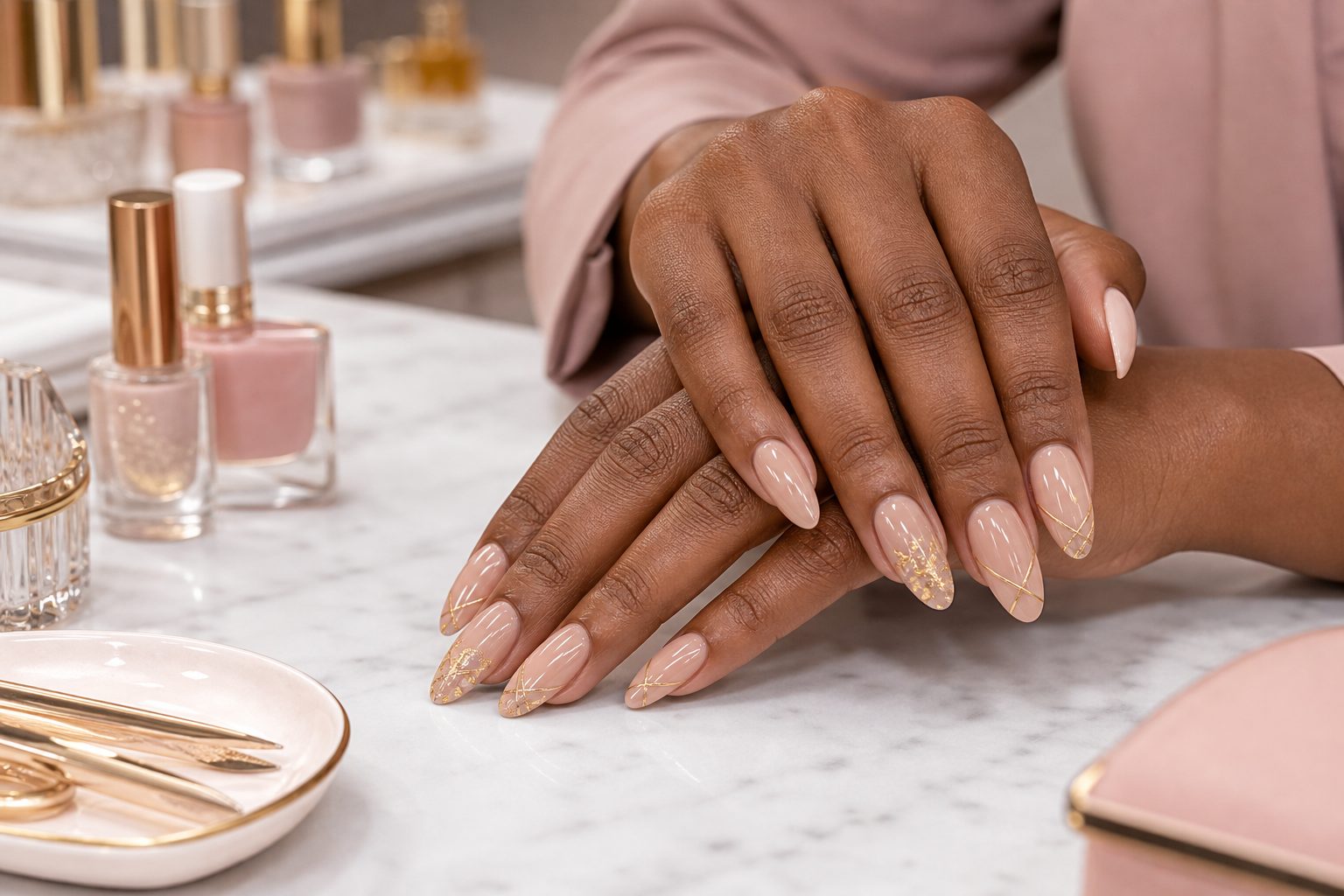
A home nail technician does exactly the same work as a salon one: preparing, applying, structuring, finishing. The difference is that she has to build her workshop first. At every appointment, in a room she is seeing for the first time, with whatever furniture she finds.
Why nail work travels
The reasons lie in the nature of the service itself.
A nail appointment is long — one hour to two and a half depending on the service — and is spent seated, still, with nothing else possible. For many people, travelling for that is an obstacle: new parents, people on constrained schedules, people with reduced mobility, people who live far from a salon.
There is also a market reason: a salon means premises and fixed charges, while a mobile business means a portable station and a diary. Many professionals start this way, and some keep the model by choice.
The WorldSkills international standard for beauty therapy places feet, hands and nails among its major competence blocks — manicures, pedicures, nail art, gel applications — and describes a trade practised one to one, in structures of widely varying size.
Rebuilding a workstation in a living room
A nail station is a precision instrument. Reproducing it in someone's home takes method.
Height and support. You work on a resting hand, a few centimetres from your eyes. A table too low or too high is paid for in back pain and in evenness. A cushion, a hand rest, a decent chair for both parties are not accessories.
Light. Domestic lighting does not let you see a free edge, a lifted corner or a bubble. A portable work lamp is not optional: it is what makes the service possible.
Power. Curing lamp, e-file if used, extraction: you need an accessible socket, and you need to know in advance what you will plug in.
The work surface. A clean, protected support, with all the equipment laid out before starting. Hunting for a bottle mid-application breaks the rhythm and lengthens the appointment.
Leaving the place clean. Filing dust settles everywhere. A professional who leaves without cleaning up leaves a trace the client will remember longer than the colour.
The question of air in a client's home
This is the most serious point in mobile work, and the hardest, because a salon's fixed equipment is exactly what is missing.
The United States Occupational Safety and Health Administration stresses that nail workers are exposed to many chemicals daily, and that these exposures add up — the more so when several products are used at once, day after day, or when ventilation is poor. It notes that good ventilation and safe work practices are enough to keep exposure to gases, vapours and particulates to a minimum, and points to simple measures: opening doors and windows, running any existing ventilation.
NIOSH, the US public research institute for occupational health, adds that artificial nail products contain many substances, of which ethyl methacrylate is the main one, and that these can cause contact dermatitis, asthma and allergies. Its testing indicates that exhaust ventilation systems can reduce chemical exposure by at least 50%. It also recommends gloves, long sleeves and eye protection against acrylic dust, storing chemicals separately in a ventilated area, and washing hands, arms and face regularly with mild soap and water.
Translated into mobile practice, that gives a short and non-negotiable list: choose the best-ventilated room in the home, keep a window open throughout, carry workstation extraction if you work with built materials, keep bottles closed between uses, wear gloves, and transport products in a closed container rather than an open bag.
It should be said plainly: this precaution protects the professional first. A client undergoes a one-off exposure; the professional accumulates it across a whole career. It is also a matter of respect for the home visited — a lingering smell in a living room is a common reason for not booking again.
What travels well, and what does not
Not every service transports equally.
Suited to home work: manicures, pedicures, semi-permanent polish, maintenance and infills, nail art. What they mainly need is light, cleanliness and time.
Less suited: services generating a lot of dust or fumes in a poorly ventilated home, very long services for someone who cannot stay still, and anything requiring heavy equipment. This is not a question of competence but of conditions.
A serious professional therefore states clearly what she does at clients' homes — and what she does not. Declining a service unsuited to the venue is better than doing it badly.
Equipment and decontamination
At someone's home nothing is supplied: no guaranteed hot water, no disinfected counter, no second set of tools.
That means carrying several sets of reusable tools when appointments run back to back, since an instrument that has touched skin does not move on to the next person without being cleaned and disinfected. It means single-use consumables in quantity — files, bits, sticks, cotton — and a closed container for waste, taken away with you. And it means carrying hand sanitiser and the means to clean the work surface before and after.
The limit of the trade is the same as in a salon: the technician works on appearance, not on health. Faced with a lifted nail, inflammation around the nail fold, unusual colouring or deformation, or pain, the right professional response is not to apply, not to cover it up, and to refer to a qualified health professional.
Time, the real economic constraint
The mobile model always breaks in the same place: the arithmetic of time.
A two-hour set actually occupies three and a half: packing, travel, setting up, the work, packing away, cleaning, the journey back. A professional charging for the service alone is working at a loss without noticing.
Three rules restore the balance. Define a service area, with an announced supplement beyond it. Group appointments by district and half-day rather than crossing town between two sets. And set a minimum charge per call-out, independent of the service chosen — otherwise a simple polish on the other side of town costs more than it earns.
A fourth point deserves naming, because it loses a great deal of money: removal. It takes time, it demands patience, and it is chargeable. Many professionals give it away once and never manage to charge for it again.
The home clientele
It is not the same as a salon's.
New parents are looking not to have to organise an outing. People who cannot travel are looking for the continuity of a service they can no longer go to. Groups — friends together, before an event, for a birthday — are looking for a shared moment, and often make the most profitable appointments. Companies sometimes arrange on-site sessions.
Each of these groups is won differently, and above all retained differently. The three-to-four-week infill rhythm, which makes up most of the trade's revenue, is secured by booking the next appointment before leaving the home.
An independent business worth structuring
Home nail work is a business without premises. It means setting prices, keeping a tight diary, buying and replacing equipment, insuring the activity and absorbing travel.
The International Labour Organization estimates that two billion workers, or 61.2% of the world's employed population, are in informal employment, and observes that this share falls sharply as education rises. The point is concrete: being registered, reachable and able to issue a receipt is what opens access to the most regular clients and to corporate work.
The exact obligations — registration, legal status, any required qualification, applicable health rules — vary widely by country and must be checked locally.
Presenting the business
A client looking for a home nail technician wants to know four things before booking: will you come to me, how long, how much, and is removal included.
A professional presentation answers directly: the service area and any supplement, the services available at home with their duration and price, an explicit rule on removal, what the client should prepare — a table, a socket, a room that can be aired — the available slots, the cancellation terms, group packages, a direct contact and how to book.
To which is added the gallery, which does all the commercial work: real sets, regularly refreshed, across varied styles and lengths. That is what lets a client recognise a style and know what to expect.
In summary
Home nail work is a precision trade practised under conditions that must be recreated at every appointment: a table, a light, air, clean tools.
Its profitability rests on three simple decisions — an area, grouped appointments, a minimum charge — and its professional quality is read in two things the client never sees: the window kept open during the service, and the second set of tools in the bag.
Do you do nails at clients' homes? See how to present your business clearly online: your area, your services, your durations and how clients can book.