
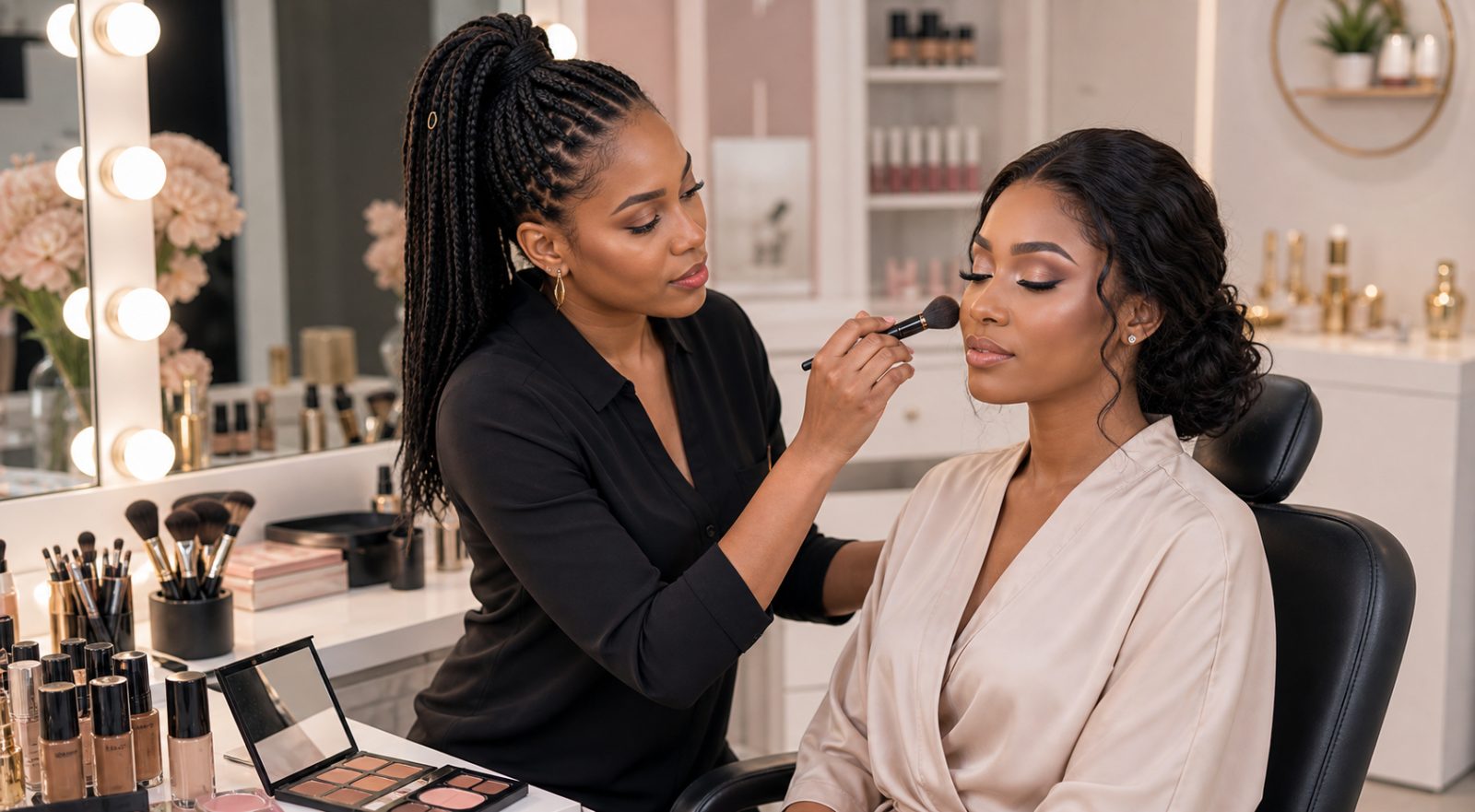
Successful make-up does not exist in the abstract. It exists only in relation to something: a light, a viewing distance, a camera lens, a duration, a temperature, a garment. That is the first thing separating a professional make-up artist from someone who is good at doing their own.
One face, several results
Take a face and five situations. In front of a studio lens, you have to anticipate that flash flattens relief and brings out texture. On a stage, the face must stay legible at twenty metres under lighting that washes everything out. For an outdoor wedding, the make-up must hold for twelve hours, survive emotion and heat, and remain convincing both in photographs and at a metre away. For video, anything that shines or shifts has to go. For everyday make-up, the person has to be able to reproduce it alone.
Five trades inside one trade. The technical gesture looks similar; the reasoning does not.
The main families of work
Depending on the professional and the market, the work divides into a few families:
- bridal make-up, often the economic backbone of the business, with its season, its trials and its impossible call times;
- photographic and editorial make-up, executed for a lens and adjusted against the screen;
- stage make-up, designed for distance and projected light;
- screen make-up, with its constant touch-ups through the shoot;
- occasion work: parties, ceremonies, professional portraits;
- teaching: private lessons, workshops, purchase advice, training.
Many professionals combine several of these. It is often the condition for making a living from the trade, since each has its own seasonality.
What light changes
This is the least understood skill from outside and the most decisive.
Make-up is judged through a filter: the light of the venue, the lens, the screen. A matte finish that is perfect to the naked eye can look powdery in a photograph; a foundation that seems natural in one room can turn under a cold lamp; a reflective particle invisible in person can throw back a white halo under flash.
The professional therefore learns to work for the final light, not the one they are working in. That implies two very concrete reflexes: controlling the light they apply make-up in — hence the importance of carrying their own source — and checking the result under real conditions before considering the work finished.
The trial, the step that prevents disaster
For anything tied to a one-off event, a trial is not a commercial option: it is a risk management tool.
It serves four purposes. Checking how the products hold on that particular skin. Agreeing on intensity with the person, who often discovers on that occasion that the photograph they showed is not what they actually want. Timing the work properly, which is essential information for building the schedule on the day. And spotting any sensitivities, with time to change product if needed.
A well-run trial turns the day itself into execution. Without one, the day becomes improvisation under time pressure, in front of a stressed person — exactly the situation in which nobody works well.
The kit and its hygiene
The kit is the means of production. It holds expensive, perishable materials intended to touch different faces.
Three rules separate a well-equipped amateur from a professional:
- nothing is taken with a finger — spatula, clean brush, disposable applicator;
- nothing goes back into the product after touching skin; you decant onto a working palette, never dip again into the pot;
- brushes get cleaned, between people and thoroughly afterwards.
Some categories demand particular care: anything going near the eye and the mouth. That is where the disposable applicator and the working palette admit no exception.
The WorldSkills international standard for beauty therapy indeed places work organisation, hygiene and professional demeanour among the competences assessed in their own right — on the same footing as technique.
Reading skin, adapting, knowing when to decline
A make-up artist is not a health professional. They diagnose nothing, treat nothing, and should promise nothing on that ground.
They do observe, because the work depends on it: skin that feels tight, that shines, that reddens, that flakes, that reacts to a product. Their competence lies in adapting preparation and textures — and, in some cases, in not making up an area at all.
Faced with a lesion, a wound, marked irritation, a visible infection or an unusual reaction, the right professional response is not to work over it and to suggest seeing a health professional. That is also what the WorldSkills standard does when it makes recognising contra-indications an expected competence.
A word, finally, on a subject this trade meets regularly: requests connected to skin lightening. The World Health Organization states that mercury-containing skin lightening products are hazardous to health and have been banned in many countries, mercury being capable of toxic effects on the nervous, digestive and immune systems and on the lungs, kidneys, skin and eyes; a 2023 amendment to the Minamata Convention further prohibits the manufacture, import and export of certain mercury-added products after 2025, a list that includes cosmetics. A professional has no business judging requests; they do have a duty to work only with products whose origin and composition they know.
Knowing what goes into the kit
That requirement has a concrete support: the label.
In the European Union, Regulation (EC) No 1223/2009 requires a cosmetic product to have an identified responsible person, to have undergone a safety assessment before being placed on the market, and to carry mandatory labelling — the responsible person's name and address, the content, the date of minimum durability or the period after opening, and precautions for use.
The framework is European and does not apply identically everywhere. But two reflexes follow from it that hold anywhere: use only identifiable, labelled products, and respect the period after opening. In a professional kit, a mascara opened three years ago is a problem, not a saving.
The portfolio is the number one commercial tool
This trade is not sold by description. Nobody books a make-up artist on the promise of "natural, luminous make-up": they book on images.
A useful portfolio follows a few simple principles. It shows varied faces — skin tones, ages, features — because the client is looking for someone who can work on their face. It clearly separates contexts: what was done for photography, for a wedding, for the stage. It shows honest photographs taken in realistic conditions, not only retouched images that prove nothing about the actual work. And it is dated and refreshed, because a portfolio frozen four years ago describes a business that has stopped.
A largely self-employed profession
Outside a few structures — salons, institutes, production companies, brands — professional make-up is practised on one's own account, job by job.
That means handling prospecting, quotes, contracts, deposits, travel, insurance, accounts and quiet periods yourself. It also means the question of formalising the business arises very concretely: the International Labour Organization estimates that two billion workers, or 61.2% of the world's employed population, are in informal employment, and observes that the share of informal employment falls sharply as education rises — from 94% among people with no education to 24% among those with tertiary education.
This is not a moral judgement but a professional observation: in this trade, the difference between a business that lasts and one that fades owes a great deal to the ability to be found, to contract properly and to get paid.
Presenting the business
A make-up artist is chosen on style and booked on terms.
A complete presentation therefore includes: the business name, the contexts genuinely covered — weddings, photography, stage, filming, lessons — a portfolio segmented by context, the area covered and the travel terms, prices or at least a range and the trial policy, booking and deposit arrangements, how long to allow, a direct contact and the networks where the work is published.
Two elements are almost always missing and yet make the difference: how long to allow and the trial policy. They are the first two questions a bride asks, and rarely the ones answered online.
In summary
Professional make-up is a craft of reading context: light, distance, duration, event. It rests on preparation — the trial — on rigorous kit hygiene, on the ability to adapt and sometimes to decline, and on a portfolio that does half the commercial work.
It is also a largely self-employed activity, whose solidity depends as much on organisation and visibility as on talent.
Are you a professional make-up artist? See how to present your business clearly online: your services, your portfolio, your terms and how clients can book.