
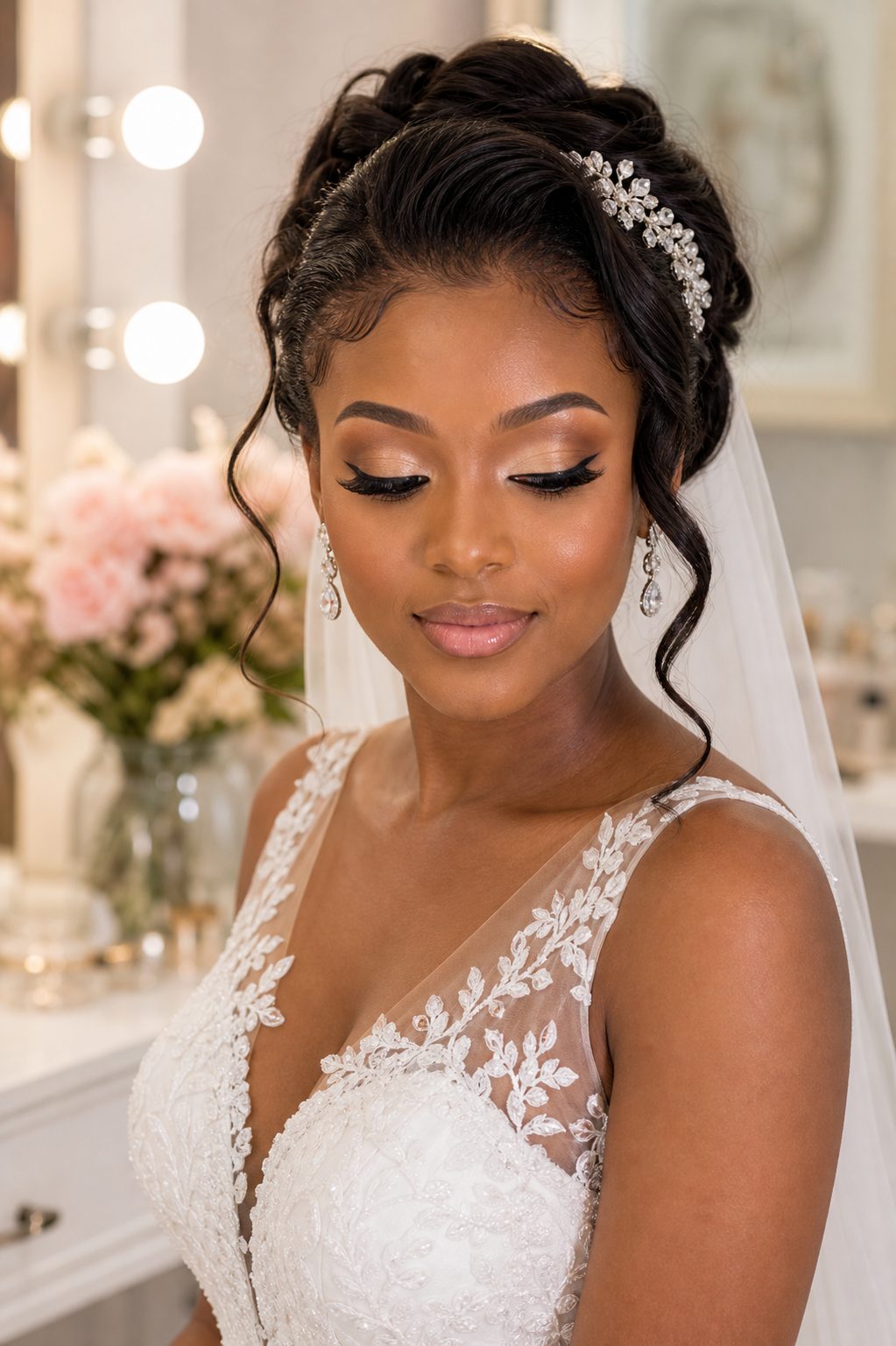
A home make-up artist rarely arrives at a calm moment. She arrives at six in the morning in a cluttered bedroom, with a dress hanging from a door, an anxious mother, a photographer who is not there yet and a person who has not slept. Working under those conditions is a competence in itself — and it is the real difference from studio work.
Going to where the client is getting ready
Travelling is not a comfort service bolted onto the trade: it matches the reality of events.
On a wedding morning, the bride cannot leave to have her make-up done. She is where she is being dressed, where her family is getting ready, where the photographer will come looking for preparation shots. Make-up therefore has to come to her, and slot into a choreography that also includes hair, dressing and a succession of arrivals.
The logic goes beyond weddings: family ceremonies, home photo sessions, corporate events, people who cannot travel, make-up lessons at home. The common thread is always the same: the service must fit a place and a time that are not negotiable.
An organisation dictated by one hour
In a studio, the constraint is availability. At someone's home, the constraint is a fixed hour in the future, known to everyone, with no way of catching up.
That imposes working backwards. You start from the time of the ceremony or the shoot, subtract the journey, the dressing, the hair, a margin for the unexpected, and you arrive at the real starting time — almost always earlier than the client imagined.
It also imposes personal discipline: arrive early, set up fast, do not start until the station is ready. An artist unpacking her kit while people wait has already lost twenty minutes she will not get back.
And it imposes a considered running order when several people are involved: the bride is not always first, because make-up applied too early endures two hours of waiting, emotion and heat before it is photographed.
The trial, the condition of the day itself
For any one-off event, a trial is not a commercial extra: it is what makes the day executable.
It serves four very concrete purposes. Checking how the products hold on that skin, in that season. Agreeing on intensity, since many people discover at that point that the image they showed is not what they want to wear all day. Timing the work properly, the only way to build a reliable schedule. And spotting a sensitivity in time to change product.
The trial is also when you talk about everything that is not technical: what time you will need to start, how many people will be made up, where you will set up, whether there is a socket and a window. Asked three weeks ahead, those questions prevent half the problems on the day.
The light you bring with you
This is the most invisible and most discriminating competence in home work.
A home is never lit for make-up. The light is yellow, sideways, insufficient, and often behind you. Yet the make-up will then be judged in a completely different light: a church, a hall, full sun, or a camera lens with flash.
The professional reflex is therefore not to accept the venue's light. You find the window and set up facing it; you bring your own neutral, frontal light source; you check the result somewhere other than the bedroom before calling it finished. An artist working under a warm bulb who never checks her work in daylight finds out about her mistake in the photographs — that is, too late.
Making up a group
On the day there is rarely one person to make up. There is the bride, her mother, her bridesmaids, sometimes six or eight people.
A group is not the sum of individual services. It is a scheduling problem: who goes when, how long each takes, who can wait, who has to be released for something else. It is also an attention-management problem: while one person is being made up, five others watch, comment and offer opinions.
Two practical rules prevent disorder. Announce a written running order with times, from the moment you arrive. And set a duration per person and hold to it firmly: ten minutes of overrun multiplied by eight people destroys the day's schedule.
Group work finally deserves to be priced as such, with a per-additional-person rate announced in advance. It is often the most profitable part of the day, provided it has been planned.
The travelling kit and its hygiene
The kit is the means of production, and at someone's home it is also the only stockroom available.
It must cover a range of skin tones and skin types, because you do not always know in advance who will make up the group. It must hold disposable applicators in quantity, enough brushes to avoid washing them between two people, a working palette, hand sanitiser, and a mirror.
Hygiene rules do not relax because you are in someone's home — they tighten, since nothing is supplied on site. You never take product with a finger. You never return an applicator to the pot after it has touched skin. You work from a palette. Products going near the eye and mouth require a disposable applicator per person, without exception.
The WorldSkills international standard for beauty therapy indeed places work organisation, hygiene and professional demeanour among the competences assessed in their own right, on the same footing as technique.
Skin, allergy and the useful refusal
A make-up artist is not a health professional. She makes no diagnosis and treats nothing.
She does observe, because the work depends on it, and she adapts: reactive skin, very dry skin, skin irritated by yesterday's waxing, marked by sunburn. The WorldSkills standard makes recognising contra-indications an expected competence, and that is exactly what this is.
Faced with a lesion, a wound, marked irritation or an unusual reaction, the right professional response is not to work on that area and to suggest seeing a health professional. Declining an area, or offering an alternative, protects the client and protects the professional — all the more on the day of an event, where a skin reaction would be experienced as a catastrophe.
That requirement has a concrete support: the label. In the European Union, Regulation (EC) No 1223/2009 requires a cosmetic product to have an identified responsible person, to have undergone a safety assessment before being placed on the market, and to carry mandatory labelling including that person's name and address, the content, the date of minimum durability or the period after opening, and precautions for use. The framework is European and does not apply identically everywhere, but two reflexes follow that hold anywhere: use only identifiable, labelled products, and respect the period after opening.
What a call-out really costs
This is the trade's commonest management error.
A forty-five minute service can occupy four hours: packing the kit, the journey out, setting up, the work, packing away, the journey back. Charging for the forty-five minutes means working for a fifth of the advertised price.
Three practices restore the balance. Announce a service area and a travel supplement beyond it. Set a minimum charge per call-out, whatever the number of people. And favour group work, which spreads the journey across several services.
Early morning, weekend and public holiday work — which is to say most event work — also justifies specific pricing, provided it is announced in the quote and not discovered at the end.
An independent business worth structuring
This trade is almost always practised on one's own account, job by job, with peaks of activity and quiet months.
The International Labour Organization estimates that two billion workers, or 61.2% of the world's employed population, are in informal employment, and observes that this share falls sharply as education rises. The observation is useful here: in a trade built on high-stakes events, being able to issue a quote, ask for a deposit, provide a receipt and carry insurance is not administrative luxury. It is what gets you chosen for a wedding rather than called in to help out.
The exact obligations — registering the business, legal status, any required qualification — vary by country and must be checked locally.
Presenting the business
A bride looking for a make-up artist always asks the same questions, and rarely finds the answers online.
A complete professional presentation gives them: the service area and travel terms, how long to allow per person, the trial policy — included or charged, when to book it — prices or a clear range, the per-additional-person rate, booking and deposit arrangements, the early-morning slots accepted, and a direct contact.
To which is added the portfolio, which does the commercial work: varied faces across skin tones, ages and features, honest photographs taken in real conditions, and images from home preparations rather than studio poses. That is what lets a client recognise the style — and understand that you can work on a face like hers.
In summary
Home make-up is a craft of execution under constraint: a fixed hour, a venue you do not choose, a light you bring, a group to schedule and a kit that has to be self-sufficient.
It rests on preparation up front — the trial — on rigorous hygiene that nothing on site makes easier, on the ability to adapt and sometimes to decline, and on pricing that counts the journey for what it really is.
Do you do make-up at clients' homes? See how to present your business clearly online: your area, your services, your terms and how clients can book.