
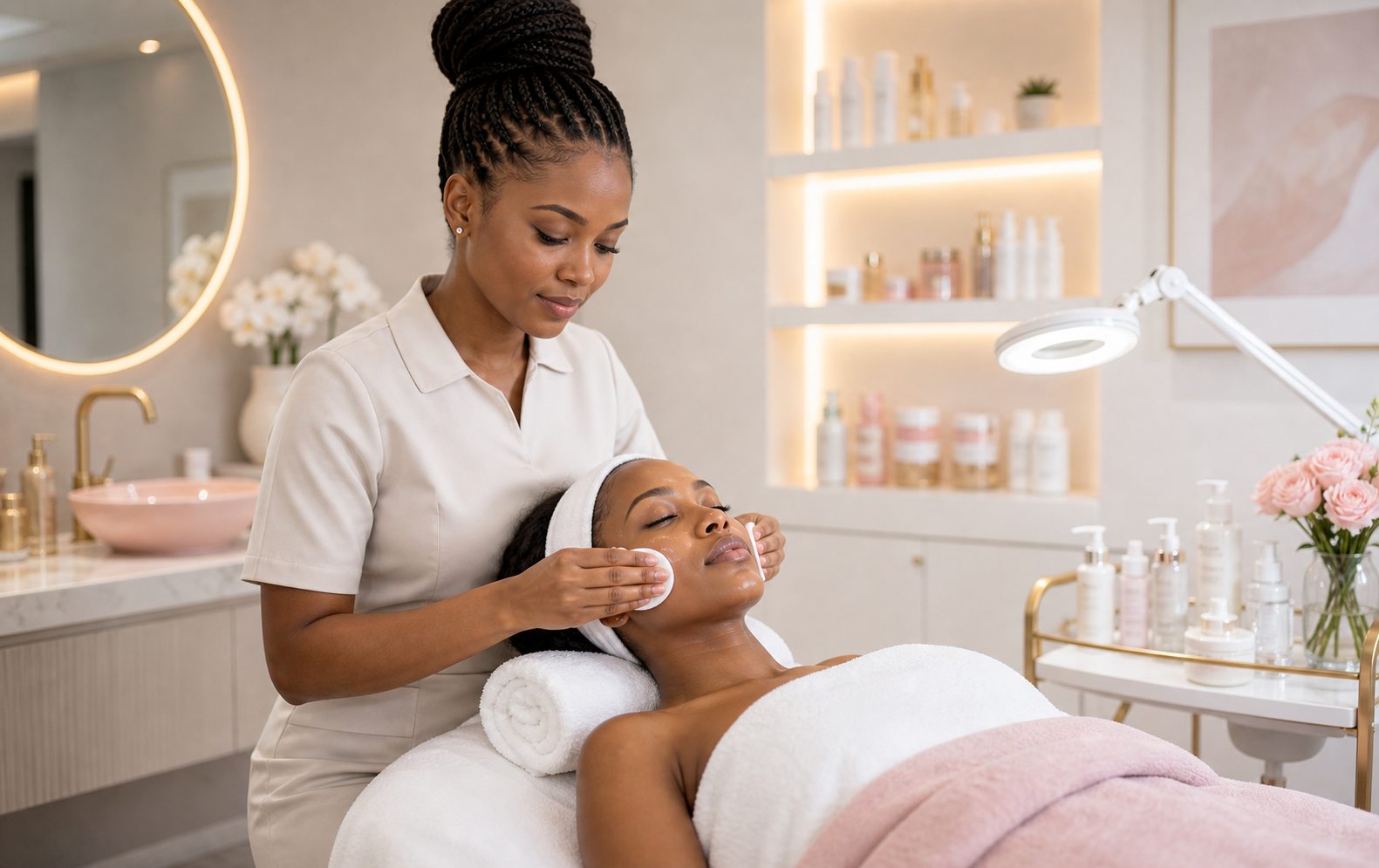
In the popular imagination, a beauty institute is where you go to be waxed and leave with a rested complexion. That is true, and very incomplete. Beauty therapy rests on a less visible competence: knowing how to look at skin, understand a request, choose a protocol — and recognise the situations where nothing at all should be done.
What a beauty institute actually is
An institute is a multi-service structure. The WorldSkills occupational standard for beauty therapy describes a professional who provides "specialist services, treatments and advice for the skin, body care, massage, and make-up of individual clients".
The way the standard weights its competences says a good deal about where the trade's centre of gravity lies: facial treatments account for around 30%, body treatments 25%, hands, feet and nails 15%, temporary hair removal 10%. The rest — work organisation, professional demeanour, client care — is far from an afterthought: roughly a fifth of the whole.
In other words: in this trade, how you receive people counts statistically as much as an entire family of treatments.
The welcome and the time given to assessment
An institute treatment does not start with a product. It starts with a conversation and with looking.
The therapist asks what the person is hoping for, since when, what they have already tried, what they use day to day, whether they have known sensitivities, whether they have particular sun exposure, whether an event is coming up. Then observation: skin type, areas of tension, reactivity, the state of the nails or of the areas to be waxed.
The WorldSkills standard names this stage precisely and attaches an essential competence to it: recognising contra-indications, that is, the situations in which a treatment must not be carried out. This is a major professional point, and it is also what separates a beauty therapist from someone applying a product.
The assessment stays cosmetic. It makes no medical diagnosis, names no illness and proposes no treatment.
The treatment room, a space built for letting go
A treatment room is not simply a closed door. It is an arrangement: temperature, light, sound, scent, lying position, clean linen, no interruptions.
That framing has a practical function. Many treatments run from thirty to ninety minutes, during which the client does nothing, looks at nothing, and has no control over what is happening. What makes the service bearable and then pleasant is the constancy of the frame: the same temperature, the same announced gestures, the same absence of surprise.
The organisation of the working station follows from this: everything needed is within reach before starting, because a therapist hunting for a product mid-treatment breaks exactly what she is in the middle of building.
The range of treatments
Institutes differ greatly in detail, but their services fall into stable families:
- facial treatments: cleansing, exfoliation, extraction, masks, massage, targeted care by skin type;
- body treatments: scrubs, wraps, massage, targeted care;
- temporary hair removal: waxing, sugaring, eyebrow shaping;
- hands and feet: manicure, pedicure, polish;
- make-up: occasion make-up, event work, lessons;
- equipment-based treatments, whose use, availability and supervision vary sharply from country to country and must be checked locally before being practised.
The choice of range is not neutral: each family implies its own training, equipment, appointment length and clientele. An institute that tries to do everything rarely does everything well.
Products: what a professional needs to know
A beauty therapist handles cosmetic products all day, on other people's skin. She need not be a chemist, but she must be able to read what she is using.
In the European Union, Regulation (EC) No 1223/2009 requires a cosmetic product to have an identified responsible person, to have undergone a safety assessment before being placed on the market, and to carry mandatory labelling: the name and address of the responsible person, the nominal content, the date of minimum durability or the period after opening — the open-jar symbol — and any particular precautions for use.
That framework is European, and it does not apply as such everywhere. But it offers a universally useful reading grid: a serious professional product is identifiable, traceable, labelled, and states how long it remains usable once opened. A product with no legible label, no identifiable responsible party, decanted into an anonymous bottle, is a professional risk as much as a risk to the client.
Where the trade stops
This is the most important section, and the one most often skipped.
A beauty therapist works on appearance. She does not treat disease. A lesion that changes appearance, a wound, persistent inflammation, an unusual reaction, pain: none of that belongs in an institute. The right professional response is to not perform the treatment and to direct the person to a qualified health professional.
One case deserves to be named explicitly, because it is common and because it puts professionals in an awkward position: requests for deliberate skin lightening. The World Health Organization states that mercury-containing skin lightening products are hazardous to health and have been banned in many countries, and notes that mercury can have toxic effects on the nervous, digestive and immune systems and on the lungs, kidneys, skin and eyes. A 2023 amendment to the Minamata Convention further prohibits the manufacture, import and export of certain mercury-added products after 2025, and the list concerned includes cosmetics.
An institute has no business passing judgement on people. It does have one simple responsibility: not to use products whose composition it cannot vouch for, and not to build an offer on ground where international regulation and health authorities have taken a position.
The economics: courses of treatment, not one-off visits
An institute does not live on isolated visits. Most visible results depend on repetition: a series of treatments, regular maintenance, a monthly appointment.
That shapes the whole business. Services are designed as programmes rather than single units; loyalty cards, packages and subscriptions are not marketing gimmicks but an expression of how the trade actually works; and the diary fills in advance, which makes stock and workload predictable.
The other side of it is a pronounced seasonality: holiday periods, changes of season, weddings, departures on holiday. An institute that does not anticipate it endures full months and empty ones.
Working alone or in a team
The trade is practised alone, in a single room, as readily as in a larger structure where beauty therapists, nail specialists, massage practitioners and reception staff work side by side.
In both cases the same physical constraint applies: you work leaning forward, in static positions, with your hands, for hours a day. The European data from the neighbouring hairdressing sector — the occupation most exposed to work-related skin disease, with close to 40% reporting musculoskeletal complaints — give the measure of what awaits a manual trade practised without attention to posture, ventilation and hand protection.
Presenting an institute
An institute is chosen on trust, and trust is built before the front door.
A useful professional presentation includes the institute's name, the families of treatments genuinely offered, their durations, prices if you choose to display them, photographs of the space and the treatment room, the address, the opening hours, booking, a direct contact, the team and their specialities, and possibly the product brands used.
Two elements matter more than people think: the stated duration of each treatment, because clients build their day around it, and photographs of the place, because a treatment is received lying down in a room one would rather have seen beforehand. Photographs of results are useful when they are honest; they lose all value the moment they promise what a treatment does not deliver.
In summary
A beauty institute is a trade of observation, of hands and of framing. It begins with a cosmetic assessment and with listening, unfolds across families of treatments that each demand their own training, and is practised in a space whose consistency creates the perceived quality.
It is also a trade of limits: knowing when not to act, knowing when to refer to a health professional, knowing how to refuse a product of unknown composition. Training, qualification and equipment rules vary by country and must be checked locally.
Do you run a beauty institute? See how to present your business clearly online: your treatments, their durations, your setting and how clients can book.