
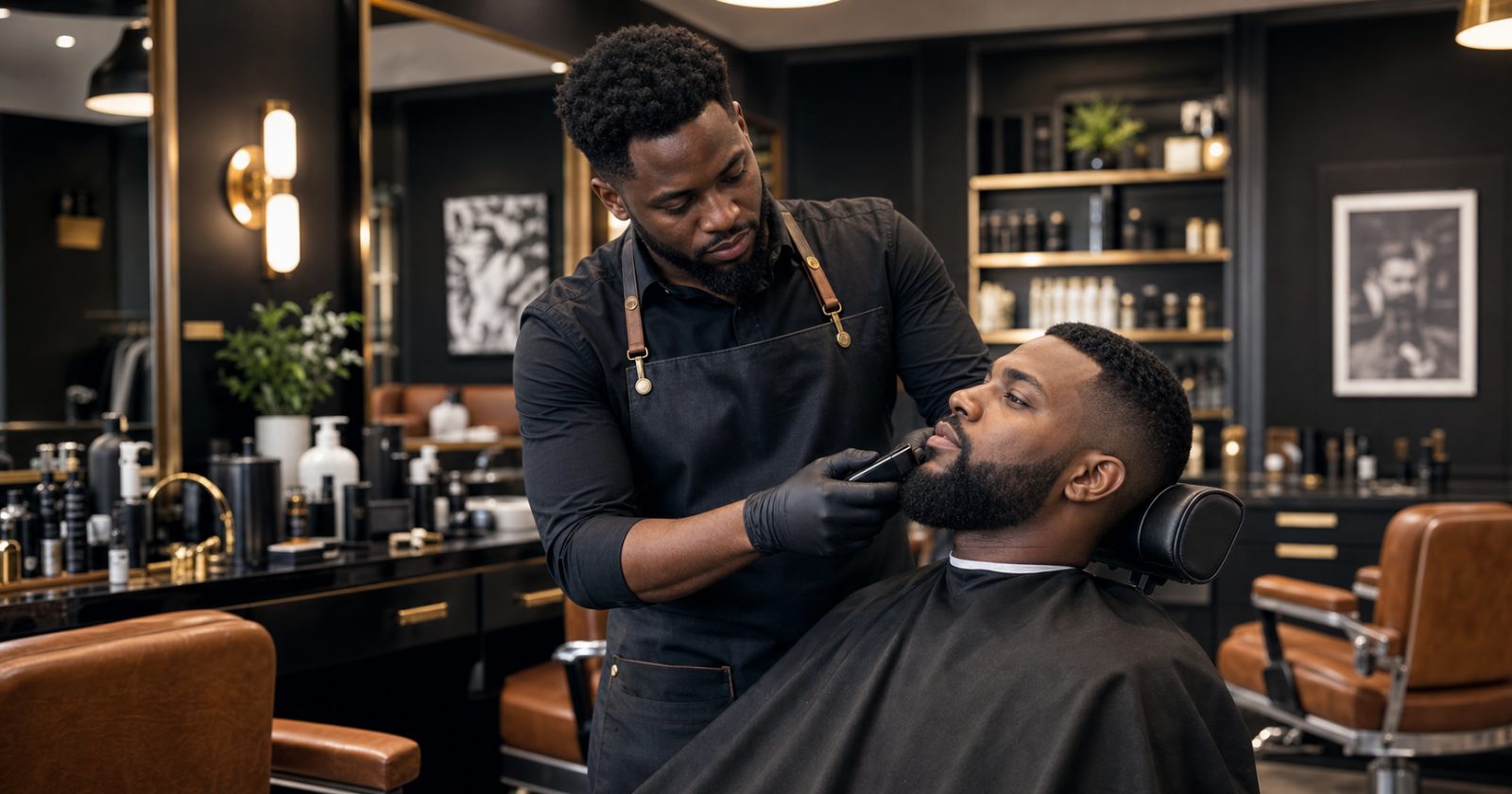
For decades the barber was filed away among the trades on their way out. The barber came back — not as nostalgia, but as a speciality. A barber shop does not do the same work as a hair salon, is not organised the same way, and is not judged by the same criteria.
A trade that became visible again
The barber's return was driven by a simple demand: men stopped wanting "a haircut" and started wanting a precise result, held and maintained. A shaped beard is not a beard left to grow. A clean fade is not a short back and sides.
That expectation created room for a professional whose value lies in precision and consistency rather than in the range of services offered. The WorldSkills occupational standard for hairdressing explicitly includes beard design among the cutting competences expected of a professional.
What sets the barber apart from the hairdresser
The two trades overlap, but their centres of gravity differ.
Barbers work largely on short hair, where mistakes cannot be recovered: length removed does not come back for weeks. They work with clippers as much as with scissors, and the gradual passage from one length to another — the fade — is the heart of the technique.
Above all, they work on the face, which changes everything. Trimming a beard, drawing an outline, shaving with a blade: these are performed millimetres from the skin, on someone who cannot see what is happening. Trust here is not a commercial extra; it is a condition of doing the work at all.
Finally, the rhythm differs. A long cut is renewed every two or three months; a short fade visibly loses its shape in two or three weeks. Structurally, then, a barber has a clientele that returns more often.
How a service unfolds
A barber shop service almost always follows the same spine, whatever its content.
It starts with looking: skull shape, hairline, cowlicks, density, how the beard sits — and above all what the client is asking for, with the translation that is always needed between the words used and the result intended. "Short at the sides" means nothing until a height has been shown.
Then the cut, from broad to fine: clearing, fading, lengths, then finishing. Then the beard: shaping, evening out, drawing the outlines. Then shaving the areas that must stay clean, with a blade or clippers depending on the service chosen.
Finishing is not a detail: it is what separates correct work from sellable work. Cleaning the neck, removing cut hair, applying a product, checking in the mirror from several angles, and the maintenance advice that sets up the next appointment.
Shaving: where the trade takes on responsibility
The straight-razor shave is the barber's emblematic gesture. It is also the only one that may cross the skin barrier.
The World Health Organization notes that hepatitis B is transmitted through contact with blood, including through the sharing or reuse of contaminated sharp objects, and lists the sharing of razors explicitly among possible sources of infection. The professional consequence is not open to debate: a blade is never shared and never reused between clients. A new blade for every person, disposed of immediately in a closed sharps container, with reusable equipment cleaned and disinfected between services.
None of this makes the barber a health worker, and this article has no business becoming a clinical protocol. It simply draws a line: the seriousness of a barber shop is measured first by what it does with its blades. Anything beyond the cosmetic — a lesion, a persistent irritation, an unusual reaction — belongs to a health professional, not to the chair.
The place is part of the service
Few businesses own their décor the way a barber shop does. Chairs, mirrors, materials, music, light: the atmosphere is not packaging, it is part of what is sold.
The reason is simple. Clients come for a result, but they stay twenty to forty-five minutes. They spend that time seated, screen-free, often talking. Many barber shops have become places where people chat, wait together, arrive with their son. That is not a side effect: it is a competitive advantage no technique can supply.
It also raises the bar on housekeeping. A carefully built setting makes the smallest lapse more visible: hair on the floor, a cluttered counter, doubtful towels. Expectations rise with the ambition on display.
A clientele that returns — and why that decides everything
A barber shop's economics rest on frequency. A regular who comes back every three weeks is worth far more over a year than an occasional customer — and costs infinitely less to attract.
Hence the importance of three very concrete things: consistency of result from one visit to the next, punctuality, and a booking system that works. An excellent but unpredictable barber loses precisely the clients who chose him for his consistency.
It also explains how quickly online booking took hold in the sector: it removes the uncertainty of waiting, which is the main reason people give up before they even walk in.
The body and the hours
As everywhere in hairdressing, the work is done standing, arms raised, in static and forward-leaning positions.
The European sector data give the measure of the risk: according to the European Agency for Safety and Health at Work, hairdressing is the occupation most exposed to work-related skin disease, with up to 70% of workers affected by work-related dermatitis, and close to 40% reporting musculoskeletal complaints — five times the average across all sectors.
The European framework agreement signed in 2016 by UNI Europa Hair & Beauty and Coiffure EU addresses exactly these points: skin protection, ventilation, workstation ergonomics, chairs, tools. It expressly covers the self-employed as well as employees — worth remembering in a trade where many work for themselves and wrongly assume none of it concerns them.
Learning the trade and setting up
Routes in vary by country: a hairdressing qualification, a barbering specialisation, private schools, in-shop apprenticeship, sometimes a licence or permit, sometimes specific health requirements for shaving services. There is no global rule; what applies locally has to be checked, both for practising and for opening premises.
One constant, though: the trade is largely learned on real heads. Speed, reading a hairline, the evenness of a fade come only with volume.
Making a barber shop known
This trade is chosen on visual proof. A client is looking for a barber whose work they like, at a distance they accept, with a booking system that suits them.
A serious professional presentation therefore includes: the shop's name, what is genuinely offered — cutting, beard work, straight-razor shaving, treatments, children's cuts — prices if you choose to display them, photographs of cuts actually done, the address and a map, opening hours, booking, a phone number or WhatsApp, the networks where the work is published, and the team with their specialities.
Photographs are the central argument: a fade is judged by eye, not in a sentence. Publishing finished work regularly, across varied hair types and styles, says more than any promotional copy.
In summary
A barber is a professional of short hair and of the face, whose value rests on precision, consistency and the trust inspired millimetres from the skin. The shop is part of the offer, the clientele returns often, and seriousness is read first in the handling of blades and cleanliness.
Training and set-up rules depend on the country. What does not: a barber shop is judged on what it shows — visible cuts, clear hours, an easy appointment.
Do you run a barber shop? See how to present your business clearly online: your services, your work, your opening hours and how clients can book.