
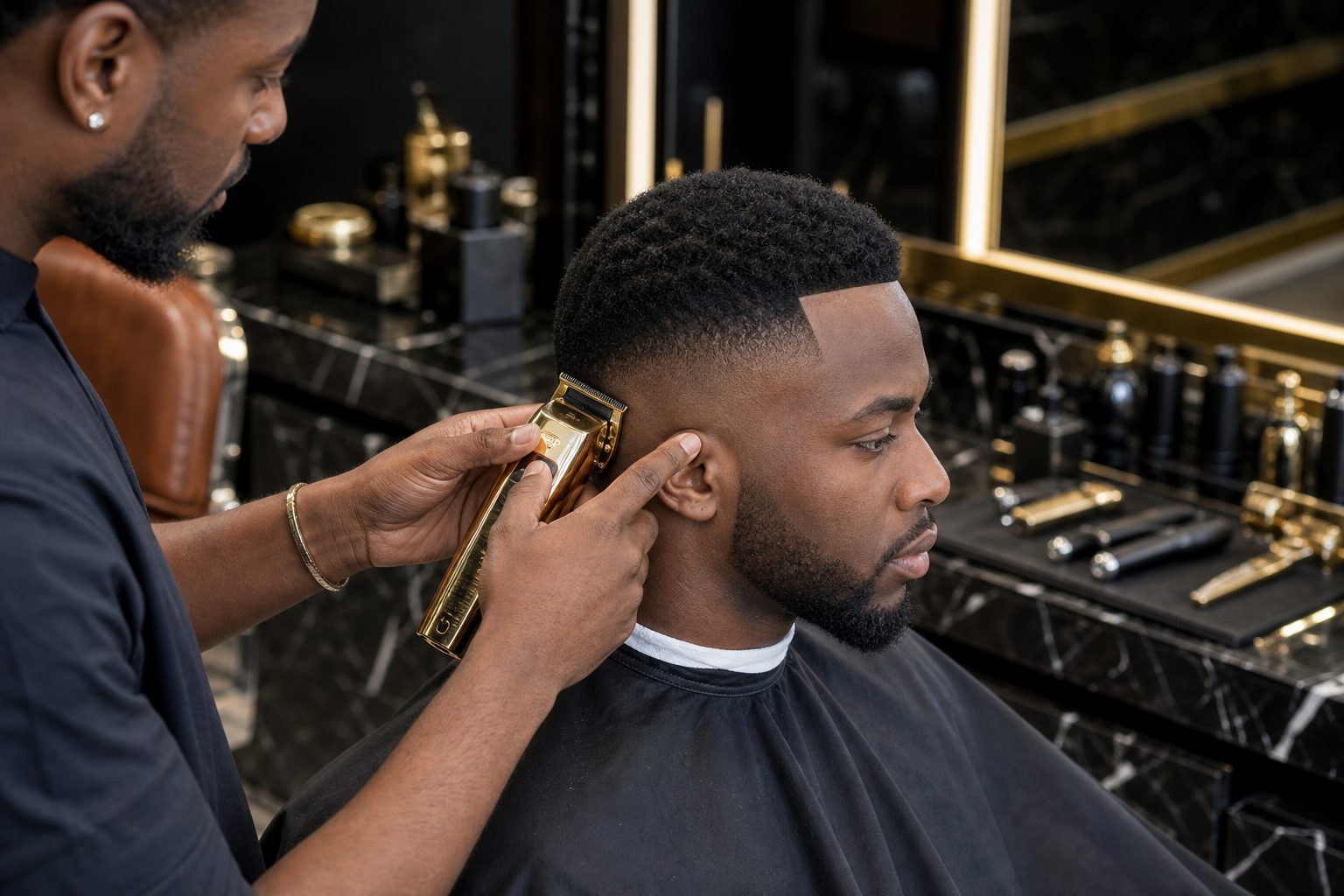
A home barber does the same job as a shop barber: reading a head, executing a fade, shaping a beard, finishing cleanly. But it is done without a basin, without an adjustable chair, without a wall mirror, without controlled lighting and without a broom within reach. This is not a downgraded version of the trade — it is a variant with competences of its own.
Why a barber travels
The reasons are not only practical.
There are, first, clients who cannot come: older people, people with reduced mobility, people who are ill, small children for whom a shop is an ordeal, large families for whom moving three children is an expedition.
Then there are clients who would rather not come: professionals who prefer to pay for the comfort of an appointment at home or at the office, people on shifted hours, clients who simply dislike waiting.
Finally there is an economic reason. Opening a shop means premises, a lease, fitting out, fixed equipment and charges that fall due every month. Starting at people's homes means a kit, transport and a diary. Many professionals begin this way, and some never leave because the model suits them.
The WorldSkills international standard for hairdressing indeed validates this plurality: it describes a trade practised in salons of every size, but also as a mobile service and in private homes.
What the absence of a shop changes
Five constraints appear from the very first home appointment.
Height. No chair adjusts. You work on a kitchen chair, sometimes a stool, usually too low. The barber's back pays the difference.
Light. Domestic lighting is yellow, sideways and insufficient. A badly lit fade shows up outdoors, not in the client's living room.
Water. No basin. Washing is negotiated, done differently, or not done — which changes how you cut.
Cut hair. In a shop it falls to the floor and you sweep. In someone's home it falls on a rug, a sofa, pale tiling. Protecting the floor and cleaning up afterwards are part of the service, not an extra.
The mirror. The client cannot see themselves during the cut. So you have to show, explain and confirm at several stages rather than at the end.
The kit: everything has to fit in a bag
A mobile barber's equipment obeys one rule: what is forgotten does not exist. There is no stockroom next door.
A serious kit therefore holds, as a minimum: charged clippers and guards plus a fallback for a flat battery, scissors, combs, brush and shaving equipment, new blades, finishing products, a cape and enough clean towels for the round, a sheet or cover for the floor, a brush and bag for the hair, disinfectant and the means to clean tools, a closed container for used sharps, a hand mirror, and a portable light source.
That last item is the one beginners most often skip. A portable light transforms the perceived quality of a home cut, because it lets you see what you are doing instead of guessing.
Hygiene when the venue changes every appointment
This is where home working is most demanding, precisely because the venue supplies nothing.
The non-negotiable point concerns blades. The World Health Organization notes that hepatitis B is transmitted through contact with blood, including through the sharing or reuse of contaminated sharp objects, and lists the sharing of razors explicitly among possible sources of infection. In practice: a new blade for every client, never a blade reused between people, disposed of immediately into a closed container the barber carries with him. That container does not stay at the client's home.
The rest follows the same logic. Reusable tools are cleaned and disinfected between clients, which means carrying several sets when appointments run back to back. Linen is clean for each person, which means carrying enough for the day. Hands are washed or sanitised before every service.
A home barber cannot lean on the appearance of premises to reassure anyone: all he has is his own practice. That is paradoxically an advantage, because the client sees everything, close up, from start to finish.
And as in a shop, the limit is unchanged: anything beyond the cosmetic — a lesion, a wound, persistent irritation, an unusual reaction — belongs to a health professional, not to the barber.
The service area and travel time
This is the central economic figure of mobile work, and the one most often miscalculated.
A cut takes thirty minutes; a round trip can take fifty. A professional who charges only for the cut is in fact working an hour and twenty for the price of thirty minutes.
Three practices keep the model viable. Define an area beyond which you do not travel, or travel with an announced supplement. Group appointments by district and half-day rather than crossing town four times. And make the most of grouped services: cutting three people in one place completely changes the profitability of a trip, which explains the success of family, building and workplace packages.
The home clientele
It is not the same as a shop's, and it is not won the same way.
Families want simplicity: several cuts in a row, at a time that suits them. Older people and people who cannot travel want continuity and reliability: a very loyal clientele, for whom a cancelled appointment is a genuine problem. Companies want an occasional or recurring service on site, often across a half-day. Time-pressed clients want a slot, early morning or late evening, when shops are shut.
A professional who builds on one or two of these groups gets a regularity that general passing trade never provides.
The appointment: setting a frame
Working in people's homes calls for explicit rules, in the interest of both sides.
It starts with a written confirmation stating the time, the address, the expected duration, the price, what is included and what is needed on site — water, a chair, a socket, a clear space. It continues with a clear cancellation policy, because an appointment cancelled on the doorstep costs the journey on top of the slot. And it assumes common-sense travel etiquette: announcing your arrival, respecting the home, leaving it as you found it.
This frame is not administrative rigidity. It is what distinguishes a professional from a favour, and what makes it possible to be paid properly.
Still a business
The home barber is a business owner without premises. He sets his prices, runs his diary, buys his equipment, insures his activity, pays his charges and absorbs his travel.
The question of formalising the business often bites hard in mobile work of this kind. The International Labour Organization estimates that two billion workers, or 61.2% of the world's employed population, are in informal employment. That is not a reproach aimed at a trade: it is a context. Registering the business, being able to issue a receipt, being insured and being reachable are precisely what opens access to the most profitable clients — companies, residences, care settings — which work only with identified providers.
The exact obligations — registration, legal status, permits to practise, health rules applying to shaving services — vary widely by country and must be checked locally.
Presenting a mobile business
A home service raises three immediate questions for a client: will you come to me, when, and how much?
A professional presentation answers those first: the service area, very explicitly; the slots genuinely available, including early and late; the prices, with the travel supplement if there is one; how long to allow; what the client needs to prepare at home; how to book and a direct contact, often a phone number or WhatsApp.
To which is added what actually sells the trade: photographs of cuts genuinely done, varied styles, different hair types, and where possible work carried out in homes rather than in a studio. Packages — family, group, workplace, monthly subscription — deserve to be displayed, because they answer exactly what this clientele is looking for.
In summary
The home barber practises a precision trade under conditions he does not control. He compensates through organisation: a complete kit, his own light, hygiene that depends on no venue, a defined service area and grouped appointments.
His clientele is often more loyal than a shop's, because it has good reasons to prefer home. It still has to know he exists, how far he travels and how to reach him.
Are you a home barber? See how to present your business clearly online: your area, your services, your slots and how clients can book.