
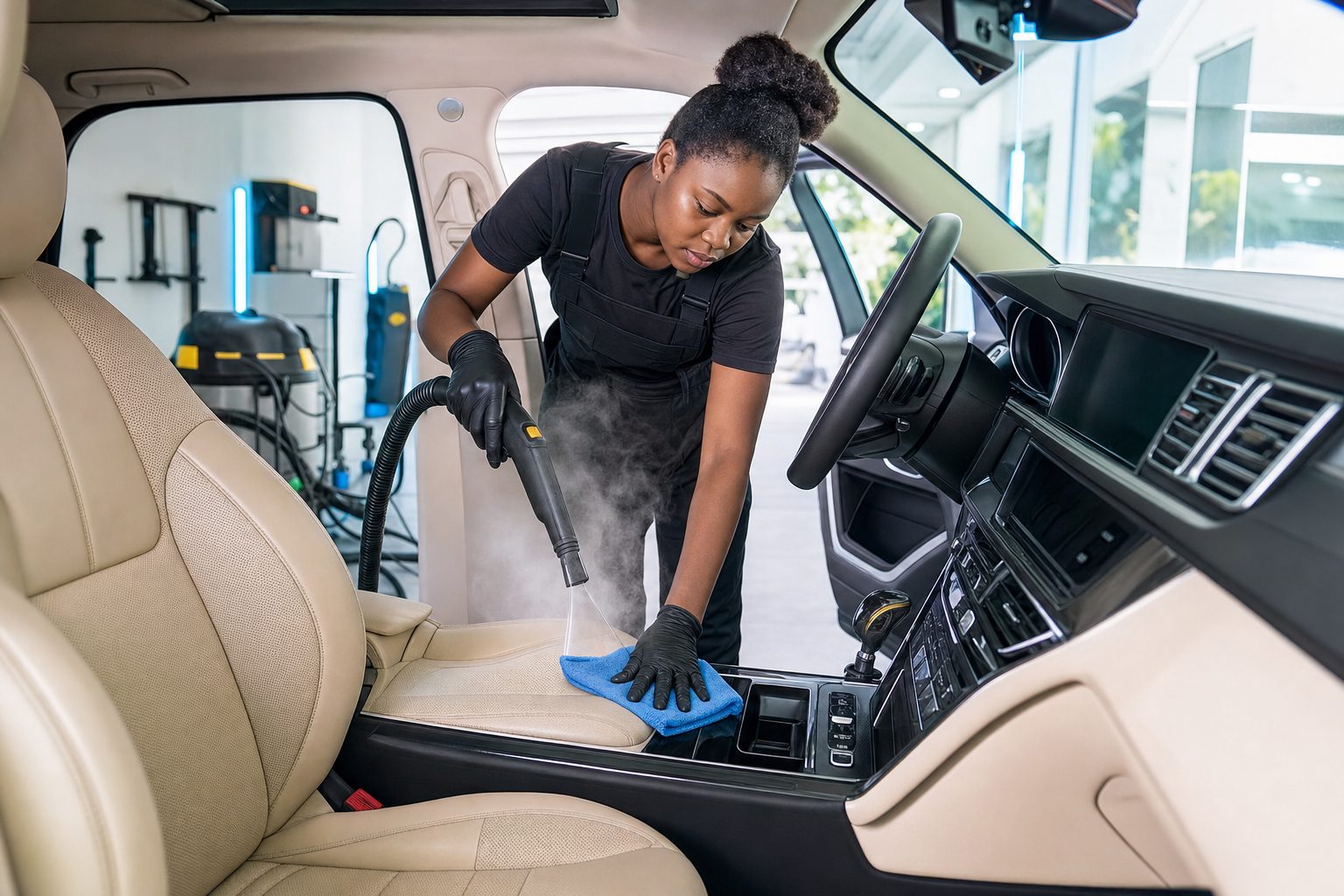
A customer comes back because last time it was good. They cannot say why, and they do not need to: what they noticed was the absence of smears on the windscreen, plastics clean without being greasy, and no new scratch on the paint. That result does not come from a miracle product. It comes from a method applied in the same order by people trained not to mix up two bottles.
What separates a professional wash
Washing a vehicle looks simple, and that is exactly what misleads. A bucket, a sponge and some soap can produce a clean-looking vehicle and lastingly marked paint.
Three differences separate the amateur gesture from professional work. The first is order: you do not start at the top, you do not finish with the wheels, and you do not go back over a surface that has already dried. The second is the product: each surface has its own, and a wheel cleaner has no business on paintwork. The third is the equipment: a dirty microfibre scratches more than it cleans.
A car wash therefore sells consistency rather than a service: that is what brings regular customers back, and what loses an inconsistent centre its clientele.
A fixed sequence, in the same order
The method rests on a series of steps that are not reordered according to how busy it is: a pre-wash to lift off what would scratch, treatment of the wheels and lower panels which carry the heaviest soiling, washing the bodywork, rinsing, drying, the interior, plastics, glass, then a final check.
That fixity serves two purposes: it protects the vehicle, since each step prepares the next and avoids rubbing abrasive dirt across paint, and it protects the business, because a written order can be taught to a new employee whereas implicit know-how disappears with the person who held it.
At peak times the temptation is to skip a step. That is exactly the moment not to: complaints almost always come from a busy Saturday.
One product per surface
Painted bodywork, clear coat, wheels, tyres, exterior plastics, interior plastics, fabric, leather, glass: these are different materials that react differently.
A product too aggressive on a plastic will whiten it. A greasy product on a steering wheel makes it slippery, which is not a cosmetic defect but a safety problem. A wheel cleaner left on bodywork can mark the clear coat. A silicone product on a windscreen interferes with wiping.
The professional rule is therefore to know your products, label them, store them separately, follow the manufacturer's instructions and train the teams not to interchange them. Improvising a mixture because a bottle is empty is the costliest mistake in the trade: it damages a customer's property.
The equipment needs maintaining too
This is the invisible part, and the one that decides the result. Microfibres and gloves are washed regularly and sorted by use — the wheel ones do not go near paint. Brushes are inspected. Nozzles are checked. Vacuums are emptied. Steam machines are maintained according to their instructions.
The reasoning is simple: anything that touches the paint must be clean, or it becomes an abrasive. A centre that economises on replacing microfibres ends up paying for paint corrections.
Water, resource and constraint
A car wash consumes water, and its quality matters as much as its quantity. Water heavy in minerals leaves marks on drying; water of doubtful quality suits neither the staff nor the surfaces.
The World Health Organization points out that microbial contamination of faecal origin is the greatest risk to drinking-water safety, and promotes a water safety plan approach that identifies and manages risks from catchment to consumer. It also notes that storage containers can become breeding grounds and that simply covering them reduces that risk.
For a centre that stores its own water — a tank, a reservoir, a borehole — that translates into concrete habits: cover it, maintain it, check it, and provide clean water for the staff separately from the water used on vehicles. The applicable requirements, for their part, depend on local regulation.
Cleaning is not repairing
The distinction deserves stating clearly, to the customer included.
A wash, even a full one, removes soiling. A paint treatment — decontamination, polishing, protection — corrects surface defects in the clear coat and improves appearance. Neither repairs a deep scratch, an impact, a chip down to the metal or a mechanical fault. A badly executed polish can even thin the clear coat.
A professional therefore reports what they see without promising to make it disappear, and refers the customer to a body shop when the defect goes beyond what a surface treatment can reach.
Reception, inspection and choosing the service
Walking round the vehicle before starting is the most profitable step of the day. It allows what already exists to be spotted and recorded: scratches, chips, a marked wheel, a loose bumper, an old stain in the cabin, a torn seat, a forgotten belonging.
That inspection protects both sides: without it, any discussion at handback becomes a matter of memory; with it, and a few dated photographs, the conversation stays factual.
It is also the moment to choose the service according to the actual condition rather than the posted price: a heavily soiled interior is not treated like a dusty one, and saying so beforehand beats discovering it halfway through. Price levels and packages depend on the local market, the type of vehicle and the centre: no general scale means anything.
The check before handback
A systematic final check, done by someone who did not carry out the work, catches what the operator no longer sees: a smear on a window, a damp seal, a forgotten rear shelf, a badly refitted mat.
Then comes handback: what was done, what was reported, what could not be removed. Redoing the work immediately and free of charge when the result is not right costs less than a lost customer — and is stated in advance rather than after negotiation.
What goes into the drain, and what does not
A car wash produces loaded effluent: silt, fuel and oil residues from lower panels, detergents, sometimes metals from brake dust.
Discharging that straight into a gutter or onto the ground is not neutral. Professional practice is to channel the water to a settling or separation device where the installation allows, to recover the silt and hand it to a suitable route, never to mix a solvent or an oil into the wash water, and to store chemicals under cover and labelled.
The concrete obligations — what kind of device, what authorisations, what checks — are entirely a matter of the national and local regulation applying where the business operates.
A team that has to be trained
The trade rests on gestures repeated by people who are often young and sometimes recruited without initial training. The quality of the centre is therefore directly the quality of its in-house training.
The International Labour Organization has published a guide on upgrading informal apprenticeship in Africa, which describes exactly this mechanism of transmission in the workshop, alongside someone more experienced, outside formal schemes — and examines how to recognise and improve it rather than ignore it.
In practice that means a written sequence on display, a demonstration, a period of supervision, and simple rules on products and equipment. To that are added the usual protections: gloves, eye protection where products require it, ventilation of enclosed spaces, non-slip floors, and particular attention wherever water and electricity meet.
In the African context
Working conditions vary sharply from one country and one city to another, and there is no single African context. Several realities nonetheless recur in some contexts and change the trade.
The first is the soiling itself. Depending on the area, dust is everywhere for part of the year, laterite lastingly marks lower panels, and the rainy season transforms interiors; elsewhere it is sea air or urban pollution that dominates. A centre is therefore not dealing with the same dirt from one place to another, and regular customers' visit frequency changes accordingly.
The second is water. In some cities supply is irregular or expensive, which pushes centres to store it, to reuse it where the installation allows, and to watch consumption per vehicle. Where water is plentiful and cheap, the constraint shifts to disposing of the effluent. Those two situations do not call for the same investment. The third is electricity: vacuums, washers, steam machines and lighting all depend on it, and in some areas outages mean planning an alternative.
The fourth is the degree of formalisation. The International Labour Organization documents the scale of informal employment in its statistical study on women and men in the informal economy, and car washing is a common example: it is practised with a bucket at the side of an avenue as much as in an equipped centre. Both realities coexist in the same cities, and a structured centre stands out less through its machines than through what it can evidence — an entry inspection, a described service, a receipt, rework in case of a defect.
That is also where the opportunities lie, unevenly across markets. Mobile payment, widespread in some countries, allows collection without a till. Instant messaging serves to book a slot or to say that the vehicle is ready — the International Telecommunication Union puts the share of the world's population using the Internet at 74 per cent in 2025, with 36 per cent for Africa, the lowest of the regions it measures: the availability of those channels therefore remains very uneven. Finally, fleet servicing — public bodies, companies, transport operators, rental firms — is in several cities a regular segment for a centre able to hold a schedule and a consistent standard.
What a car wash does not promise
A car wash does not make a deep scratch disappear, does not recover a clear coat damaged down to the metal, repairs no mechanical fault and does not guarantee that an old stain will come out. It replaces neither a body shop nor a garage.
What it does commit to can be checked: an inspection before starting, a described service, a sequence applied in order, products suited to each surface, clean equipment, a final check and stated rework if the result is not right. That is also what makes it legible: a stable sign and location, services described without exaggeration, posted prices, a receipt, genuine reviews. Artificial intelligence can help manage appointments or draft a service description; it does not judge a vehicle's condition in place of a professional who has it in front of them.
Finally, this article describes a trade. It contains no mixing recipe and no chemical procedure: products are used according to their manufacturer's instructions, and the obligations mentioned vary from country to country.