
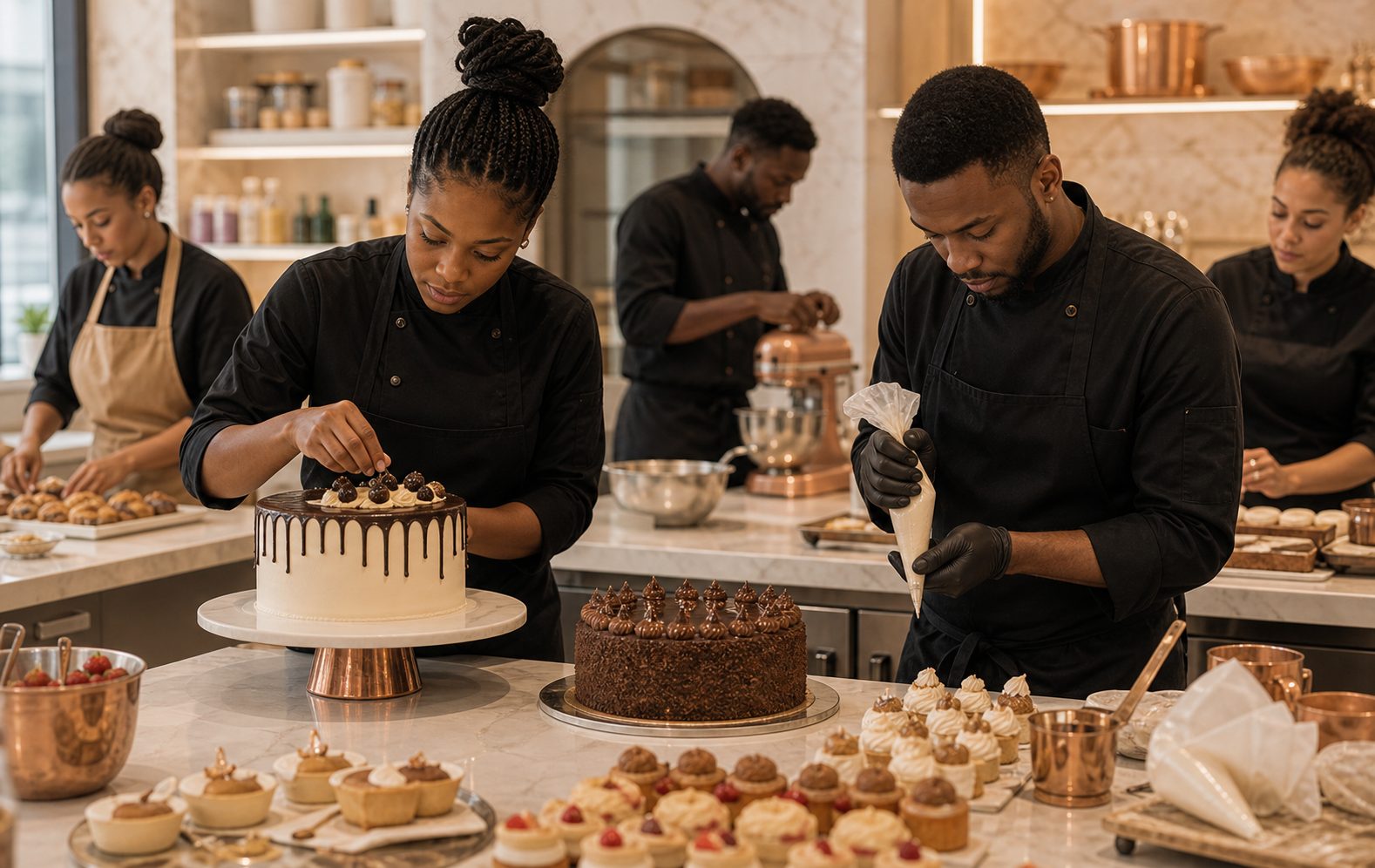
The window is full at opening. It should be nearly empty at closing. In between, nobody made anything: it was all done already. That inversion, which looks like nothing, separates pastry from almost every other food trade and explains most of what happens in one.
The morning bet
A pastry chef decides every day how much of each thing to make, without knowing who will come.
The decision draws on what is known: the day of the week, the forecast weather, school holidays, the festival coming up, what sold yesterday and the day before, what is left in the window tonight. Too little, and the display is bare by eleven — customers leave and, worse, they come back less often. Too much, and the surplus is lost, because a cake that is fresh this morning is not fresh tomorrow.
That calculation, redone every day, is the central management skill of the trade. It cannot be learned anywhere except in the shop you work in, because it depends on one clientele, one neighbourhood and one particular rhythm.
A day that starts while the city sleeps
The direct consequence of the model is a timetable: everything must be ready at opening, so work must start very early.
The workshop runs while the shop is shut. Doughs prepared the day before come out, things are baked, cooled, assembled, filled, glazed, decorated and set in the window. Some preparations impose their own clock: a dough needs rest, a ganache needs to crystallise, an entremets needs to set, a cream needs to cool before it can be worked. You cannot hurry a setting time because you are running late.
That constraint also orders the tasks: whatever must rest is done first, whatever suffers from heat is done at the coolest moment, whatever keeps badly is done last. A well-run workshop is not a fast one: it is one where nothing waits unnecessarily.
The gram and the minute
Pastry is the food trade where improvising costs the most.
In a kitchen you can recover: lengthen a sauce, correct, adjust the seasoning. In pastry, many preparations are chemical and physical balances — proportions of sugar, fat and water, raising agents, baking temperatures, resting times. A meringue overworked, a dough that got too warm, a caramel taken a few seconds too far: the result is not mediocre, it is wrong, and it has to be started again.
Hence habits that strike a visitor to a workshop: everything is weighed, including what looks trivial; recipes are written down and followed; temperatures and times are recorded; every ingredient is prepared before anything begins. That discipline is not rigidity — it is what allows a product to be identical in January and in July, made by one person or another.
It also has an economic consequence: in a trade where the raw material is weighed, a portion slightly off, repeated a hundred times a day, shows up in the accounts at the end of the month.
Waste is a metric, not an accident
An unsold fresh product at closing is a lost product. That is built into the model, which is exactly why it has to be measured.
Pastry chefs who run a solid business know what they throw away, by product family and by day. That figure tells them what they overproduce, what only sells every other day, what to cut back, and what is better made to order only. Without the measurement you produce blind and compensate by making more — which makes the problem worse.
Several levers reduce waste without emptying the window: turning one base into several products, planning smaller formats for the end of the day, keeping certain pieces to order only, and above all genuinely adjusting production from one day to the next instead of repeating the same sheet every morning.
The window is a working tool
A pastry shop sells largely through the eye. The customer chooses what they see, and chooses fast.
A display is therefore composed: heights, alignments, gaps, colour contrast, signature products at eye level, legible labels saying plainly what each thing is. It is also maintained: restocked, straightened, cleared of anything that has dried or sweated. A half-empty window at midday does not say "we sold well", it says "there is nothing left".
Displayed prices are part of that legibility. In a trade where two cakes of similar size can represent very different hours of work, explaining what you sell — by name, by a short description, by its composition — spares the customer from choosing on looks alone.
Orders invert the model
Alongside window sales sits a second activity that follows the opposite logic: orders.
A birthday cake, a wedding piece, a dessert buffet, a corporate order: here the customer is known, the quantity is fixed, the date is set, and there is no waste. It is the most predictable and often the most rewarding part of the trade — and also the least forgiving, because a wedding cake cannot be delivered the next day.
It has its own protocol: an order written down rather than agreed verbally, a deposit, a date and time for collection or delivery, a precise description of what is expected, and an explicit conversation about any dietary constraints. It also requires knowing how to say no: accepting a piece you have never made before for a wedding is a bad idea, and a serious professional offers something else rather than experimenting.
The calendar rules
Few food trades are as seasonal.
Religious and civil festivals, weddings, back-to-school periods and family celebrations create considerable peaks, over a handful of days, with demand concentrated on particular products. The rest of the year looks like a steadier base. A shop that does not anticipate those peaks — in raw materials, packaging, labour and refrigeration capacity — endures them instead of living off them.
Conversely, those periods are the chance to be discovered by customers who do not push the door the rest of the year: a festive order done well often produces a regular.
Storing, transporting, informing
Pastry handles sensitive products: eggs, creams, dairy, preparations that are not re-cooked. That demands a vigilance which is not administrative box-ticking.
The World Health Organization estimates that 866 million people — almost one in nine worldwide — fall ill each year after eating contaminated food, and that these illnesses cause around 1.52 million deaths a year. Children under five bear 29% of that health burden. The hazards identified are biological first — bacteria, viruses, parasites — then chemical.
The international reference framework for hygiene is the Codex Alimentarius collection of codes of practice, developed jointly by FAO and WHO, whose general principles of food hygiene serve as the basis for every other text in the field. In a workshop that translates very concretely: separated zones and utensils, temperature control for sensitive preparations, respected shelf lives, clean hands and surfaces, and suitable transport for anything leaving the shop.
Informing the customer belongs to the same professionalism. Being able to say what is in a preparation — nuts, eggs, milk, gluten and other ingredients likely to cause a problem — is a skill of selling as much as of making. The exact labelling and information obligations vary between countries: local regulation applies, and it is local regulation you need to know.
How the trade is learned
Routes in vary sharply by country: a vocational qualification, a supervised apprenticeship, a private school, certification by a recognised body. No global rule applies, and presenting one country's system as the norm would be wrong.
Across much of Africa, transmission runs largely through workshop apprenticeship: you learn with a master, by watching, then assisting, then doing. The International Labour Organization devoted a resource guide to this system for the continent, noting that at its most informal the master–apprentice relationship can remain entirely verbal — no agreed duration, no curriculum, no assessment, no certification. That is the strength of the model, which genuinely trains and trains many, and its limit: what is not certified is hard to convert into recognition later.
For a pastry chef setting up, the practical consequence is simple: documenting what you can do — through finished work, photographs, references, a certificate where one exists — partly replaces what a diploma would say for you.
Shop, workshop, or both
The legal shape of the activity is not neutral, and classifications show it. The French activity nomenclature distinguishes pastry making — artisanal production combined with retail sale of fresh pastries, without bread — from bakery-pastry, and expressly excludes tea-room activity, which moves into food service instead.
That administrative detail describes something real on the ground: adding three tables and serving drinks does not extend the pastry shop, it creates a second trade, with its own service, hours and constraints. Many workshops make that choice; it is better made knowingly.
Presenting a pastry shop
A customer looking for a pastry shop wants very simple questions answered: what do you make, where are you, when are you open, and can I order for a date?
A professional presentation gives the name of the shop and what characterises it in one sentence, the product families you genuinely offer, the specialities that bring people in, the address and a landmark, the real days and hours — including your closing day — whether orders are possible, the notice needed depending on the piece, how to order (phone, messaging, form), collection or delivery, the area covered if you deliver, and payment methods.
Photographs here are more than decoration: they are the catalogue. A customer ordering a wedding piece buys from a picture. Show real work, several formats, several styles, and say plainly what can be made to order and what cannot.
Finally, state what you can do for particular requests — free of a given allergen, without alcohol, for large numbers — where that is genuinely the case. It is often what makes someone choose one workshop over another.
In short
Pastry is a trade of anticipated production: you make before knowing who will buy, with products that do not keep and a precision that does not forgive approximation. Success rests on three unspectacular things — forecasting accurately, producing consistently, and measuring what you lose.
Training, setting-up and hygiene requirements depend on the country, and it is the local rule that applies. What does not vary is the customer's eye on the window: they buy what they see, and they come back if it is just as good the second time.
Do you run a pastry shop? Show your work, your specialities, your hours and your order lead times: that is what people look at before pushing the door.