
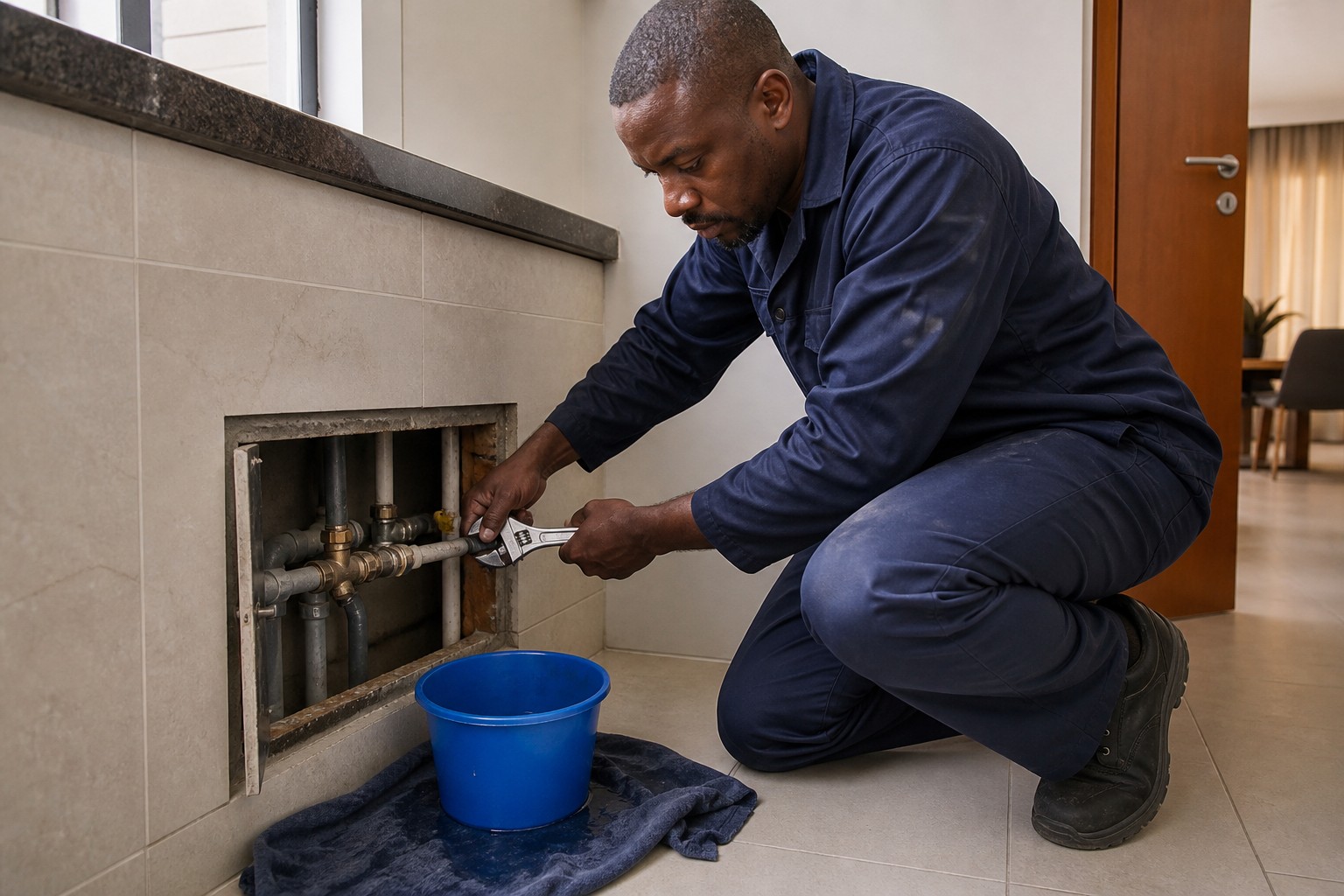
"It's dripping under the sink." "There's a mark on the ceiling." "The cistern won't stop." These sentences describe a symptom, in a place that is not necessarily where the problem is. Water travels, follows a pipe, crosses a partition and comes out wherever it can. The whole trade begins with that gap.
What the client describes, and what has to be found
The client reports an effect; the plumber looks for an origin. Between the two there is a method.
It starts with questions: since when, continuously or intermittently, after what event, at what time of day, does it change when a tap is opened, has anyone already worked on it. A leak that only appears when one particular outlet is used is not looked for in the same place as constant seepage.
Then comes observation: the mark, damp in the wall, the state of accessible connections, pressure at the taps, how the drains behave. What can be seen points somewhere; what is deduced is verified.
Diagnosis before the quote
This is the step some skip, and it decides everything else.
Pricing without having identified the cause amounts to selling a repair at random. Redoing a joint when the pipe is pierced upstream gives a spectacular result for a few weeks, then the same damage returns — this time with a client who feels they paid for nothing.
Diagnosis is therefore work in itself, and it is charged as such. Many professionals deduct it from the cost of the job when the client goes ahead: an honest practice, provided it is announced before the visit rather than discovered on the invoice.
Repair or replace: saying what will not hold
A good part of the work turns on that judgement, and it does not belong to the client alone.
A tired part can be put back into service for a while; a pipe corroded along its whole length cannot be salvaged at the point where it gave way. The professional's role is to say clearly which of the two situations they are looking at, and what each option implies — immediate cost, likely lifespan, risk of recurrence.
A client may perfectly well choose the temporary repair, because their budget allows nothing else. What is not acceptable is choosing it without knowing that it is temporary.
Parts: stated quality, receipts, warranty
Not all fittings are equal, and the difference does not show at installation: it shows two years later.
Professional practice is to say what quality is being fitted and what that changes about its lifespan, then to invoice supplies with their receipts. The distinction between labour and supplies appears on the quotation, separately.
When the client buys their own parts, one point must be settled before starting: who answers for what. A professional cannot guarantee the quality or the life of equipment they did not supply; their warranty then covers the installation. That is said at the quotation stage, not after the failure.
Price levels depend on the local market, the nature of the job and how accessible the pipework is: no general scale means anything, and deposit or warranty terms belong to the contract and the applicable law.
Emergencies, and what can be done straight away
An active leak does not wait for an appointment. The first useful reflex, on the client's side, is simple and carries no risk: shut off the water supply and, if water is reaching an appliance or an electrical installation, touch nothing and call in the competent professionals.
On the plumber's side, urgency imposes an organisation: a response time announced and kept, a price given before travelling, and the clear-sightedness to say on the phone when a situation is beyond what they can handle.
What is not the plumber's business
A damp mark does not always have a plumbing origin. It may come from an infiltration in the façade, a roof, rising damp, a failure of waterproofing, or condensation linked to inadequate ventilation. An honest professional says so when the signs do not converge on their field, rather than opening a partition for nothing.
Likewise, anything touching the home's electrical installation — the supply to a water heater, a socket near a water point — belongs to an electrician. And where a defect may concern the building's structure, the assessment belongs to a qualified professional, according to the qualifications required and the locally applicable framework.
Finally, on water itself: the World Health Organization points out that microbial contamination of faecal origin is the greatest risk to drinking-water safety, and promotes a water safety plan approach from catchment to consumer. A plumber does not analyse water and does not pronounce on whether it is safe to drink; they do, however, report what they observe — an uncovered tank, a doubtful interconnection, a possible backflow between systems — and refer the client to whoever can check it.
Testing in front of the client, and the site handed back
A job ends with a check carried out in the client's presence: water back on, the system pressurised, every point touched tested, a check that no seepage appears.
That moment is worth more than any explanation. It turns an invisible repair — under a sink, behind a hatch — into something the client has seen working.
To that is added the state of the place: debris removed, floor cleaned, hatch closed. Plumbing work always leaves traces somewhere other than the pipe; removing them is part of the job.
In the African context
Conditions vary sharply between countries, cities and types of housing: there is no typical African plumbing, and two buildings on the same avenue can pose opposite problems.
The first reality is water supply. Depending on the neighbourhood, mains supply is irregular, which leads many homes to install storage — a tank, a reservoir, a rooftop cistern — and often a booster pump. That adds a whole competence to the trade: sizing and maintaining that equipment, understanding the pressure problems it creates, and knowing that repeated interruptions test an installation differently from a continuous supply. The World Health Organization also notes that storage containers can become breeding grounds and that simply covering them reduces that risk — a point a plumber sees on site and can report.
The second is the nature of the building stock. The United Nations human settlements programme points to the scale of the need for adequate housing by 2030 and to housing's central place in urban policy. What follows for a plumber is very concrete: a significant share of jobs concerns homes built progressively, extended in stages, where pipework has been prolonged without an overall plan. Tracing a pipe there calls for more method than equipment.
The third is the supply of parts. Depending on the market, the availability and quality of taps and fittings vary considerably, and references that look alike do not last the same time. Knowing what holds up locally, and saying so to the client, is an economic skill as much as a technical one.
The fourth is how the trade is structured. The International Labour Organization documents the scale of informal employment in its statistical study on women and men in the informal economy, and plumbing is a common example. The opportunity is clear for those who structure themselves: a written quotation, receipts for supplies, a test carried out in front of the client and an invoice open access to clients — managing agents, companies, landlords, non-resident owners — who cannot work any other way.
Digital contributes unevenly across markets. Messaging serves to receive a photograph of the leak before travelling, which improves preparation; mobile payment settles the bill without cash, including for an absent owner. The International Telecommunication Union puts the share of the world's population using the Internet at 74 per cent in 2025, with 36 per cent for Africa, the lowest of the regions it measures: these channels matter where they exist, without replacing on-site diagnosis.
What a plumber does not promise
They do not guarantee that no other leak will appear elsewhere on old pipework, nor the life of a part they did not supply, nor the disappearance of damp whose origin is not plumbing, nor a result on an installation they could not inspect. They stand in neither for an electrician, nor for a qualified professional on anything structural, nor for a laboratory on water quality.
What they do commit to can be checked: a diagnosis carried out before the quotation, a price announced before the work, the distinction between labour and supplies, the stated quality of parts, a test in front of the client, a site handed back clean, and an invoice.
That is also what makes the business credible: a stable professional identity, a number that answers, real past work, quotations and invoices, clear payment methods and genuine reviews. None of that requires particular software, and none of it replaces word of mouth.
Artificial intelligence can help prepare a quotation, organise rounds, draft a report or sort enquiries. It does not see the pipework, locates no leak, does not confirm that a repair will hold, and does not replace the pressure test carried out on site.