
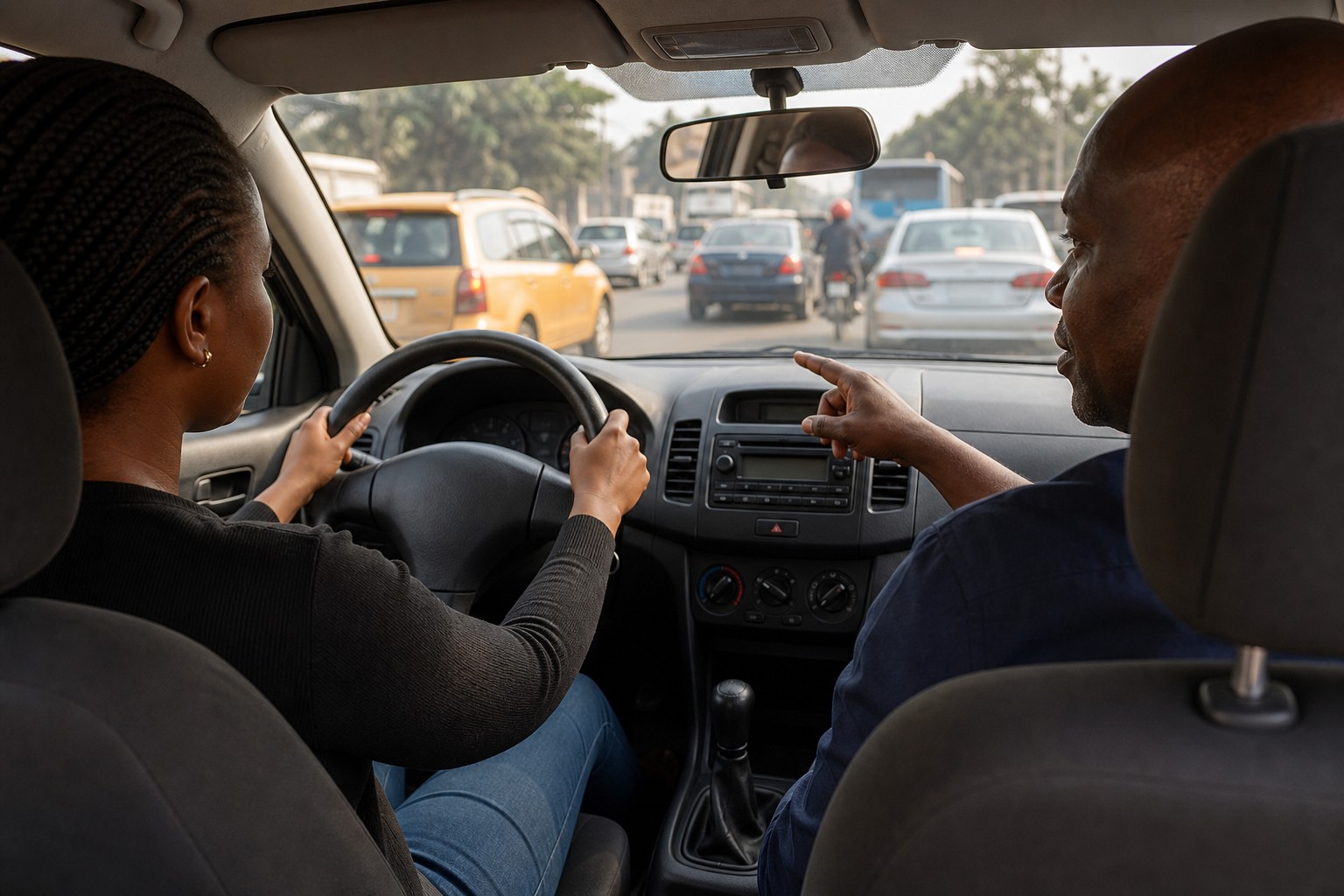
A learner is driving along a busy avenue. She is looking at the road ahead and nothing else. To her right, a man sees what she does not — the vehicle pulling out two cars ahead, the pedestrian about to cross, the light about to change — and must decide, within a second, whether to say it, to wait, or to act. That is exactly the job.
A teaching position that exists nowhere else
The instructor works from the passenger seat. That position has three consequences nothing else in teaching reproduces.
First, they must see before their learner. Not to drive for them, but to anticipate what is coming and calibrate their intervention. An experienced instructor is permanently a few seconds ahead of the person driving.
Second, they cannot correct afterwards. In a classroom, a failed exercise is redone. In traffic, a mistake produces its effect immediately. Teaching must therefore anticipate: preparing the learner for a situation before it arrives, rather than commenting on it once it has passed.
Third, they must ration their words. Talking too much saturates attention that is already saturated; saying nothing lets a bad habit settle. The central skill of the job is choosing, from a flood of information, the one thing to say right now.
Dual controls are not an autopilot
A dual-control vehicle lets the instructor act on the pedals, and sometimes on the steering. It is an indispensable safety net; it is also a teaching tool that can be misused.
An instructor who brakes at every hesitation deprives the learner of the experience of handling the situation themselves. One who never intervenes turns a lesson into risk-taking. Between the two lies a judgement — intervening late but surely, then explaining why — that separates a professional from a passenger.
That judgement requires knowing your learner. This is precisely what one-to-one work allows: after two or three hours, an instructor knows a person's weak points, which situations make them tense, and when they stop taking things in.
Stress is part of the subject taught
Many learners do not have a technical problem but a confidence problem. That applies as much to beginners as to people who have held a licence for years and no longer dare to drive.
Dealing with it is work in its own right. It means starting in environments poor in information before adding complexity, breaking difficulties down — a hundred parking manoeuvres before one in real traffic — creating success before demanding progress, and naming what is happening rather than denying it: someone shaking as they pull away needs it said calmly, not ignored.
It also requires a posture. An instructor who shouts gets a learner who tenses up, therefore drives worse, therefore gets shouted at more. Calm here is not an optional human quality: it is a professional skill.
A progression built for one person
This is the main advantage of one-to-one work over a collective arrangement, and it only counts if it is used.
An independent instructor can build each session from the last: revisiting what was not secure, skipping what already is, choosing a route for a precise objective, moving fast where the person moves fast. They can also fit the pace to the learner's life — two hours on a Saturday are sometimes worth more than four scattered sessions.
That staged, competency-based logic rather than an hours-based one matches what the International Labour Organization carries in its body of standards on human resources development, which brings together Convention No. 142 of 1975, Convention No. 140 on paid educational leave, Recommendation No. 195 of 2004 and Recommendation No. 208 of 2023 on quality apprenticeships: what counts is the competence installed, not the time spent.
In practice that means keeping a record. A serious instructor notes after each session what was worked on, what is secure, what remains fragile and what comes next. Without that record there is no progression, only a succession of hours.
What this teaching actually carries
The World Health Organization estimates that around 1.16 million people are killed each year in road traffic crashes. It specifies that 92% of those deaths occur in low- and middle-income countries, which hold around 60% of the world's vehicles, and that more than half the victims are vulnerable road users — pedestrians, cyclists and riders of powered two-wheelers. The risk factors are well established: speed, alcohol and psychoactive substances, non-use of helmets and seat belts, distracted driving, unsafe infrastructure and vehicles, and inadequate post-crash care. Its global status report on road safety published in 2023 counts roughly 1.19 million deaths a year.
In response, in 2017 WHO gathered under the title Save LIVES a set of priority interventions organised into six strategies — speed management, leadership, infrastructure design and improvement, vehicle safety standards, enforcement of traffic laws and post-crash survival — to be implemented in an integrated way.
An instructor acts on neither roads nor vehicles. They act on something nobody else can install: a driver's reflexes during their first hours. The relationship to speed, the habit of fastening a belt before starting, not touching a phone while moving, how a junction is scanned: what is learned there stays.
That also imposes a requirement of personal consistency. An instructor who answers a message during a lesson cancels everything they explained about distraction.
Independent, and what that changes
An instructor working outside a company gains pedagogical freedom and loses everything else: scheduling, finding learners, invoicing, vehicle maintenance and insurance all become their own business.
The most visible difference for the learner is flexibility: an independent instructor travels, adapts to timetables, offers slots a company cannot open. The least visible is isolation: nobody covers for them when ill, nobody discusses a learner who is stuck, nobody takes over when the relationship does not work.
Experienced professionals offset that isolation by keeping links — with other instructors, with driving schools they refer to or receive learners from — and by knowing which situations they should not handle alone.
The conditions for practising — qualification, authorisation to teach driving, business status, insurance covering learner drivers, a declared dual-control vehicle — vary sharply between countries, and in several of them teaching driving cannot be done outside an approved establishment. It falls to every professional to check with the competent authorities of their territory what actually applies, before selling lessons.
The vehicle is the tool and the message
For an independent instructor, the car represents most of the investment and all of the visible credibility.
It must have working dual controls, be maintained on a schedule, insured for the exact use made of it, and clean. That last point is not cosmetic: a learner spends twenty hours sitting in it, and the state of the vehicle is part of what they learn from a professional.
Preventive maintenance has a direct economic consequence here: a vehicle off the road does not cost a repair, it costs a week of cancelled lessons with learners who will find someone else.
The economics of available hours
An independent instructor sells hours, and only a limited number are genuinely sellable: those when learners can drive.
High-demand slots are few — late afternoons, Saturdays — and midday ones fill with difficulty, except with particular audiences. Travel time between learners is never billed, which makes the geographical coherence of the client list decisive: three learners in the same district are worth more than three across the city.
Add fuel, maintenance, insurance and vehicle depreciation, which run regardless of occupancy. As in any activity of this kind, the variable that decides the balance is not the hourly rate but the number of hours actually delivered — and therefore the reliability of the schedule and the policy applied to late cancellations.
Presenting an independent instructor's service
A prospective learner wants to know four things very quickly: what you offer, where you travel, when you are available and what it costs.
A professional presentation gives your name and background in one credible sentence, the services genuinely provided — full learning, regaining confidence at the wheel, targeted test preparation, refresher work — the categories concerned, the geographical area you travel to, the length and format of lessons, your real availability, the hourly rate and cancellation terms, a description of the vehicle, and a contact that answers quickly.
Two things make a particular difference. The area covered, because you travel and a learner wants to know immediately whether they qualify. And regaining confidence at the wheel: it is a frequent request, poorly served by conventional providers and rarely advertised — naming it explicitly attracts people looking for exactly that.
One thing to avoid: promising success in the test or a guaranteed number of hours. The hours needed depend on the person, and announcing them in advance means either lying or trapping yourself.
In short
A driving instructor practises teaching under conditions no other teacher knows: no room, no chance to start over, sitting beside their learner, responsible for seeing before them. Their skill lies in the dosage — when to speak, when to stay silent, when to intervene — and in the ability to build a progression for one person.
Conditions of practice, qualification and authorisation depend entirely on the country and its competent authorities, and independent practice is not possible everywhere. What does not vary is what remains: the way of driving a learner carries for thirty years was learned over some twenty hours, sitting next to someone.
Are you a driving instructor? State your services, your area, your availability and your rates: that is what people look for before calling you.