
"Send me a photo, give me a price." The request is understandable, and it is nonetheless the best way to get it wrong. A set designed from a photograph always runs into a constraint the photograph did not show: a pillar, a service door, a ceiling too low, a light that flattens the colours.
No two rooms are decorated the same way
A set is not a catalogue applied to a volume. It is an answer to a specific place, for a specific event, with a specific number of guests.
Three things change everything. The volume and its proportions: what fills a low room overwhelms a high one, and the reverse. The existing surfaces: coloured walls, a marked floor or an exposed ceiling impose choices that neutral walls do not. The light: the venue's own, what you add, and the hour at which the event takes place.
Hence a commercial consequence the trade accepts: you do not quote seriously before seeing the room. A proposal made at a distance is an estimate, and must be presented as one.
The visit: what you look at
The visit is not a commercial courtesy, it is measuring up in the broadest sense.
You note the useful dimensions, the available height, the position of openings and possible fixing points, the state and colour of the surfaces, the existing lighting and how it is switched, the sockets and where they are, the circulation routes, the delivery access — door width, stairs, lift, distance from the unloading point —, the storage available, and the hours the venue allows for set-up and strike.
You also ask what cannot be seen: who else is working there, at what time, and who decides on site. A set is almost never installed alone in an empty room.
From concept to proposal
Then comes the design: an intention, a palette, materials, a layout. The decorator translates a wish — understated, warm, formal, festive — into concrete elements: surface treatments, a backdrop, an aisle, furniture, textiles, plant or floral arrangements, ambience pieces, signage.
Budget steers the materials more than it cuts the ambition. Fresh flowers or a durable reusable build, fabric or structure, hire or fabrication: these are trade-offs, and they are presented as such.
Decoration differs here from stage design, which answers to a production and to different technical constraints. It does not substitute for it, and a serious decorator says so when a project belongs to the other trade.
The itemised quote
A readable quote separates what can be traded off: design, textiles, structures, furniture, floral elements, any decorative lighting, set-up labour, transport, strike — and what stays out of scope.
That separation has a concrete virtue: it lets a client remove an item rather than abandon the project. It also avoids the trade's most frequent misunderstanding — assuming the furniture is included because the photograph showed some. Where tables, chairs or tableware are hired on the client's behalf, they appear as a distinct item.
Price levels depend on the venue, the guest count, the materials and the local market: no general scale exists. Likewise a deposit, an earnest payment, a bond and an advance do not have the same legal effect everywhere; cancellation terms are read in the contract and in the country's rules.
The set-up
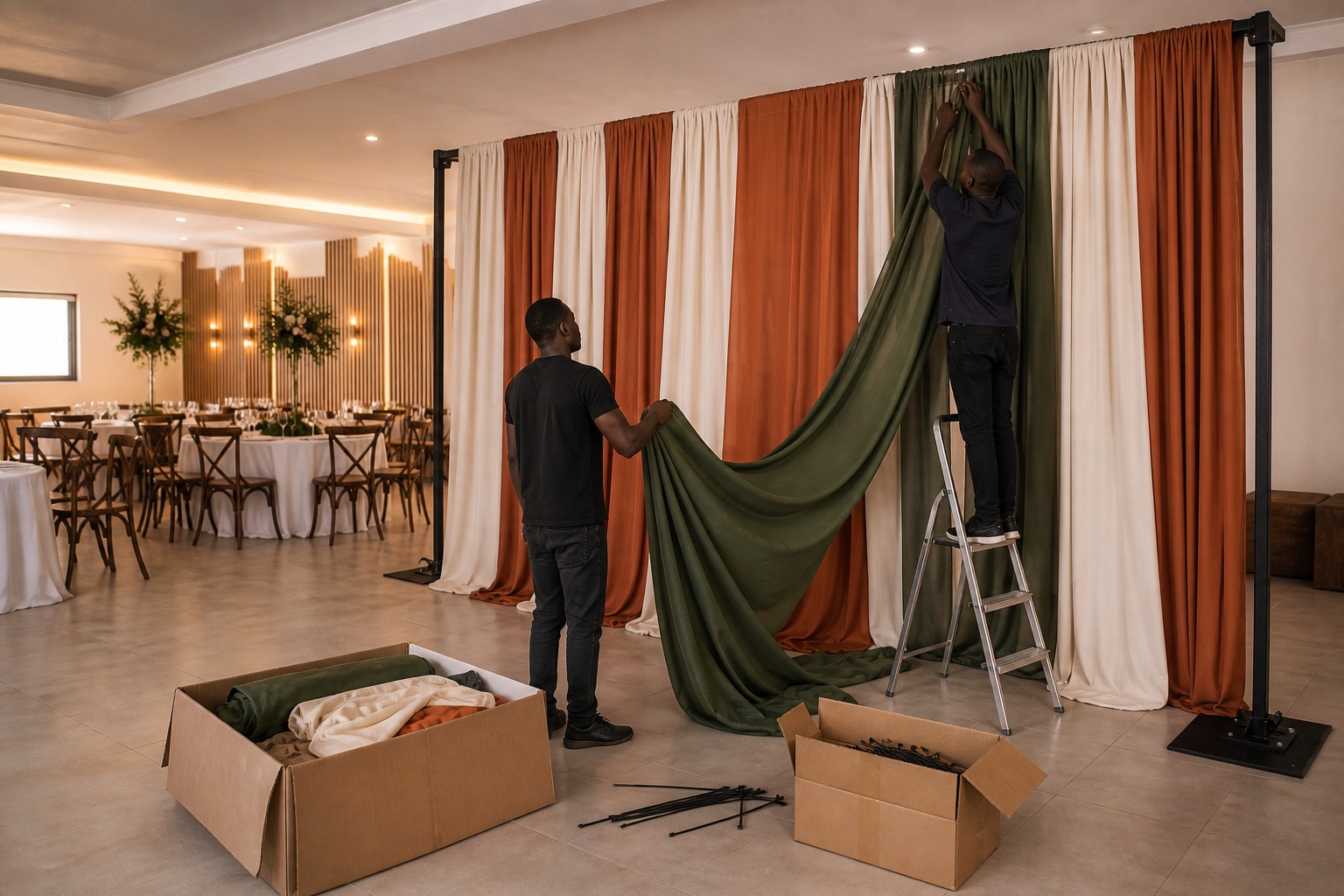
The set-up is the real moment of the trade. It requires a crew, a slot obtained from the venue, equipment prepared and checked at the workshop, and an order of installation: what is high before what is low, what is fixed before what is movable, what blocks circulation last.
It also requires safety for those installing. Work at height, manual handling, temporary structures: these are situations that the International Labour Organization's Convention No. 167 on safety and health in construction addresses at the level of principles — appropriate equipment, competent personnel, prevention of falls. Load-bearing structures, suspended loads and work at height belong to trained and equipped people, and sizing a structure is never improvised on site.
Finally, a set must never obstruct what has to stay clear: circulation routes, access, exits, the venue's own equipment. That is the point where aesthetics give way to safety, without discussion. The exact requirements depend on the venue and the applicable rules, and are checked with the site.
Strike and handback
The service does not end when the party does. The strike is planned in the quote: when, by whom, in how long, and in what state the room is returned.
It is a commitment clients notice late but strongly: nobody wants to clear a hall at two in the morning. It is also a constraint for the venue, which often imposes a time by which the room must be free.
Stock: inventory, condition, return
A decoration workshop lives with stock that goes out and comes back: structures, textiles, chair covers, vases, decorative lighting, furniture, accessories.
The professional must be able to answer at any moment: what do we have, where is it, is it available on that date, in what condition, which event is it reserved for, and when does it come back. The medium hardly matters — notebook, spreadsheet or software — provided one source is authoritative, failing which the same set is promised twice.
Condition is documented on the way out and on return. When damage is found, that double record is what allows a factual discussion; the financial consequences depend on the agreed terms and the applicable law, never on a general rule.
In the African context
Decorative practices, expectations and means differ greatly from one country, one city and one milieu to another: there is no typical African set, and the trade consists precisely in answering a given context.
What recurs in several contexts is, first, the variety of occasions. Weddings are only part of the activity: dowries and customary ceremonies, christenings, birthdays, retirements, graduations, religious events and corporate receptions hold an important place, with their own codes and very different budgets. A decorator working only on weddings would be giving up most of their market.
Then comes the nature of venues. A hired hall, a hotel, a restaurant, a family courtyard, an outdoor space or a marquee: many sites have no planned fixing points, no storage, no adjustable lighting and no stable power. The set must then be self-supporting, transportable and re-assemblable — which steers design choices well before aesthetic ones. Outdoors, wind and rain become design parameters, not surprises.
Supply matters too. Depending on the market, some materials, textiles or flowers depend on imports with variable lead times, which favours durable reusable builds and makes maintaining the stock an economic skill as much as a technical one.
On crews, the International Labour Organization has published a guide on upgrading informal apprenticeship in Africa: a significant share of the craft is transmitted in the workshop, alongside someone more experienced, outside formal schemes. The guide examines how to recognise and improve those paths rather than ignore them — a question directly useful to a workshop training its own installers.
Finally, professionalisation is a real differentiator. The International Labour Organization documents the scale of informal employment in its statistical study on women and men in the informal economy, and event decoration is one example: it is practised occasionally as much as by established workshops. Digital helps unevenly across markets: instant messaging serves to receive an enquiry, send photographs of the room and approve a proposal; mobile payment simplifies deposits; social media are often the main portfolio. The International Telecommunication Union puts the share of the world's population using the Internet at 74 per cent in 2025, with 36 per cent for Africa — the lowest of the regions it measures: these channels matter where they exist, without replacing the site visit.
What a decorator does not promise
They do not guarantee that a set seen in a photograph can be reproduced in another room, nor a date's availability before confirmation, nor that an outdoor build will hold in any weather, nor the supply of anything not in the quote. They stand in neither for the venue, the caterer, the technical suppliers, nor the competent authorities.
What they do commit to can be checked: a visit before quoting, a proposal suited to the room, an itemised quote, an agreed set-up slot, a trained crew, a set that obstructs no circulation route, a strike included and a room handed back.
That is also what makes a workshop credible: real, dated work, an enquiry form, a calendar that is kept, quotes, contracts, invoices and genuine reviews.
Artificial intelligence can help prepare a mood board, structure a quote, sort enquiries or draft a service description. It does not replace the site visit, guarantees no structure will hold, and does not decide what can safely be installed.