
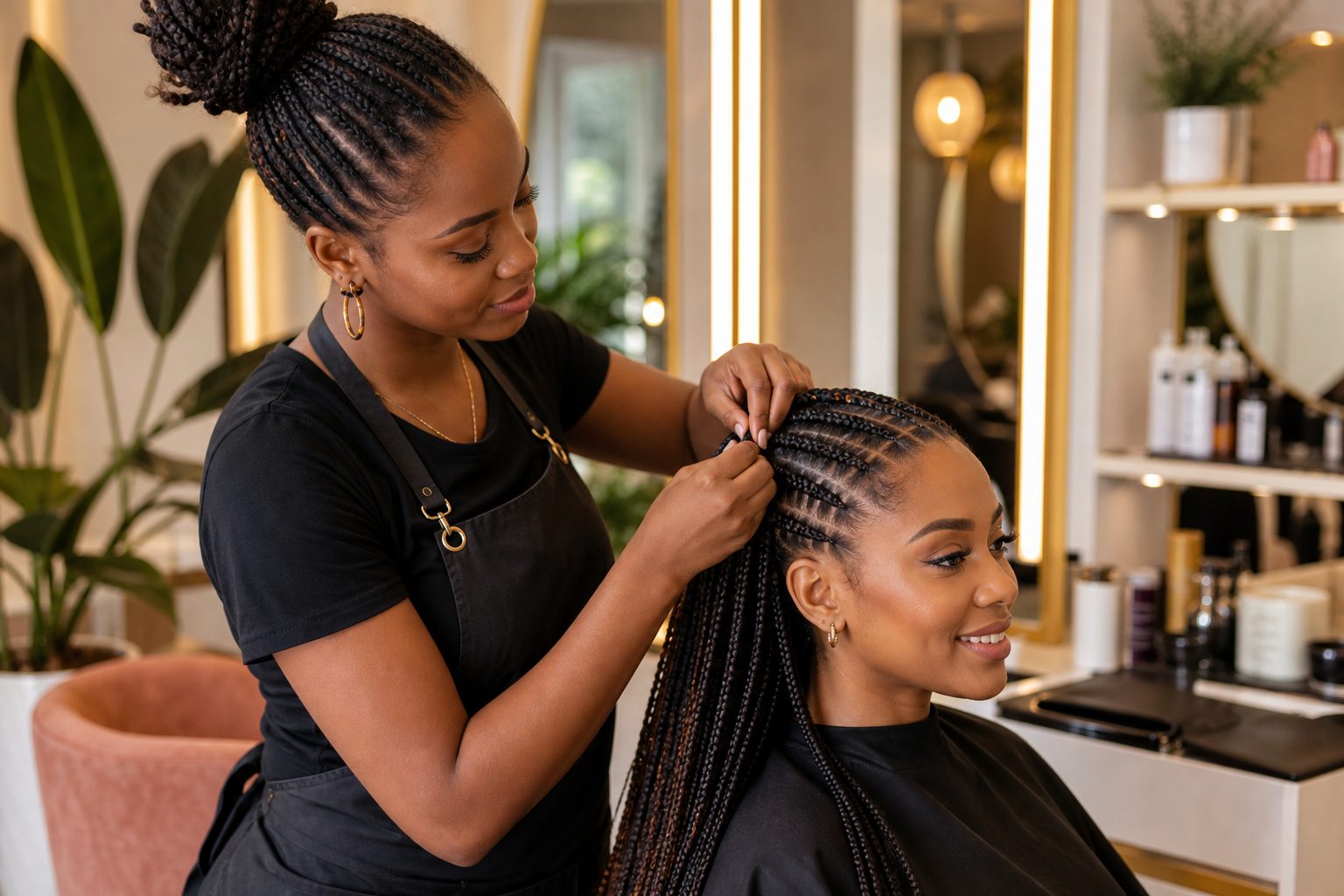
There are few trades where the unit of work is measured in half-days. Braiding is one of them. A full service occupies the professional and the client for three to eight hours, sometimes more. That duration is not an organisational detail: it is the central fact around which the whole trade is arranged.
A service measured in hours
Most beauty services are measured in minutes. A set of braids is measured in afternoons.
Three things follow immediately. First, a braider cannot run ten clients a day: she does one, sometimes two. Second, the relationship is not the same — you do not spend six hours with someone the way you spend twenty minutes. Third, the work requires somewhere you can sit comfortably for a long time, which explains why the home is so often the natural venue for this trade: the client's, or the professional's.
The main families of styles
The word "braids" covers techniques with different levels of difficulty, different durations and different prices:
- cornrows, worked flat against the scalp, with parting patterns that can become genuine designs;
- free-hanging braids, including box braids, built with or without added hair;
- twists, twisted rather than plaited;
- crochet and faster techniques, which shorten the sitting;
- locs, their starting and their maintenance;
- weaves and wigs, a neighbouring but distinct competence;
- children's styles, shorter in duration but far more demanding in patience.
Each family means a different technique, a different time, a different quantity of hair. Grouping them under a single price is the trade's first management mistake.
The WorldSkills international standard for hairdressing places work with attachments and extensions within its styling block, and stresses that the internationalisation of the trade requires professionals to understand and work with diverse cultures, trends and hair types.
How a long appointment unfolds
A braiding appointment follows a stable order, each stage conditioning the next.
The consultation: what the client wants, the size and number of braids, the length, the colour of the added hair, the time available, and above all the date of the last set and the state of the scalp.
Preparation: detangling, sectioning, sometimes washing and drying. This is the least rewarding and most decisive stage: you cannot braid badly detangled or badly parted hair properly.
The braiding itself, strand after strand, section after section, over several hours.
Finishing: the ends, the shaping, clearing the hairline, checking the overall evenness.
Maintenance advice, which is not a courtesy extra but part of the service: how to sleep in it, how to wash it, how long to keep it, when to come back.
One practical constraint runs through all of it: fatigue. The client's, seated for hours, and the professional's, standing or leaning with arms raised. Planning breaks, a comfortable position, water, a backrest: this is not comfort, it is what makes it possible to finish the work cleanly.
Tension: the limit the trade must know
This is the most important professional point in this article, and it deserves to be said plainly.
A style that is too tight pulls on the scalp. The American Academy of Dermatology describes traction alopecia as hair loss caused by repeatedly wearing tightly pulled hairstyles, and notes that it particularly affects girls and women of African descent.
Its recommendations are directly usable by a professional: loosen braids especially along the hairline, prefer thicker braids or locs over very fine ones, do not keep them in too long — the AAD points to a limit in the order of six to eight weeks — alternate styles to let the hair recover, wear weaves temporarily and remove them at once if they hurt, choose a sewn-in weave over a glued one, and make sure cornrows are not tight.
It also describes warning signs any professional should be able to recognise during the work: pain, a stinging scalp, crusts, or the "tenting" effect when sections are pulled upward. A client who says it hurts is not a sensitive client: that is a technical signal.
The AAD finally recommends seeing a dermatologist about hair loss. That is exactly the trade's limit: a braider does not diagnose and does not treat. She adapts her practice, declines to work on a damaged scalp, and refers to a health professional when the situation goes beyond her.
Saying so does not weaken the trade. On the contrary, it is what separates a professional from someone who braids: she knows what her work does to the hair over three months, not only in the photograph taken that evening.
Textured hair, a material in its own right
Working on coily and curly hair is a speciality, not a variation.
The material does not behave like straight hair: it detangles differently, breaks differently, swells, holds water, and responds to heat and tension in specific ways. A professional who has mastered it knows what she can ask of a head of hair and what she cannot.
That is a scarce and durably demanded competence, and a commercial argument in itself. Many clients look first for a professional who can work their texture, before they even look at a style.
Where the trade is learned
Transmission happens very largely through observation and practice: you learn in the family, alongside an established professional, or by assisting for months before working alone.
The International Labour Organization has devoted a resource guide for Africa to this mode of learning. It notes that at its most informal end the master–apprentice relationship may remain entirely verbal, with no agreed term, no schedule of learning, no assessment and no certification. The system genuinely trains, and it trains many; its limit is that uncertified skill is hard to convert into recognised value later, particularly with clients or partners looking for guarantees.
Training and licensing requirements vary widely by country — some regulate braiding specifically, others not at all. Local rules have to be checked.
Charging for time, not for a product
This is the trade's own economic difficulty, and the one most poorly solved.
A six-hour service sold at the price of a haircut is sold at a loss. Yet that is often the comparison the client makes in her head.
Three principles help escape the trap. State the duration alongside the price, every time: it is the only way to make the price intelligible. Differentiate prices by the size and number of braids, the length and the presence of added hair, because those parameters determine the actual time. And treat the hair extensions separately: supplied by the client or by the professional, but always identified as a distinct item.
One complementary practice works very well: offering a shorter refresh or hairline maintenance price, which brings the client back between two full sets.
A clientele that passes on by word of mouth
This trade lives on recommendation and loyalty. Nobody hands over six hours of their day and their head to a stranger.
As in many independent service activities, formalising changes the scale of what can be aimed at. The International Labour Organization estimates that two billion workers, or 61.2% of the world's employed population, are in informal employment. Being registered, reachable and identifiable is not an administrative formality: it is what makes it possible to move from a neighbourhood clientele to clients who travel further because they have seen the work.
Presenting the business
This trade sells in images, but it is booked on three pieces of information clients look for first: how long, how much, and is the hair supplied.
A complete professional presentation therefore includes: the business name, the styles genuinely mastered, an indicative duration for each type of set, prices by category, the rule on extensions, where the work takes place — at the client's, at the professional's, or both — and the area covered, the hours, booking, a direct contact, and a gallery of finished work.
The gallery is decisive and must be honest: real sets, on varied textures and lengths, properly photographed. That is what lets a client picture the result — and arrive on the day with a realistic expectation.
In summary
Home braiding is a long-form manual trade, practised on a demanding material, in a prolonged relationship with the client. Its technique is judged on evenness, its professional quality on tension, and its profitability rests entirely on the ability to charge for time.
It is also a trade with a clear limit: adapt, loosen, decline to work on a damaged scalp, and refer to a health professional when the situation calls for it.
Are you a hair braider? See how to present your business clearly online: your styles, your durations, your prices and how clients can book.