
"It's overheating." "The light is on." "It's drinking too much fuel." These sentences begin almost every job, and none of them says what needs repairing. A shop that replaces a part on the strength of a symptom is working at random: sometimes it works, often the customer comes back.
What the customer describes, and what has to be found
A symptom is a consequence observed by someone who is not a mechanic: valuable because it points somewhere, insufficient because very different causes produce the same sensation.
The work therefore starts with listening precisely: since when, cold or warm, at what speed, permanently or intermittently, after what event. To that is added the history: what was done recently, by whom, with which parts — many faults follow on from a previous job.
Taking the vehicle in
Reception is an administrative act as much as a technical one: identify the vehicle, record the mileage where relevant, note the visible condition, write down the customer's request in their own words, note the belongings present, and state what is authorised at this stage — often the diagnosis alone.
None of that is a universal legal obligation; requirements vary with national regulation. But a shop with no record of a vehicle's condition on arrival is in difficulty at the first dispute.
Diagnosis: hypotheses, then verification
Diagnosing is not guessing. It is building a list of hypotheses consistent with the symptoms, then eliminating them one by one through checks: direct observation, cheap checks before expensive ones, measurements where they are possible, confirmation of the cause, and only then a repair decision.
A professional also accepts saying that an intermittent fault could not be reproduced, rather than naming a part at random. That rigour has a direct commercial consequence: diagnosis is work in itself, and is charged as such.
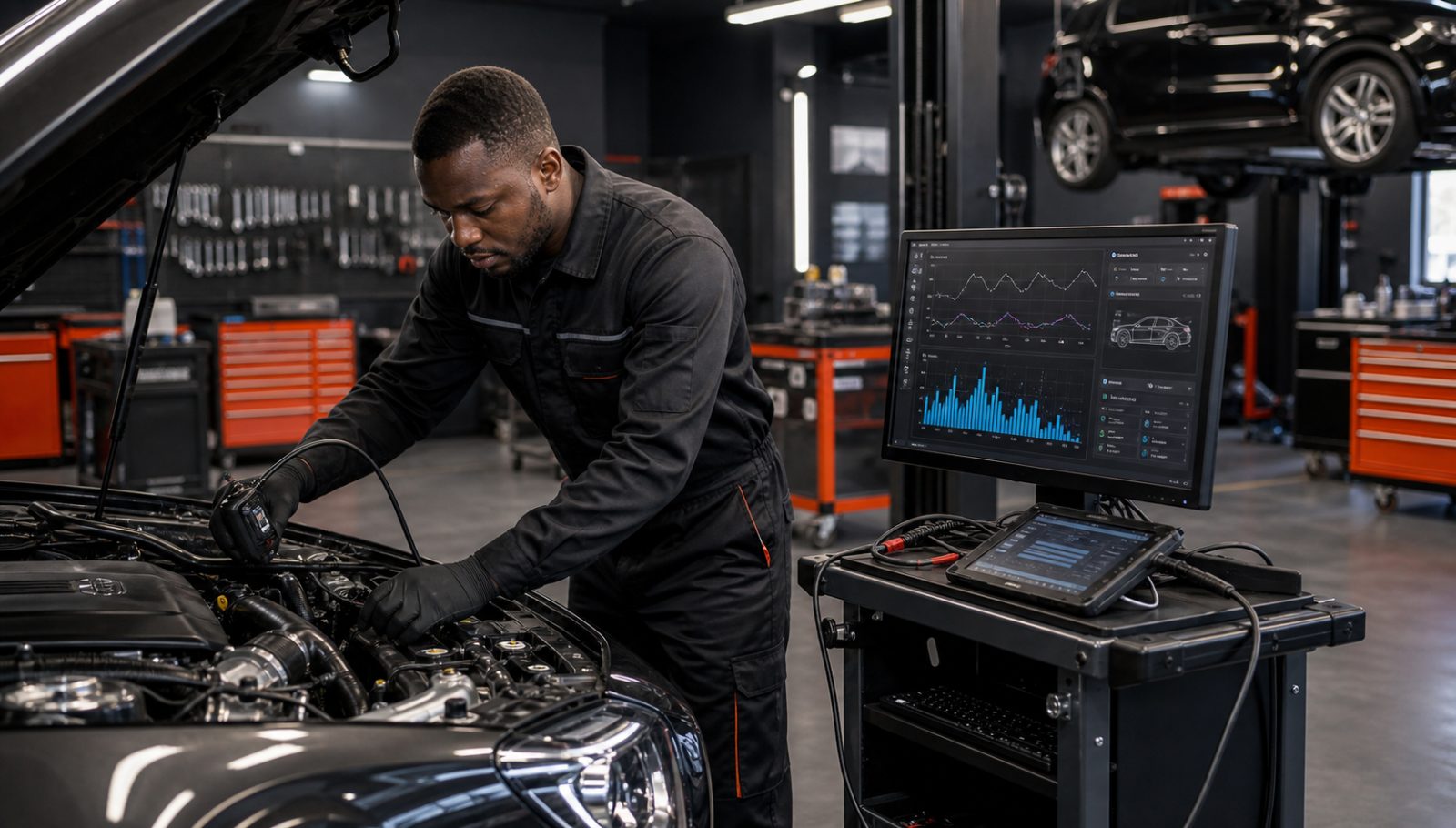
The scanner does not say which part to replace
The electronic diagnostic tool is indispensable, and it is also the source of the trade's most common misunderstanding.
Five things must be distinguished. The symptom, what the driver feels. The fault code, what the control unit recorded. The measurement, what is actually read on the vehicle. The interpretation, what that means given the model and the context. The cause, what has to be corrected.
A code may point to a circuit, a value out of range, or a sensor reporting an anomaly — without the sensor being at fault. Replacing the component named in the code without checking amounts to believing a thermometer is broken because it reports a fever. The tool provides information; interpretation remains the trade.
The quote and the authorisation
A limited job must not silently turn into a much heavier invoice. A readable quote separates the findings, the proposed work, the parts planned, the estimated labour and what stays out of scope, and it is approved before the work. Price levels vary by country, city and workshop: no general scale means anything here.
The delicate point is the fault discovered mid-job. A dismantled component sometimes reveals a problem the diagnosis could not see. The professional course is then to stop, call, explain and obtain a fresh authorisation — not to carry on assuming the customer will agree.
Parts: reference, origin, traceability
Identifying the right part is a job in itself: the same model often exists in several versions depending on the year, the engine or the market it came from, and an approximate reference will not do.
Not all parts are equivalent, and no simple hierarchy holds: depending on the case, a manufacturer's original part, a supplier's part, an aftermarket part, a remanufactured one or a checked used one can be the right or the wrong choice. What matters is that the customer knows what is fitted to their vehicle, and that provenance is established — a reference inconsistent with the packaging or absent traceability are signals a professional takes seriously, all the more on safety-related components.
When the customer brings their own part, the question to settle before starting is simple: who answers for what. The workshop does not guarantee the quality or the life of a part it did not supply, and that is said at the quote stage.
The immobilised vehicle and the job file
A vehicle that stays in the workshop becomes a flow to manage: it takes up space, it must be identifiable, its keys stored and findable, its condition tracked, and removed parts kept attached to the right file.
Hence the value of a job file, on paper or digital depending on the size of the business: vehicle, customer, reported problem, diagnosis, authorised work, parts used, who worked on it, handback. It is what allows the question "what exactly did you do?" to be answered six months later. Stock obeys the same logic: the balance between common parts held and cash tied up depends on the vehicles actually repaired in that workshop, not on a general rule.
Critical systems: what is not improvised
Some jobs are not a matter of do-it-yourself, and it is useful to say why rather than how.
Braking and steering bear directly on safety: they require serious diagnosis, appropriate parts, competent staff and a final check before handback. Work under a vehicle requires suitable lifting equipment, stable and of sufficient capacity — it is one of the most dangerous situations in the workshop. Airbags and pretensioners, fuel circuits, pressurised air conditioning and batteries each call for specific precautions, and the high-voltage circuits of hybrid and electric vehicles require dedicated skills, suitable manufacturer documentation and their own equipment: a workshop without those refers the customer elsewhere.
Finally, fluids are not interchangeable: the correct product depends on the manufacturer's specifications, is read in the documentation, and is not inferred from habit.
Oils, batteries, tyres: what leaves the workshop
A repair shop produces waste, some of it hazardous: used oils, soaked filters, brake and coolant fluids, batteries, tyres, solvents, packaging.
Used oils are not poured onto the ground, into a sewer or into a gutter, and are not burned in an improvised way: they are collected in suitable containers, stored under cover and handed to an authorised route where one exists.
Lead-acid batteries are covered by an international framework: the Basel Convention on the Control of Transboundary Movements of Hazardous Wastes has adopted technical guidelines on the environmentally sound management of waste lead-acid batteries, which recommend among other things relying on manufacturers, distributors and workshops to take back the old battery when a new one is supplied. The concrete obligations on collection, for their part, are a matter of national regulation.
Handback, invoice and warranty
Handback is the moment the work becomes intelligible: what was found, what was done, which parts were replaced, what remains to be watched, the limits of the job and the amount invoiced.
Showing the removed parts is a modest and formidably effective practice: it is the best evidence that they needed removing. Conversely, "your car is perfect now" is neither true nor sustainable — a vehicle repaired on one point remains a mechanical assembly with its age and its use.
The warranty deserves to be written down. The part's warranty, the warranty on the work done, any manufacturer's warranty and a purely commercial undertaking must be distinguished. Their scope depends on the contract and on each country's law: no duration is universal. Likewise, preventive servicing intervals depend on the vehicle, its use and its environment; they are read in the manufacturer's documentation, not in a general figure.
In the African context
Working conditions vary sharply from one country and one city to another, and a single description would be false. Several realities nonetheless recur in some contexts.
The first concerns the vehicles repaired. The United Nations Environment Programme devoted a report to it, Used Vehicles and the Environment: A Global Overview of Used Light Duty Vehicles — Flow, Scale and Regulation, covering 146 countries importing used vehicles. It notes that many vehicles exported to low- and middle-income countries are of poor quality and would fail a roadworthiness test in their country of origin, and calls for harmonised minimum standards. For a workshop the consequence is direct: the diversity of models, years and source markets is far greater, which makes identifying exact references harder and more decisive. Parts availability follows — supply depends on imports with variable lead times, and the use of remanufactured or checked used parts holds a place other markets know less well.
Operating conditions also weigh, differently by area: dense traffic in some cities, degraded surfaces on some routes, dust, heat, humidity, long distances between towns. The same model does not wear the same way in a coastal capital and on a laterite road.
The regulatory framework is heterogeneous: periodic technical inspection exists in some countries, in different forms and at different intervals, and not in others. The United Nations Economic Commission for Europe administers an agreement on the adoption of uniform conditions for periodical technical inspections of vehicles, to which States beyond Europe adhere, without any rule applicable everywhere following from it.
On skills, the International Labour Organization has published a guide on upgrading informal apprenticeship in Africa: much of the transmission of the craft happens in the workshop, alongside a master, outside formal schemes. Depending on the country, certifications exist, are being introduced, or are absent.
Several developments finally open prospects, again unevenly: professionalisation is a real commercial differentiator where it remains rare; mobile payment simplifies collection in some markets; instant messaging has become a common professional channel; and fleet servicing is in several cities a structuring segment.
What a repair shop does not promise
A repair shop does not guarantee that no other fault will occur, that an old vehicle will be as good as new, that a used part will last like a new one, or that an intermittent fault will necessarily be reproduced. It stands in neither for the manufacturer, nor for an inspection body, nor for an insurer.
What it does commit to can be checked: a recorded request, a diagnosis carried out before any repair, an authorised quote, identified and traceable parts, a maintained file, a check before handback, replaced parts shown and an explained invoice. Artificial intelligence can organise files or help draft a quote; it invents neither a diagnosis nor a part reference, and does not declare a vehicle safe without a check.
Finally, this article describes a trade, not a repair manual: the operations mentioned belong to trained and equipped people, and the obligations cited vary from country to country.