
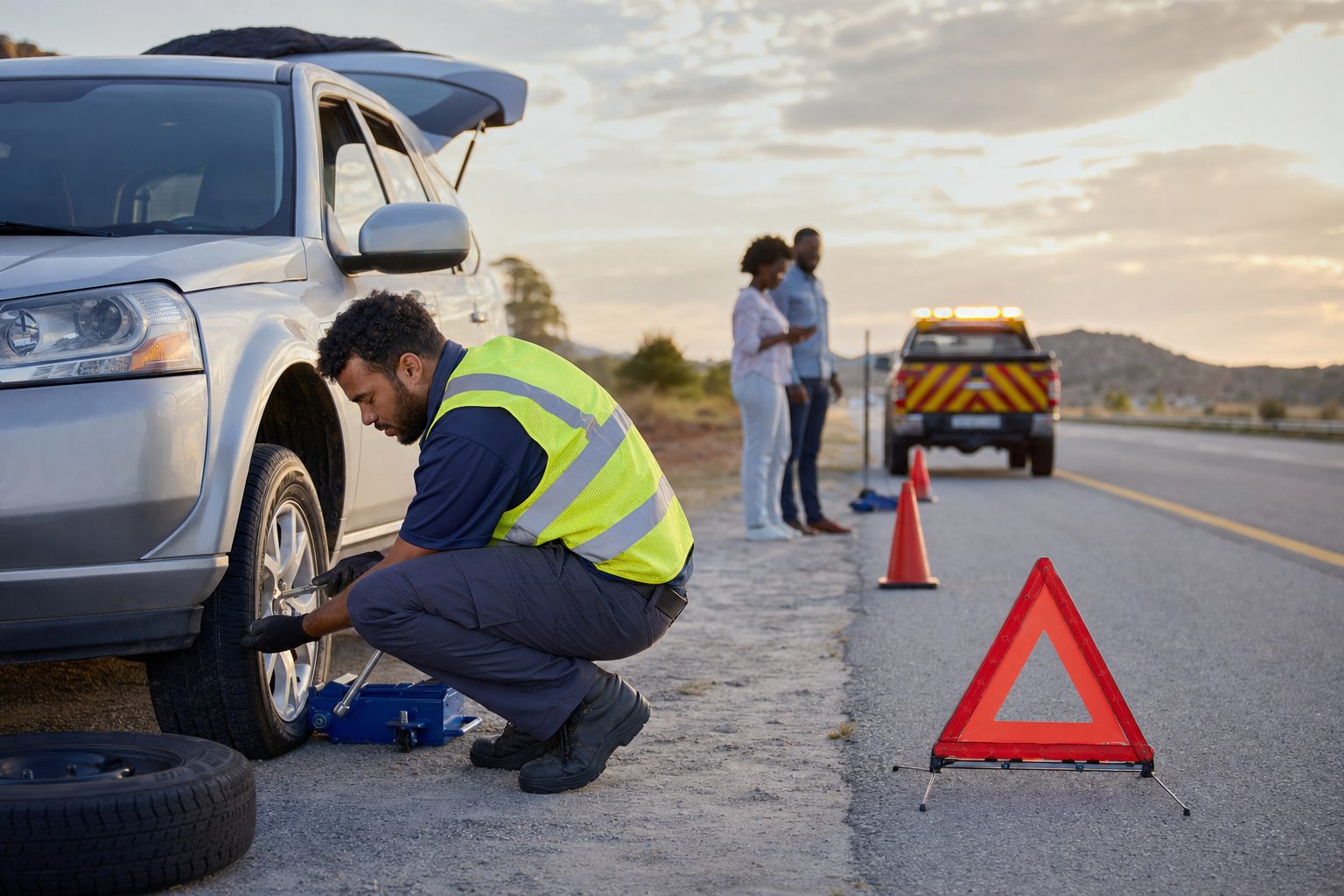
Eleven at night, a boulevard, a car stopped in the nearside lane. The person on the phone wants to know what it will cost and how long someone will be. The right answer nonetheless starts elsewhere: are you safe, are your passengers out on the side away from the traffic, do you have a warning triangle. The rest is organised afterwards.
A trade that travels
A recovery operator does not receive vehicles: they go to them. That inversion changes everything. They choose neither the place, nor the hour, nor the lighting, nor the weather, nor the state of the traffic. They work in an environment they have not prepared and do not control.
Hence an organisation entirely turned towards anticipation: what has not been planned before leaving cannot be improvised on site. The equipment loaded, the information gathered on the phone and the choice of response vehicle decide the outcome far more than manual skill.
That clearly separates this trade from the repair shop's, which has a workshop, tools, time and stock. The recovery operator has what they loaded, at the side of a road, with a customer in a hurry and sometimes anxious.
The call: safety before price
The phone assessment is the most important professional act in the chain, and it starts with making the scene safe.
Depending on the situation, the instructions cover the same points: make yourself visible, move occupants away from the traffic where the road is busy, place the warning device at a sufficient distance, put on a high-visibility vest, do not stay behind or under the vehicle. These depend on national regulation, on the layout of the road and on the moment — an operator adapts them, they do not recite a list.
Then comes gathering information: the nature of the fault as the customer describes it, the exact location, the type of vehicle, whether there are passengers, the state of the traffic, the lighting. What the customer says is not a diagnosis, but it is enough to choose the right technician and the right equipment.
The price is announced at that moment, before departure, and is not meant to change on site. If the fault turns out to be different from the one described, the professional course is to tell the customer and agree what happens next before working. Price levels, any supplements and local custom depend on the country, the city, the hour and the distance: no general scale means anything.
On site: make it safe, then assess
On arrival the order does not change. The work area is made safe — positioning the assistance vehicle, signage, lighting — before anyone attends to the broken-down vehicle.
The on-site assessment confirms or corrects what was said on the phone. It answers a simple question: can this vehicle drive away safely under its own power, or must it be transported? The easy answer — "I'll try to get it started" — is not always the right one.
A serious operator knows how to say they will not repair at the roadside. A roadside is not a workshop: the lighting is inadequate, the ground is not level, the tooling is limited, time is short and traffic passes a few metres away. Some operations simply have no place there.
What is handled on site, and what is not
Common interventions come down to a few things: assisted starting and a check of the charging circuit, replacing a wheel with the vehicle's own spare where one exists and is usable, clearing a simple situation, or establishing that the vehicle must be towed.
Anything touching critical systems belongs in the workshop. Braking and steering bear directly on safety and are not repaired on a verge. Fuel circuits, airbags and pretensioners, pressurised air conditioning call for specific precautions. Hybrid and electric vehicles add high-voltage circuits requiring dedicated skills, suitable documentation, specific equipment and their own procedures: an operator not trained on those vehicles arranges transport rather than opening anything.
Batteries themselves call for caution: significant stored energy, short-circuit risk, gas release depending on the technology. Those are reasons to call in someone equipped, not instructions to copy. Finally, anything requiring work under a vehicle needs suitable lifting means, stable and of sufficient capacity: a roadside almost never offers those conditions.
Towing
Transporting a vehicle is a technical operation in its own right: choosing the loading method according to the vehicle and its condition, securing it, checking before moving off, the route, unloading.
Two points belong to the customer and deserve stating: where the vehicle is taken — the garage of their choice, not the operator's by default — and what happens to the vehicle's contents. A professional notes the visible condition of the vehicle at loading and what it contains, ideally with a few dated photographs. That is the only serious protection against a later dispute.
Night adds constraints of its own: reduced visibility, fatigue, faster traffic on some roads, fewer receiving garages available. It is prepared for as a normal condition of the trade, not as an exception.
Equipment checked before every departure
A failed intervention means coming back, which costs twice. Checking the equipment before leaving is therefore a routine, not an occasional precaution: starting equipment, tooling, warning devices, lighting, winch and straps, personal protective equipment.
To that is added the state of the response vehicle itself. An operator whose truck breaks down becomes the problem they were supposed to solve.
Keeping a record of an intervention
Even on a thirty-minute job, a useful record remains: who called, where, what fault was reported, the time of the call and of arrival, what was found, what was done, where the vehicle was taken, what was invoiced and how it was paid.
That record serves three purposes: answering a question asked later, invoicing without argument, and showing after a few months which faults recur, in which places and at which hours — which helps decide what equipment to carry and how to organise the teams.
Road safety, the frame of the trade
This trade is practised where crashes happen. The context is a reminder: the World Health Organization, in its Global status report on road safety 2023, documents the scale of road traffic injuries and the considerable gap between regions and income levels. Its Save LIVES technical package sets out the levers identified, among them speed management, infrastructure, vehicle standards, enforcement and post-crash care.
For a recovery service, that translates into practices: never turn an intervention into an unexpected obstacle for other road users, signal early and widely, position the assistance vehicle so as to protect the work area, and treat moving occupants away as the first measure, before any diagnosis.
The staff are themselves exposed. The International Labour Organization has published guidelines on promoting decent work and road safety in the transport sector, dealing among other things with working conditions, fatigue and how teams are organised. A round-the-clock service is designed with sustainable shifts, not by relying on individual endurance.
In the African context
There is no single African context: the conditions of an intervention differ from one country, one city and even one road to the next. Several realities nonetheless recur in some contexts and bear directly on this trade.
The first is location. In several cities, street addressing is partial or little used day to day: people navigate by district, by avenue, by a nearby shop. An operator therefore spends real time pinning down a position, and a location shared by messaging has become a core working tool. The International Telecommunication Union puts the share of the world's population using the Internet at 74 per cent in 2025, with 36 per cent for Africa — the lowest of the regions it measures. That channel is very useful where it exists, and it does not replace the ability to guide someone by voice.
The second is traffic. In some cities, response time depends less on distance than on the hour: a few kilometres at peak time can take longer than a much longer trip in the middle of the day. Announcing a realistic time beats a flattering one that will not be met.
The third is the state of the network and the nature of the faults. Depending on the route and the season, degraded surfaces, dust or temporary flooding produce recurring interventions — tyres, suspension, bogged-down vehicles — which determine what equipment to carry. On some intercity routes, the distance between two assistance services makes the operator's self-sufficiency far more critical than in town. The fourth is the fleet itself: depending on the market, it is largely made up of imported used vehicles of widely varying ages and origins, which means varied towing and lashing points.
These constraints come with real opportunities, again unevenly. Mobile payment solves, in some countries, a problem peculiar to the trade: taking payment at the roadside, at night, without handling cash. Instant messaging serves to receive a location, a photograph of the vehicle, and to confirm a price in writing before departure. Assistance contracts with companies, public bodies or rental firms are in several cities a regular activity, less dependent on random calls. And professionalisation — a price announced and held to, checked equipment, traceability, equipped staff — is a strong differentiator where the offer remains informal.
What a recovery service does not promise
A recovery operator does not guarantee getting every vehicle moving again, nor repairing at the roadside what belongs in a workshop, nor a response time insensitive to traffic or weather. They stand in neither for the garage nor for the insurer — cover and claims procedures being matters for the contract and each country's law.
What they do commit to can be checked: an assessment on the phone, safety instructions given before any commercial discussion, a price announced before departure, checked equipment, work carried out in a secured area, the vehicle taken where the customer asked, and a written record of what was found, done and invoiced. To that are added an honestly described coverage area and the habit of pointing customers to a nearer colleague when that serves them better. Artificial intelligence can help take enquiries or organise rounds; it does not make a diagnosis at a distance and does not declare a vehicle fit to drive.
Finally, this article describes a trade. It contains no intervention procedure: the operations mentioned belong to trained and equipped people, and the rules on signage, insurance and traffic vary from country to country.